

Spoiler Alert: Being a startup is NOT easy. Every single day feels like you’re sprinting (been there; done that). You drown in data, juggle sales calls like your life depends on it, chase investors, and STILL make critical decisions based on, “ehhh, maybe?” That’s the exhausting reality for most of us founders. A reality you can easily change with AI for startups.
But where do you even start? Don’t worry; we’ve already done all the grunt work for you. In this article, you will learn exactly how to replace slow, manual work with instant insights, how to stretch your unspeakable budgets further, and how other newbies compete with bigger players with AI on their side as their unfair advantage.
What Is AI for Startups and Why Does It Matter?
AI for startups is using smart software to turn raw data into helpful insights, automating repetitive work, and speeding up decision-making without the need for an expensive data science team. Simply put, it multiplies small teams’ force.
Here’s why AI for startups actually matters:
- You can generate market predictions within seconds instead of days.
- It helps you avoid hiring data teams, which significantly reduces costs.
- Teams scale their reach. Treating 10 data points or 1 million is the same when you’ve got AI.
- Your decisions are data-driven from day 1, which means better credibility with investors.
- AI lets small teams move at the pace of big competitors.
AI for Startups: Top 10 Use Cases That Will Inspire You
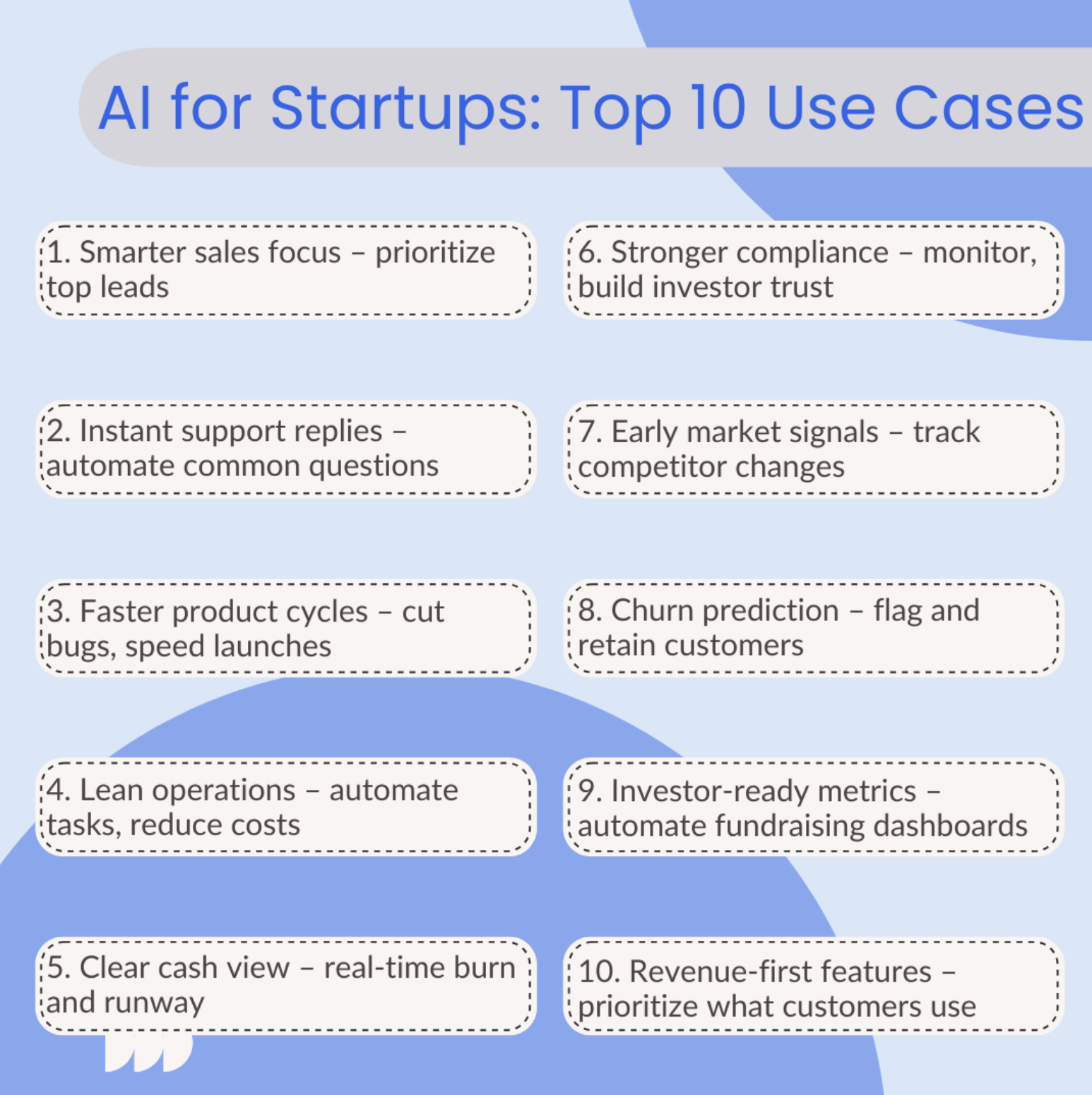
Pick one of these use cases based on your biggest pain point this month, set clear metrics, and run a 14-day test.
1. Make Sales Work Harder Than Your Headcount
Early sales at startups look busy without results. Your reps likely chase every lead, emails end up in inboxes where they don’t belong, and follow-ups slip through the cracks. This pattern drains your time and hurts your team’s morale.
You can easily fix this with a simple daily loop:
- Score leads
- Focus on the best 20%
- Let your system handle routine touchpoints
An agile CRM equipped with AI scoring and recommended next steps can quickly enhance your response rates. Salesforce Agentforce or Glean are great options for this. But the tool doesn’t matter as much as your team’s habits.
What you should do: Connect your pipeline, set one scoring rule based on past wins, and send 1 targeted sequence to the top 20%. Track your win rate and cycle time. The result? You can expect the same small team to work at the pace of a team 2 times larger within 4 weeks.
“Smart segmentation closes more deals than flashy campaigns. Let data guide your next move, and keep messages clear enough to execute daily.” — Jeffrey Zhou, CEO and Founder of Fig Loans.
2. Bring Your Support Wait Times Down to Minutes
Your backlogs grow when your customer query queue is filled with the same 10 questions. When your team responds to each one of those individually, your response times stretch, customer satisfaction level drops, and churn starts to creep.
Send the easy stuff to an AI assistant and hire people for the more sensitive issues. A no-code bot like HubSpot’s builder handles customer questions about passwords, shipping status, refunds, and setup. When you check your customer’s sentiments early on, you can easily flag frustration.
Target outcome:
- Resolve 60-70% of routine tickets in seconds with AI
- Reduce average handle time by almost half
- Lift CSAT by 15-20%
A team that uses Salesforce was able to cut call times by 80% with this pattern. You can copy the same flow.
3. Launch Products in Weeks Instead of Quarters
When there’s a lot of debate and back-and-forth, it burns your sprints. Bugs go unchecked, tests run late, and the roadmap moves on gut feel instead of deadlines.
Use AI to get to the truth faster. JetBrains AI spots errors before your code hits review. Miro Assist gives you a workable mock in a day. For health teams, AWS HealthLake brings clinical data into 1 place without a heavy setup.
Simple loop:
- Collect feedback
- Cluster themes
- Rank by impact
- Build the smallest fix
This can reduce your bug rate by 30% before release and accelerate your cycle by 20-40% after 2 iterations.
“AI doesn’t replace your product vision. It clarifies it faster. When you let models highlight recurring pain points, your roadmap becomes a series of validated bets rather than hopeful guesses.” — Leon Huang, the CEO at RapidDirect.
4. Keep Your Operations Lean as You Scale
Paperwork and manual checks can slow your teams more than any of your competitors. Invoices begin to stack up, inventory drifts, and hiring slips.
Automate repetitive tasks and keep an eye on the numbers every day. Splunk AI catches anomalies across systems, and Eightfold.ai screens candidates on skills first. This speeds up your interview process and improves candidate fit.
What to expect: 10-20% lower operating costs within the first 3 months. Plus, you’ll see fewer stockouts, faster time to hire, and fewer manual errors that usually block your cash flow.
“Clear operations outperform last-minute heroics. When you evaluate vendors by cost, quality, and timeliness, renewals shift from debates to data-driven savings.” — Nicolas Breedlove, CEO of PlaygroundEquipment.com
5. See Cash Clearly Every Morning
Runway fears come from stale spreadsheets. By the time a board deck ships, the truth will have already changed.
Connect your accounts once, then let an analysis tool show you burn, cash runway, and variance. Julius answers all your plain language questions like, “What moved my gross margin last week?” through data mapping and “How much runway should I expect if we slow hiring by one month?”
Baseline result: Forecast in seconds instead of days, spot fraud on 100% of your transactions, and improve revenue forecast accuracy by 20-30%.
6. Treat Security and Compliance as Your Sales Asset
A single breach or oversight in policy can halt deals and intimidate investors. Startups that appear careless with their data often miss out on a follow-up meeting.
Establish ongoing monitoring and implement straightforward rules that you can uphold. Tools like Crisp Thinking monitor for potential brand and security threats. If you operate in regulated industries, make sure you maintain evidence of controls and transparent audit trails.
Outcome to aim for: Fewer incidents, faster security reviews, and shorter sales cycles because you create trust from the first day.
7. Read the Market Before It Changes
Competitors don’t announce their price shifts or new bundles. You only notice it when your leads go AWOL.
Use AI to watch public pages, job posts, release notes, and pricing. Pull the data into a single sheet, then ask for patterns. Julius handles the heavy lift here.
Your weekly ritual:
- Scan changes
- Name the risk
- Draft the move
This straightforward check gives you weeks to react and helps you avoid unexpected drops in revenue.
“Competitive insight begins with steady observation. Record every market move, interpret it clearly, and respond with purpose. Consistent awareness compounds faster than assumptions.” —Leigh McKenzie, Community Advocate at Traffic Think Tank
8. Reduce Your Churn Rate With Facts (Not Guesswork)
Churn feels sudden when you don’t watch out for early signs. It doesn’t have to come as a surprise.
Predict risk based on usage, provide supportive communication, and outline renewal schedules. Segment customers according to the value they bring to your business and the actions that lead to savings.
Target result: Flag the top 10% at-risk customers, convert half of them with one high-value outreach, and see a 15-25% churn drop in the first 90 days. That lift alone can add months to the runway.
“Retention starts with empathy, not algorithms. But AI gives you empathy at scale, it sees subtle behavioral changes before humans do, so your team can step in with care instead of repair.” — William Fletcher, CEO of Car.co.uk
9. Get Ready to Walk Into Any Fundraising Meeting
Investors move quickly when your numbers are crisp and repeatable. They slow down when your data room looks manual and unpredictable.
Streamline cohort analysis, customer acquisition expenses, lifetime value, and retention metrics. Create a single dashboard that you can share in real-time. Julius helps you answer follow-ups without having to create a new spreadsheet every single time.
What changes: Diligence should take you days, not weeks. Your story stays consistent across meetings with AI, and your close rate rises because your confidence is apparent to investors.
“Investors act fast when your data and narrative align. Precise metrics and organized reporting eliminate friction and keep the deal moving forward.” — Anna Zhang, Head of Marketing at U7BUY
10. Prioritize Features That Move Your Revenue
Teams often launch features that nobody ever even uses. This happens when you use different tools to collect feedback, and the trend goes unnoticed.
Consolidate reviews, tickets, interviews, and usage data into a single tool. Let AI group themes and measure their impact. Choose the feature that enhances your retention rate or increases your customers’ average order value as a priority.
Result to expect: Delivery speeds increase by 20-40% with the right features, which minimizes dead ends, and gives you a roadmap aligned with actual metrics rather than subjective opinions.
6 Benefits of AI for Startups to Level the Playing Field
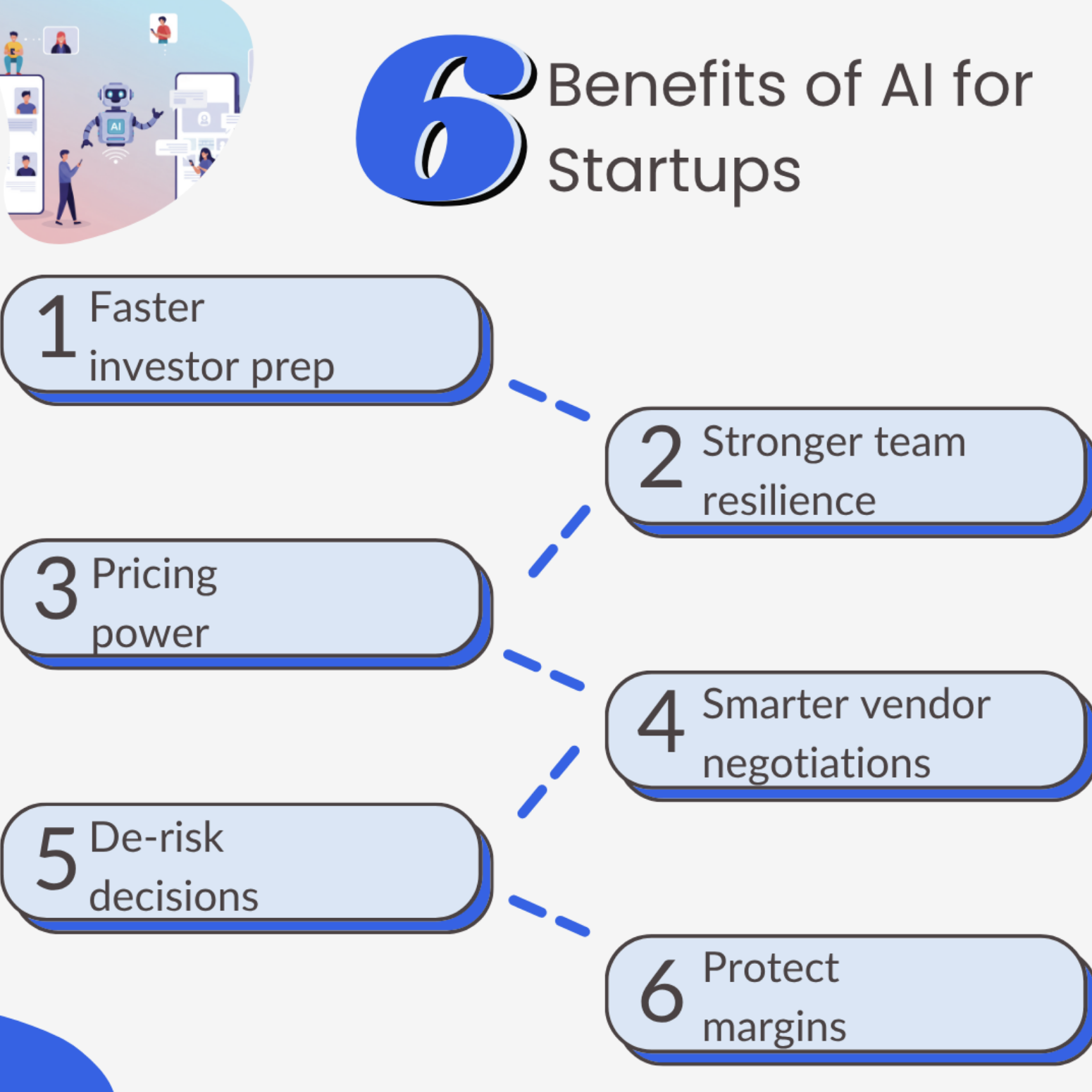
Use these 6 benefits as a checklist to see exactly where AI gives you the upper hand against some of the bigger competitors.
- Win Investor Time with Board-Ready Numbers: Track cohort views, CAC, LTV, and retention in real-time, not in one-off presentation decks. Use a single dashboard so you can answer follow-ups quickly and cut your prep time by 70-90%.
- Make the Team Resilient When People Leave: Centralize queries, definitions, and recurring analyses so knowledge stays even when your staff changes. Store plain-language questions and saved reports; reduce new employee onboarding time by 25-40% and eliminate rework caused by inconsistent data.
- Earn Pricing Power with Proof: Conduct an analysis of willingness to pay based on orders, discounts, and customer churn. Segment customers according to their value and increase prices by 3-8% in areas with low risk; maintain or increase value where price sensitivity is significant to make sure your net revenue remains positive.
- Negotiate Like a Large Buyer: Score vendors based on their cost, delivery speed, defects, and credits from invoices and support logs. Bring a monthly scorecard to renewals and claw back missed credits. You’ll likely see 3-7% unit-cost savings within one renewal cycle.
- Mitigate Risks on Major Investments with Weekly Scenarios: Every Friday, outline three straightforward paths: base, push, and conservative. Connect each scenario to hiring, advertising expenses, and return on investment; eliminate one low-performing project each quarter and reallocate the budget to the most successful one within a week.
- Protect Your Gross Margin with Daily Micro-Optimizations: Monitor returns, promotional depth, shipping costs, and payment fees all in one view. Create guardrails that pause a discount when the margin falls below a set point; increase margin points by 1-3 without adding new staff.
“Small adjustments drive bigger profits. Track fees, returns, and discounts every day, and you’ll see margins grow without adding more people.” — Kellon Ambrose, Managing Director at Electric Wheelchairs USA
5 Steps to Start Using AI in Your Startup Business
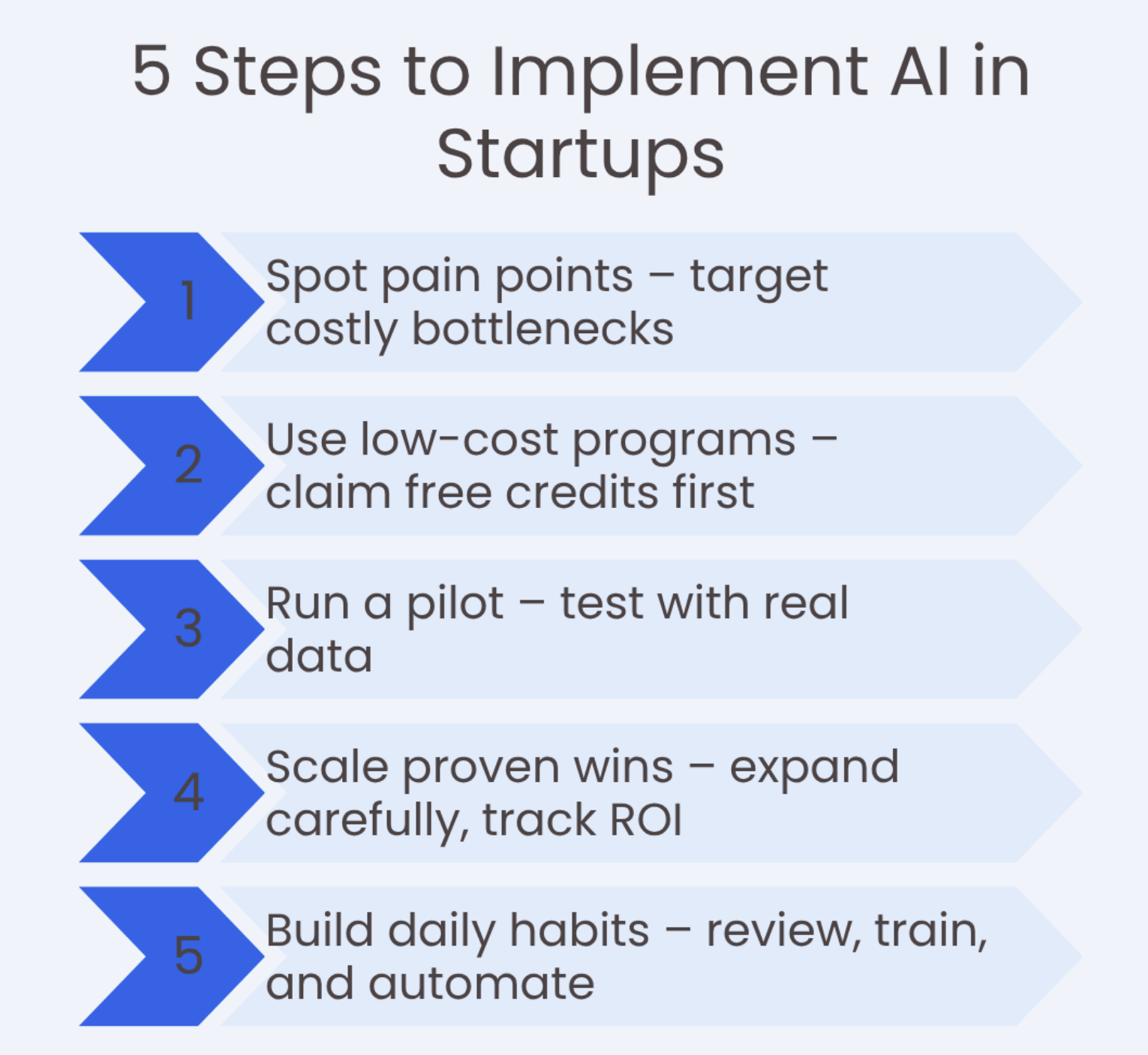
Use these 5 steps to implement AI in your startup business slowly and gradually.
Step 1: Spot the Pain Points That Slow You Down
Most teams try AI everywhere at once and burn their time with no results to show for it. You should zero in on the 1-2 workflows where you notice the most delays or where costs hurt the most. Think sales follow-ups that drag, support queues that swell, or forecasts that are always outdated.
- List the top three repetitive tasks your team spends the most hours on each week.
- Map what each task costs you today (team hours × hourly rate).
- Prioritize the one task where automation would free at least 20% of your time.
- Write down the metrics you want to improve. For example, “cut support response from 12 hours to 1 hour.”
Step 2: Tap Into Low-Cost AI Programs First
You don’t need huge budgets or data science hires to get started with AI. Founders can access free or near-free AI credits that cover the first experiments.
- Claim up to $5,000 in credits through AWS Activate or Google Cloud for Startups.
- Use free versions of tools like HubSpot’s AI or Julius’s starter plan to get instant value.
- Join community programs like Google AI Academy to upskill your team without extra cost.
- Track every credit and free trial in one sheet to avoid overspending.
Step 3: Launch a Pilot With Real Data
The fastest way to prove value is to test your AI tool against your current baseline. Keep the scope narrow so nobody questions the results.
- Export a live dataset (CRM contacts, ticket logs, or invoices).
- Run a 14-30 day pilot that targets one clear outcome like, “lift lead conversion by 10%.”
- Use no-code dashboards to compare before vs. after in plain numbers.
- Share the first results with your team and investors as proof of your progress.
Step 4: Scale When the Numbers Can Support This Move
Once a pilot shows savings or growth, expand carefully. Scaling means connecting tools to live systems and tracking ROI every week.
- Automate repetitive workflows like reports, alerts, and weekly dashboards.
- Connect APIs for real-time updates instead of static exports.
- Expand to the next 1-2 use cases where the payoff is clear.
- Document a simple “AI playbook” so your new hires can adopt the same habits.
Step 5: Make AI Part of Your Team’s Daily Habits
Scaling only works if your team actually uses AI. Build it into the rhythm of how you review data, make decisions, and measure outcomes.
- Set a weekly data review where AI-generated reports guide your decisions.
- Track 3 simple metrics: Hours saved, revenue influenced, and accuracy of predictions.
- Train every new hire on the same AI workflows so habits spread.
- Create a shared library of AI queries, reports, and checklists so nothing gets lost.
“The biggest mistake founders make is waiting until they ‘feel ready’ for AI. You’ll never be. Start small, learn fast, and let automation prove its ROI before you even notice you’re scaling.” — Suhail Patel, Director of Dustro
How to Measure the ROI of AI Implementation for Startups?
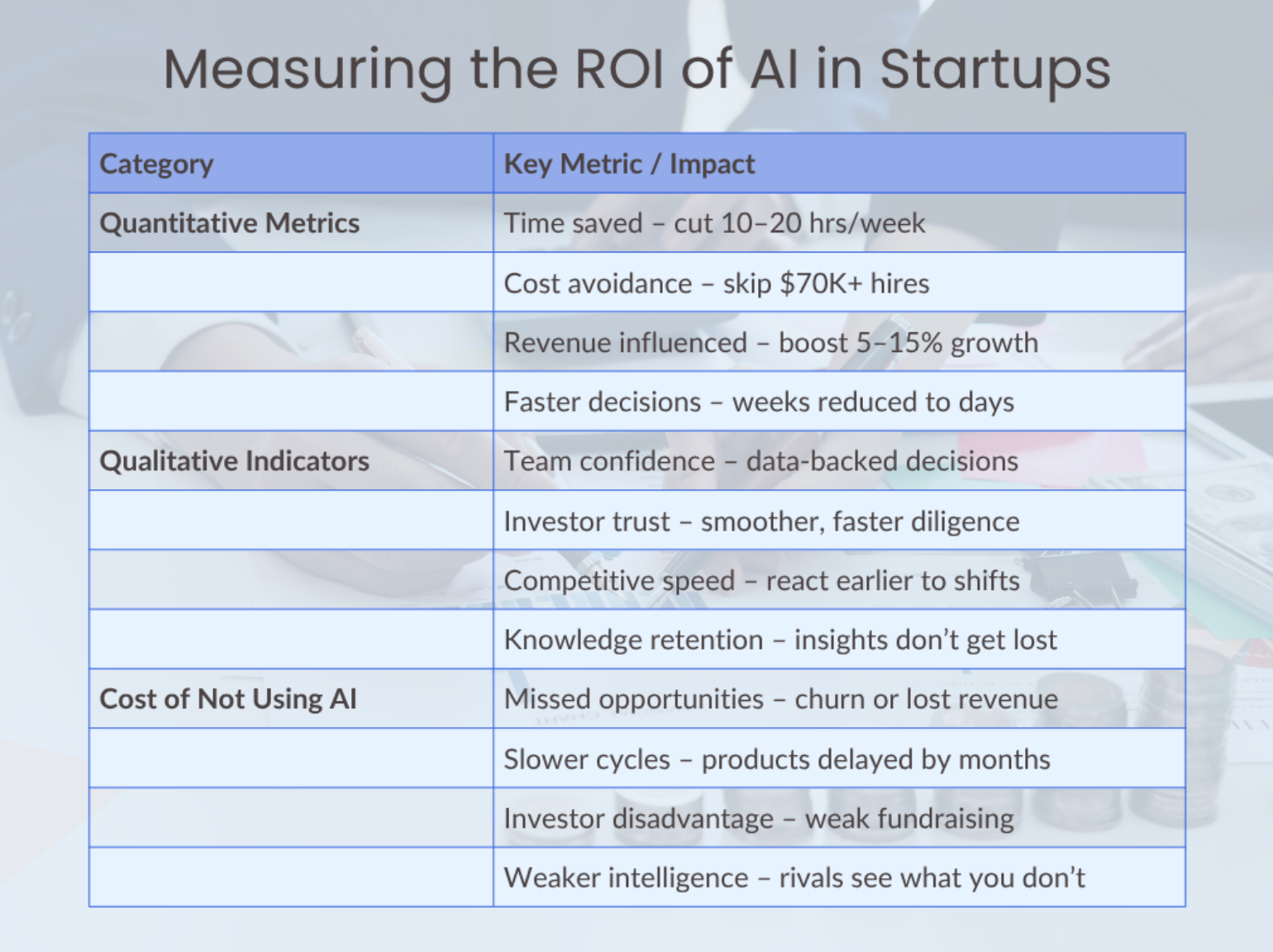
To measure the ROI of AI in startups, track how much time it saves, how much cost it helps you avoid, how much revenue it adds, and how much faster decisions get made compared with your baseline.
For most startups, ROI shows up within the first 30-90 days through reclaimed hours, decreased costs, and improved conversion or retention rates that have a direct effect on growth. The easiest way to calculate it is to compare the money you saved and the revenue you gained against the cost of the AI tools you use.
1. Quantitative Metrics to Measure the Impact of AI for Startups
- Time Saved on Analysis: Replace 10-20 hours of manual spreadsheet work per week with automated reports.
- Cost Avoidance: Skip hiring 1-2 data roles that average $70,000-$120,000 per year.
- Revenue Influenced: Attribute uplift from AI-driven decisions, often 5-15% higher conversion or retention rates.
- Decision Velocity: Cut decision cycles from weeks to days to speed up market response by 30-40%.
2. Qualitative Indicators of AI Success
- Team Confidence: Founders and managers make decisions backed by live data instead of guesswork.
- Investor Feedback: Diligence rounds move faster when metrics are accurate and repeatable.
- Competitive Speed: Teams react to market shifts weeks earlier than rivals.
- Knowledge Retention: Insights are documented and accessible, not locked in individual heads.
3. The True Cost of Not Using AI as a Startup
- Missed Opportunities: Late reactions to customer churn or competitor moves.
- Slower Iteration Cycles: Products take quarters to ship instead of weeks.
- Investor Disadvantage: Data rooms look manual, which slows fundraising and lowers valuations.
- Weak Competitive Intelligence: Rivals who use AI gain visibility into pricing, demand, and trends that you never see.
Conclusion
AI for startups has transitioned from being a mere "nice-to-have" to an essential tool. It is now the most reliable way for small teams to break free from the monotonous cycle of outdated spreadsheets, relentless busywork, and investor presentations that become obsolete before they are even shown.
Rather than managing countless tools or depending on expensive analysts, startups can now turn raw data into instant insights that drive every decision. You connect your systems once, ask the right questions, and get real-time answers on cash flow, growth, and retention—insights you can act on in your next standup or investor meeting.
Modern AI is practical and founder-friendly. It ensures that your data works for you, not against you. In today’s market, the startup that moves from guessing to analyzing—and from reacting to predicting—will always lead the race.
 FAQs
FAQs
Absolutely. No-code platforms and natural language interfaces make it simple. Julius, for example, works in plain English so you can query your data without writing code.
Most operational AI tools run between $0-$500 per month. Compared with hiring a full-time data role that costs $70,000-$120,000 per year, the ROI is clear.
Start with data analysis AI. Tools like Julius give you clarity on runway, sales, and margins, which makes every downstream decision stronger.
Check for consistency: do you have clean CRM records, transaction logs, or support tickets? Even imperfect data can produce value once you centralize it in one place.
Disclaimer
The information in this article is provided for general educational purposes only and does not constitute legal, financial, security, or business advice. You should conduct your own due diligence and consult qualified professionals before implementing any tools, strategies, or recommendations described here.
References to third-party products, services, and brands (e.g., software, platforms, or vendors) are provided for illustration only and do not imply endorsement or partnership. Availability, features, pricing, and performance may change without notice.
This article may contain links to external websites. iplocation.net is not liable for external links, including their content, availability, policies, or any losses or damages arising from their use. Visiting third-party sites is at your own risk; review their terms and privacy policies before engaging.
All mentioned trademarks and brand names are the property of their respective owners.
Share this post
Author

Read the latest articles from Michael McKown

July 3, 2025
Why IP Whitelisting Still Matters in 2025
In 2025, the cybersecurity landscape is more layered and complex than ever, with organizations embracing Zero Trust, advanced MFA, and AI-powered threat detection. Yet, amid all this progress, the humble practice of IP whitelisting continues to hold its ground. It might seem like a relic in a world racing toward [...]
Learn more
November 20, 2024
Why would an IT professional need a ghostwriter?
Information technology specialists are not usually writers, but they do have written communication needs. IT professionals are also very well paid. Assigning a high-salary IT professional to writing reports when they could be performing more crucial duties just wastes money. A technical ghostwriter could step in [...]
Learn moreLeave a comment
All comments are moderated. Spammy and bot submitted comments are deleted. Please submit the comments that are helpful to others, and we'll approve your comments. A comment that includes outbound link will only be approved if the content is relevant to the topic, and has some value to our readers.
Comments (0)
No comment