

Stay Connected Abroad in 2026 Without a Physical SIM Card
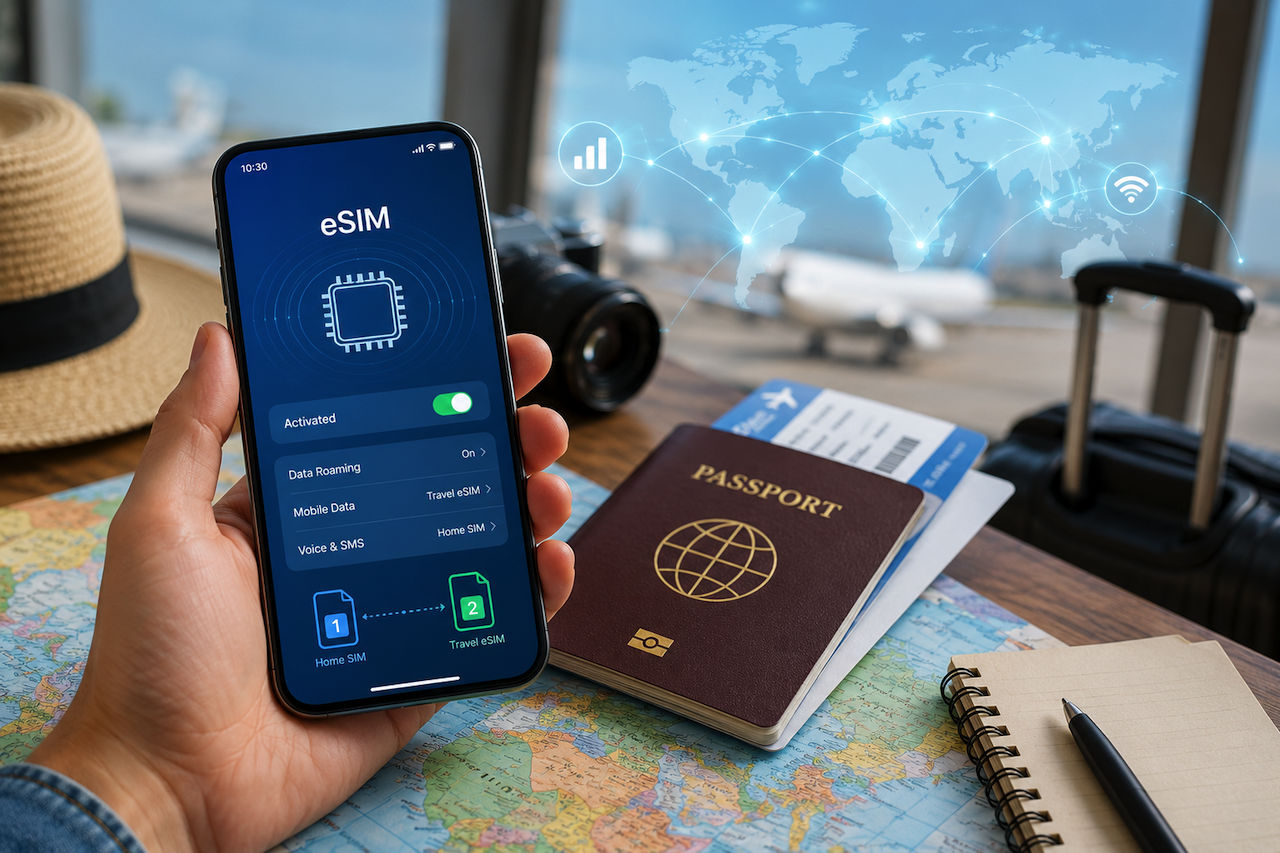
Traveling internationally in 2026 no longer requires hunting for a local SIM card at the airport or paying outrageous roaming charges to your home carrier. Embedded SIM technology, known as eSIM, lets you download a local or regional data plan directly onto your iPhone, Samsung, or Google Pixel before you even board the plane. You land already connected, with your home number still active and zero physical SIM swaps to manage.
This article walks you through how it works, which providers to consider, and how to set everything up in under five minutes.
What Is an eSIM, and Why Does It Replace the Physical SIM?
An eSIM is a programmable chip embedded directly in your smartphone's motherboard. Instead of inserting a removable card, you download a digital profile from a carrier or a travel eSIM provider. Apple removed the physical SIM tray entirely from all iPhones sold in the United States starting with the iPhone 14, and Samsung is aggressively pushing toward eSIM-only models in its newest Galaxy lineup. For travelers, the shift is a clear upgrade. You no longer need to find a kiosk at the airport, struggle with a tiny SIM ejector tool over a dirty café table, or risk losing your home SIM during the swap. Everything happens through your provider's app or website.
5 Reasons to Ditch the Physical SIM Card for International Travel
- No more airport SIM queues: Walking off a long-haul flight straight into a SIM card queue is a classic travel headache. With an eSIM, you buy your plan from home, install the profile before you leave, and activate the data the moment you land. The process can often be completed before departure and activated upon arrival.
- No roaming bill shock: International roaming charges can vary significantly depending on the carrier and destination. Travel eSIM plans may provide a lower-cost alternative in many cases. Travel eSIM plans may offer lower data costs than international roaming, depending on the provider and destination. Over the course of a two-week trip, the savings often cover the cost of a checked bag.
- Dual SIM by default: All modern iPhones (XS and later) and most flagship Android phones support running two cellular profiles simultaneously. Your home line stays active for SMS verification codes, bank confirmations, and family calls, while your eSIM travel line carries the data load. You select the data line in settings, leave calls and texts on your home line, and forget about it.
- Better security: A physical SIM can be removed in seconds with a paperclip. If your phone is lost or stolen abroad, anyone can pop the SIM into another device. An eSIM cannot be physically removed, and your provider can remotely turn off the profile if anything goes wrong.
- Multi-country coverage from a single plan: Traveling across multiple countries on the same trip? A regional eSIM plan covers all three under one activation. No need to buy three local SIMs or swap profiles at each border.
Top 8 eSIM Providers for International Travel in 2026
- voilà: Offers travel eSIM plans covering more than 190 countries.
- Saily: Offers coverage across a large number of destinations and provides app-based eSIM management.
- Ubigi: Provides international eSIM plans and supports 5G connectivity in many destinations.
- Yesim: Offers a variety of plan durations, including longer-term options.
- Nomad: Provides regional and country-specific travel plans.
- GigSky: Offers international coverage, including select cruise and inflight options.
- Holafly: Offers travel eSIM plans, including unlimited-data options in some destinations.
- Airalo: Provides a large catalog of country-specific and regional eSIM plans.
Choosing an eSIM Provider for International Travel
Travel eSIM providers differ in coverage, pricing, plan duration, network partnerships, app features, and customer support options. Some focus on broad global coverage, while others specialize in regional plans, unlimited data packages, or long-term travel options.
Examples of well-known travel eSIM providers include voilà, Saily, Ubigi, Yesim, Nomad, GigSky, Holafly, and Airalo. Each provider offers different combinations of supported destinations, pricing models, and plan features.
Before purchasing a plan, compare coverage, data allowances, validity periods, pricing, network quality, and available support channels. The best choice depends on your destination, travel duration, expected data usage, and whether you need coverage across multiple countries.
How to Set Up an eSIM Before Your Trip
- Check your device compatibility: Every iPhone XS or newer supports eSIM. On the Android side, Samsung Galaxy S20 and later, Google Pixel 3 and later, and most flagship Xiaomi, OnePlus, and Oppo models from 2020 onward are compatible. Open Settings > Cellular (iOS) or Settings > Connections > SIM Manager (Samsung) to confirm.
- Buy your plan from a trusted provider: Pick your destination on the provider's website or app. For example, voilà eSIM and similar travel eSIM providers offer plans for different regions and travel styles. Choose a data volume and validity period that match your trip length.
- Install the eSIM profile: You will receive a QR code by email or directly in the app. Scan it, follow the prompts, and label the new line clearly (for example, Japan Travel or Europe Travel). Installation takes under two minutes.
- Activate on arrival: Most travel eSIMs activate the moment your device connects to a network in the destination country. Switch the data line to your travel eSIM in settings as soon as you land, and keep your home line active for SMS and calls.
Practical Tips for a Smooth eSIM Experience Abroad
- Install the eSIM profile before leaving home, while you still have stable Wi-Fi. Do not wait until you reach the airport in a country where data is expensive.
- Keep your home SIM line active to receive two-factor authentication codes via SMS. Most banks still require this.
- Turn off data roaming on your home line in Settings to avoid surprise charges from your local carrier.
- Label each eSIM clearly inside Settings so you can switch between them easily during multi-country trips.
- Save your QR code in a password manager in case you need to reinstall the profile on a replacement device.
Travel Connected Without the Physical SIM Hassle
Going SIM-free abroad is no longer a niche choice in 2026. It has become a common option for travelers who want to avoid roaming fees, simplify connectivity, and stay connected across multiple destinations. With eSIM technology, users can activate plans before departure, keep their primary phone number available for calls and text messages, and manage everything directly from their devices.
Whether you choose a global, regional, or country-specific plan, comparing providers and installing your eSIM before leaving home can help create a smoother travel experience. As eSIM adoption continues to expand across smartphones and carriers, digital connectivity is becoming an increasingly convenient part of international travel.
 FAQs
FAQs
Yes. Modern iPhones and Android phones support dual-SIM by default. Your home line keeps receiving calls and SMS, while the travel eSIM handles all data. You select which line is used for data in your settings.
Travel eSIMs often route data through international roaming partners, which may affect how internet traffic is handled in certain regions. Available services and access can vary depending on the provider, destination, local regulations, and network partners. Check the provider's documentation before purchase to understand any limitations that may apply.
Contact your eSIM provider to remotely disable the profile. The remaining data may or may not be transferable to a new device, depending on the provider's policy. Support availability and response times vary by provider.
Some providers allow top-ups on an active plan, while others require you to purchase and install a new eSIM profile. This can be an important consideration if you tend to extend your trip or use more data than expected.
Three to five gigabytes cover most travelers' needs for maps, messaging, social media, and occasional video streaming. Consider ten gigabytes or more if you plan to tether other devices or work remotely.
In many cases, yes. Travel eSIMs can save time and make it easier to compare plans before departure. While local SIM cards may sometimes offer lower prices, eSIMs often provide greater convenience and flexibility.
Featured Image generated by ChatGPT.
Related Articles
January 15, 2026
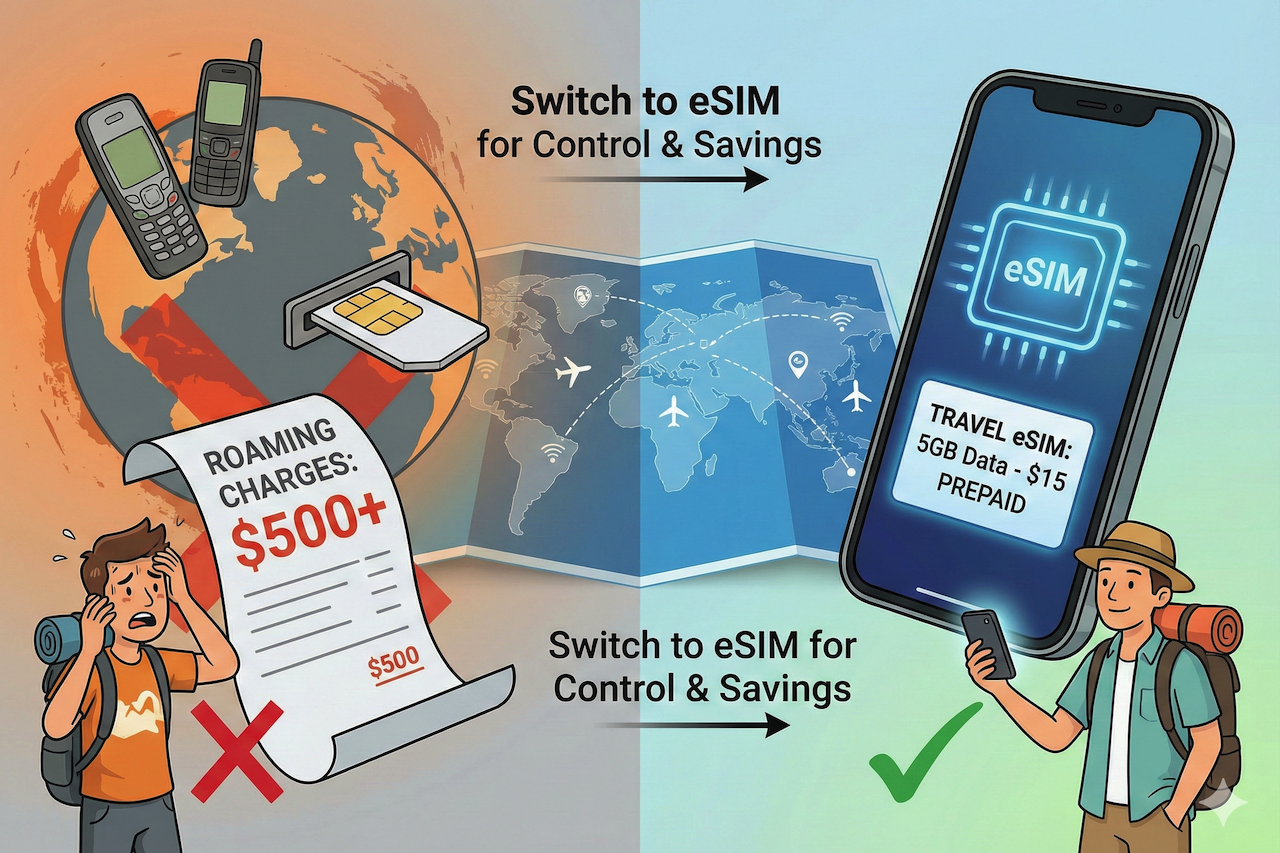
Travel eSIM Apps: How to Reduce Roaming Costs While Traveling
Ten to fifteen years ago, mobile communications abroad were among the most annoying expenses while traveling. Tourists either turned off their phones immediately upon landing o...
Read More
October 16, 2025
How to Receive OTPs Abroad Without Roaming: A Guide to Staying Connected Securely
When you’re traveling abroad, getting locked out of your bank account, email, or two-factor-authenticated app can ruin your day fast. Most OTP (one-time password) systems still...
Read More
November 6, 2024
Five Best Ways to Stay Connected to Your Child While Studying Abroad
Studying abroad is both a moment of pride and a challenging pursuit for a child. Every parent must focus on several factors, including cultural differences, language barriers, and...
Read More
Comments
Comments are moderated to keep the discussion useful and respectful. Spam, automated submissions, and low-value promotional comments are removed. Comments with outbound links may be approved when the link is relevant to the article and genuinely helpful to readers.
No comments have been published yet.