

The Business Risks of Weak Digital Privacy Practices

Digital privacy is no longer just a legal checkbox. It is a core business function that touches every department, every customer relationship, and every dollar on your balance sheet. Companies that treat privacy as an afterthought are learning a hard lesson: the cost of neglect consistently and significantly outweighs the cost of getting it right from the start.
Businesses of all sizes face an expanding landscape of threats tied directly to how they manage data. The risks are regulatory, financial, reputational, and operational. They stack on top of each other fast. And the window to act before something goes wrong is shorter than most leaders realize.
This article breaks down the real business risks that come with weak digital privacy practices and explains why leaders at every level need to make this a priority today.
Why Digital Privacy Is a Business Issue, Not Just an IT Problem
Many organizations still hand privacy responsibility entirely to the IT or security department. That is a structural mistake. Privacy affects legal liability, brand trust, customer retention, and revenue growth.
"Privacy is not a firewall issue. It is a boardroom issue. The moment leadership treats it as infrastructure rather than strategy, they have already put the company at risk." — Seph Fontane Pennock, Founder of Regenerated.com
The reality is that weak privacy practices create compounding risks. One gap in your data handling can trigger a chain reaction involving regulators, legal teams, customers, and the press, often all at once. The typical response is reactive and expensive. A proactive approach is both cheaper and more effective.
Leadership needs to ask hard questions. What data does the company collect? Who has access to it? How long is it retained? What happens if it is exposed? These are not IT questions. They are business questions, and they need business answers.
1. Regulatory Penalties and Legal Liability
The Fines Are No Longer Small
Governments worldwide have dramatically sharpened their enforcement capabilities around data privacy. The EU's General Data Protection Regulation (GDPR) allows fines of up to 4% of global annual turnover.
In the United States, state-level laws like the California Consumer Privacy Act (CCPA) and a growing patchwork of similar legislation add another significant layer of exposure. Non-compliance is genuinely and measurably expensive.
According to a 2024 IBM Cost of a Data Breach Report, the average cost of a data breach globally reached $4.88 million. That figure includes legal fees, regulatory fines, customer notifications, and technical remediation. The reputational and long-term business damage adds a great deal more on top of that number.
“Many companies underestimate how quickly weak data protection can become a business liability. One privacy failure can damage customer trust, disrupt partnerships, and create long-term operational risks.” — Galin Ananiev, Founder of Seatpin
Regulatory enforcement is also becoming more coordinated across jurisdictions. A company operating in multiple countries faces overlapping requirements, and failing to meet one regulator's requirements often draws scrutiny from others.
Lawsuits Follow Breaches
Beyond regulatory fines, class action lawsuits have become a near-guaranteed outcome after major data incidents in many jurisdictions. Legal costs can stretch on for years. Small and mid-size businesses often lack the legal bandwidth and financial reserves to weather these battles. A single breach can generate litigation that outlasts the underlying incident by half a decade.
The legal exposure also extends to executives personally in some regions. Directors and officers can face individual liability for governance failures related to data protection. That changes the risk calculation significantly at the leadership level.
2. Loss of Customer Trust
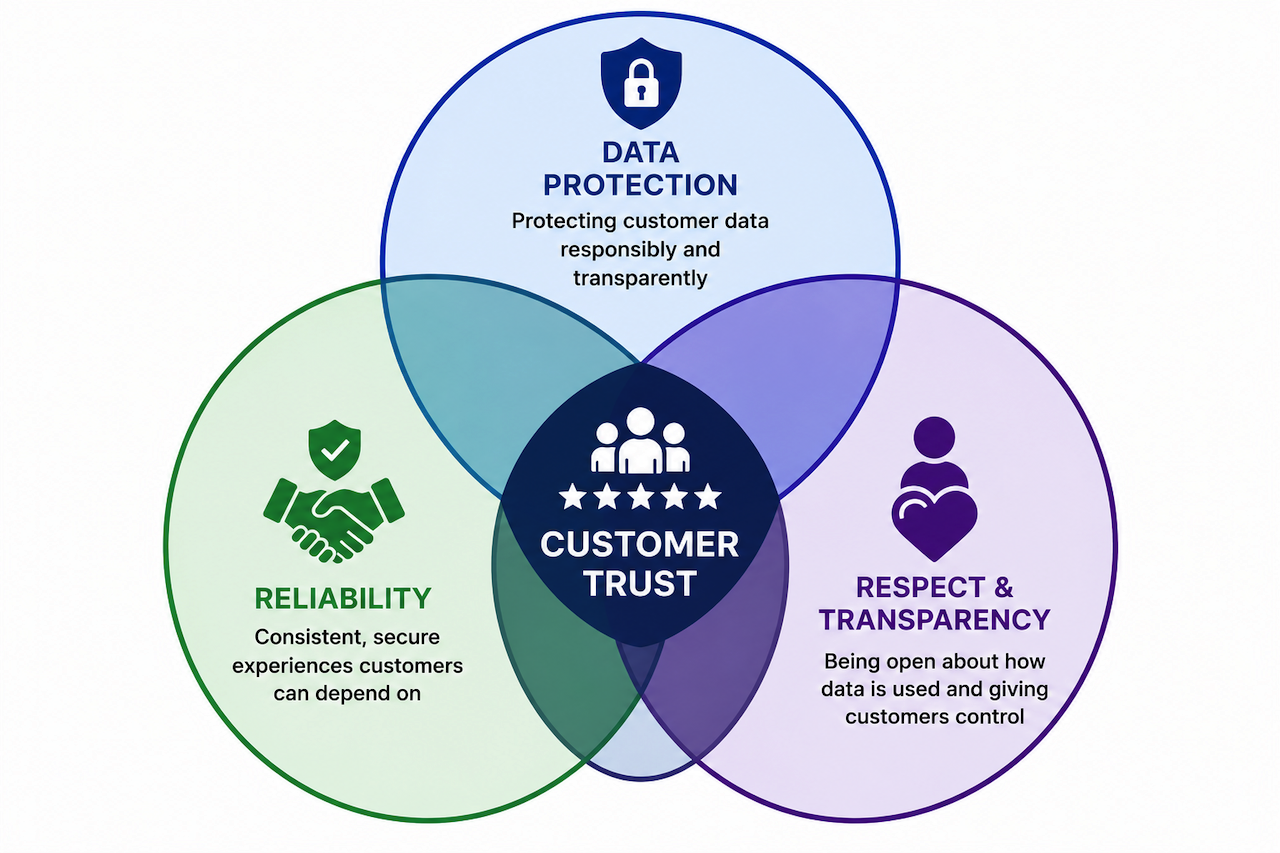
Image generated by ChatGPT.
Trust Is Your Most Fragile Asset
Customers are increasingly aware of how their data is used, shared, and protected. Awareness has grown sharply as high-profile breaches have made headlines globally. One negative experience, one breach notification email, one damaging news headline, and customers are gone. Rebuilding trust takes far longer than losing it.
"Once a customer loses confidence in how a company handles their data, no discount campaign or public apology brings them back. Trust is binary. You either have it, or you do not." — Bryan Henry, President at PeterMD
A 2023 Cisco Consumer Privacy Survey reinforces this, finding that 81% of consumers believe a company's approach to privacy reflects how it treats customers overall.
That is not a soft metric. It directly influences purchase decisions, renewal rates, and referral behavior across both B2C and B2B contexts.
Loyalty Ripple Effect
When customers leave because of a privacy incident, they talk about it. In the digital era, word of mouth travels fast across review platforms, social media, and professional networks.
One breach can chip away at a customer base for years through negative reviews, reduced referrals, and search results that surface the incident long after the technical issues have been resolved internally.
Customer acquisition costs in most industries are high enough that losing established customers is genuinely damaging to growth projections. Retaining a customer costs far less than finding a new one, and weak privacy practices put your retention numbers at constant Risk.
3. Operational Disruption and Business Continuity
Incidents Grind Business to a Halt
A data breach or ransomware attack does not just expose sensitive information. It shuts down systems, paralyzes teams, and forces emergency responses that consume resources across the entire organization.
Operations that normally run on autopilot suddenly require around-the-clock manual attention from people simultaneously managing internal panic, external communications, and legal coordination.
The downstream impact spreads quickly to customers, partners, and vendors through missed deliverables and broken service agreements.
Third-Party Risk Compounds the Exposure
Weak privacy practices rarely remain contained within a single organization. Businesses typically share data with dozens of vendors, partners, contractors, and software providers. If any of those third parties are compromised and gain access to your data, you share in the liability and reputational fallout, regardless of where the failure originated.
Companies without a structured third-party risk management framework are particularly exposed. Vendor assessments, contractual data protection obligations, and ongoing monitoring are not optional extras at this stage of digital business. They are foundational requirements for any organization that handles sensitive data.
4. Reputational Damage
Your Brand Becomes the Story
When a breach makes the news, the company name becomes permanently linked to the incident in search results, news archives, and industry memory. Prospective customers research brands before buying, especially in competitive markets.
If your privacy incident surfaces prominently in search results, that is a direct and measurable conversion killer that persists long after the technical issues are resolved.
"A data breach is a brand event, not just a security event. Technical recovery and reputation recovery require entirely different playbooks, and most companies only plan for one of them." — Rawad Baroud, CEO of ZeroGPT
Smaller businesses often struggle most with reputational damage because they lack the PR infrastructure to mount a credible recovery campaign.
Talent Acquisition Suffers
Skilled professionals in technology, finance, and data-sensitive roles research employers carefully before accepting offers. A visible history of data mishandling signals poor internal culture, weak leadership judgment, and potential legal exposure for employees.
That makes recruiting harder, lengthens time-to-hire, and drives up compensation expectations. Organizations with clean privacy records attract better candidates more easily and at lower cost.
5. Financial and Investment Risk
Investors and Acquirers Are Paying Attention
ESG (Environmental, Social, and Governance) criteria now regularly and explicitly include data privacy and cybersecurity posture as evaluation factors. Institutional investors, venture capital firms, and private equity groups increasingly conduct thorough privacy due diligence before closing deals.
Weak data governance practices can kill a funding round, reduce your valuation, or add burdensome clauses to deal structures.
"We walk away from deals where data governance is unclear or underdeveloped. Investors cannot price Risk they cannot see, and privacy risk is one of the hardest to quantify after the fact." — Sharon Amos, Director at Air Ambulance 1
Publicly traded companies face additional pressure, as a disclosed breach can quickly send share prices downward, with a slow recovery that is never fully guaranteed.
The Hidden Cost of Remediation
After a breach, the patching, auditing, forensic analysis, and system overhaul that follow are rarely budgeted for in advance. These remediation costs hit operating budgets hard, often at exactly the moment when the company is simultaneously managing legal fees, increased customer service loads, and falling revenue from lost business.
The financial impact of a privacy incident can be severe enough to threaten long-term business viability, particularly for organizations without strong cash reserves.
6. Competitive Disadvantage
Privacy Is Becoming a Market Differentiator
While weak privacy is a significant business risk, strong privacy is increasingly a genuine competitive advantage. Businesses that earn and communicate their privacy credentials attract customers, enterprise partners, and institutional investors who value responsible data stewardship.
Organizations that lag lose deals to competitors that can demonstrate a stronger, more transparent privacy posture.
“Clients increasingly judge businesses by how responsibly they handle information. Companies that cannot demonstrate strong privacy practices risk losing trust and opportunities to competitors that can.” — Andrew Pho, General Manager at Mister Baluster
Vendor and Partnership Doors Close
If your data practices are weak or unverifiable, enterprise partners may refuse to integrate with your systems or to share data with you under contract. That closes doors to lucrative partnerships and can effectively cut you out of entire market segments where data sharing is a prerequisite for participation.
Enterprise contracts in most regulated industries now include data protection clauses with explicit termination rights if a vendor experiences a breach or demonstrates material non-compliance.
How to Reduce Business Risk Through Better Privacy Practices
Improving your privacy posture does not require a massive overnight transformation. The following practical steps deliver meaningful and measurable risk reduction without requiring you to overhaul your entire operation at once.
Conduct a Privacy Audit
Start with an honest and thorough assessment of what data your organization collects, where it is stored, who can access it, how long you retain it, and what protections are in place.
Many businesses are genuinely surprised by how much unnecessary data they hold and how loosely it is secured. Knowing your current state is the essential starting point for any meaningful improvement.
Implement a Data Minimization Policy
Collect only what you genuinely need to run your business and serve your customers effectively. Every piece of unnecessary data you hold is a liability waiting to materialize.
A clear, enforced data minimization policy reduces your attack surface, simplifies compliance obligations, and signals a mature, intentional privacy culture to regulators, customers, and prospective partners.
Train Your Team Consistently
Human error remains the leading cause of data breaches across all industry sectors. Regular and engaging training makes a measurable and sustained difference.
Employees who genuinely understand the risks and their own role in managing them become your strongest privacy asset rather than your biggest vulnerability. Training should be ongoing, varied, and tied to real-world scenarios relevant to each team's work.
Build a Vendor Risk Framework
Map every third party with access to your data, including software providers, contractors, and service partners. Require formal privacy assessments during onboarding, include clear data protection obligations in your contracts, and conduct regular reviews of existing relationships.
Your privacy posture is only as strong as your weakest vendor link, and that link is often the one that receives the least scrutiny.
Create and Test an Incident Response Plan
Establish in advance exactly who is responsible for what when something goes wrong. Assign roles, define communication protocols, identify legal and PR contacts, and practice the response through tabletop exercises before you need it in a live situation.
A tested incident response plan dramatically reduces both operational and reputational damage when a breach occurs. The National Institute of Standards and Technology (NIST) Privacy Framework provides a practical and widely respected foundation for building a privacy framework suited to your organization's size and complexity.
Quick Reference: The Six Core Business Risks at a Glance
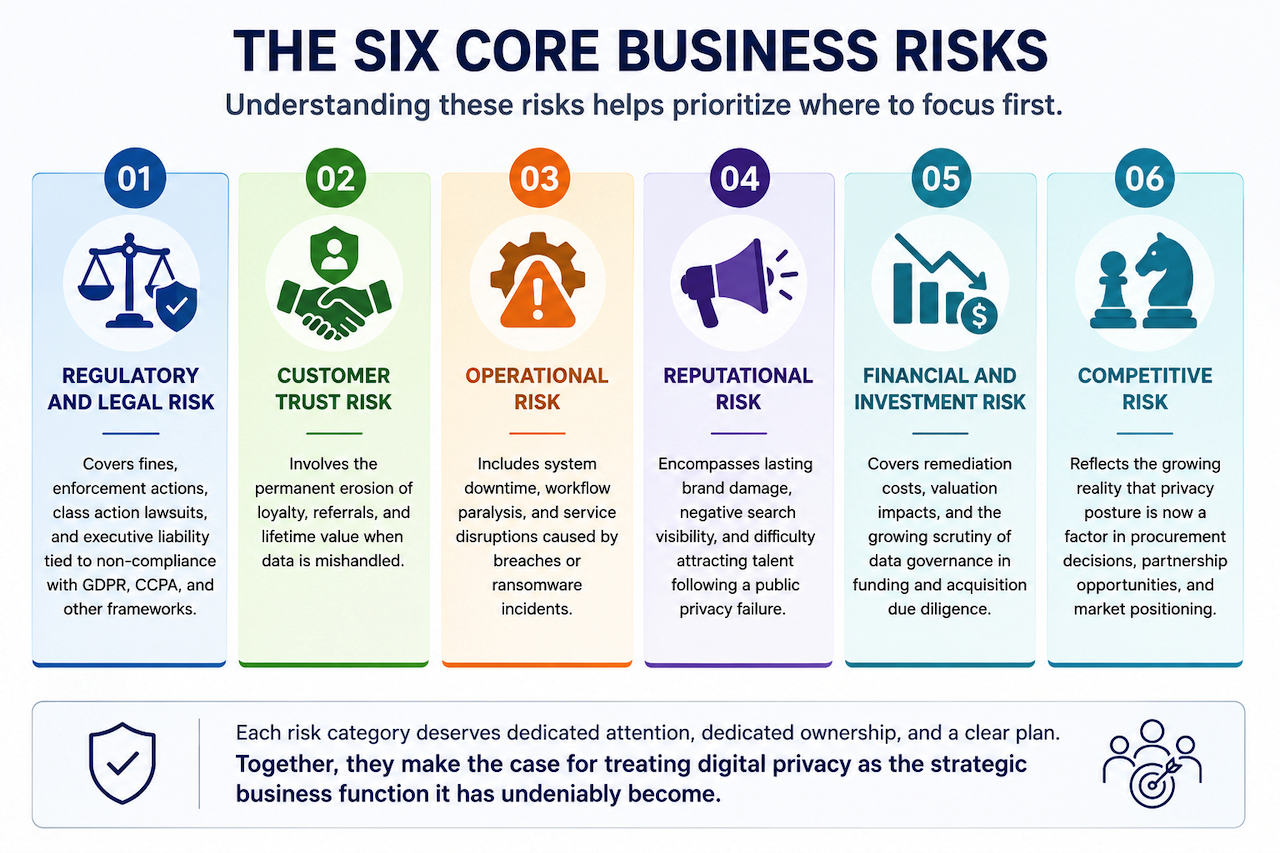
Image generated by ChatGPT.
Understanding these risks in summary helps prioritize where to focus first.
- Regulatory and Legal Risk: Covers fines, enforcement actions, class action lawsuits, and executive liability tied to non-compliance with GDPR, CCPA, and other frameworks.
- Customer Trust Risk: Involves the permanent erosion of loyalty, referrals, and lifetime value when data is mishandled.
- Operational Risk: Includes system downtime, workflow paralysis, and service disruptions caused by breaches or ransomware incidents.
- Reputational Risk: Encompasses lasting brand damage, negative search visibility, and difficulty attracting talent following a public privacy failure.
- Financial and Investment Risk: Covers remediation costs, valuation impacts, and the growing scrutiny of data governance in funding and acquisition due diligence.
- Competitive Risk: Reflects the growing reality that privacy posture is now a factor in procurement decisions, partnership opportunities, and market positioning.
Each risk category deserves dedicated attention, dedicated ownership, and a clear plan. Together, they make the case for treating digital privacy as the strategic business function it has undeniably become.
In a Nutshell
The business risks of weak digital privacy practices are real, measurable, and growing in scope and severity every year. Regulatory pressure is intensifying across every major market. Customers are making choices based on trust and transparency. Investors and acquirers are demanding verifiable governance before committing capital. The financial cost of privacy incidents continues its steady upward trajectory.
The encouraging reality is that strong privacy practices are achievable at any company size and at any budget level. It takes genuine commitment from leadership, clarity of ownership across the organization, and consistent execution in day-to-day operations. Businesses that invest seriously in privacy now will not simply reduce their risk exposure. They will build a durable and visible competitive advantage that attracts better customers, better partners, and better talent over the long term.
Disclaimer
The information provided in this article is for general informational and editorial purposes only and should not be considered legal, cybersecurity, compliance, or financial advice. Readers should consult qualified professionals regarding their specific privacy, regulatory, and data protection obligations.
Any references to third-party companies, frameworks, products, or websites are included solely for contextual and informational purposes. iplocation.net does not endorse, guarantee, or assume responsibility for the accuracy, reliability, security, or practices of any third-party websites or external links referenced in this article.
iplocation.net shall not be held liable for any losses, damages, compliance issues, security incidents, or consequences arising from the use of external links, third-party services, or reliance on the information presented in this article.
Featured Image generated by ChatGPT.
Related Articles

April 7, 2026
5 Ways Your Business Can Strengthen Online Privacy Without Slowing Growth: Smart, Scalable Security Strategies
In today’s digital landscape, businesses can no longer afford to ignore online privacy as they pursue growth in a global marketplace. The good news is that it’s possible to strengt...
Read More
January 6, 2026
Protecting Your Digital Privacy After a Car Accident: What Your IP Address Reveals
In the aftermath of a car accident, most people focus on physical injuries, vehicle damage, and insurance claims. However, there's another dimension that often goes unnoticed: your...
Read More
July 23, 2025
Why Digital Privacy Has to Be a Business Imperative in the Remote Work Era
The shift towards remote work has transformed the modern workplace but it's also transformed how we think about digital privacy and employee well-being. With employees scattered ar...
Read More
Comments
Comments are moderated to keep the discussion useful and respectful. Spam, automated submissions, and low-value promotional comments are removed. Comments with outbound links may be approved when the link is relevant to the article and genuinely helpful to readers.
No comments have been published yet.