

Software, Information Technology, Web Development
A Practical Framework for Deciding the Future of Legacy Applications Modernization
Every enterprise architecture team is sitting on at least one application nobody wants to touch. It runs the business, it’s held together by a developer who left three years ago, and every roadmap review ends with the same line: “we’ll deal with it next quarter.” Next quarter rarely comes, because nobody has a repeatable way to decide what “dealing with it” even means.
This is a framework problem, not a technology problem. Retiring, replatforming, or fully rebuilding a legacy system are all valid answers. The failure mode is making that call app by app, on gut feeling, under deadline pressure, with no consistent criteria behind it.
Why Legacy Application Decisions Are Harder Than They Look
Legacy systems rarely fail all at once. They erode a little more maintenance cost each year, a little less institutional knowledge, one more integration bolted on sideways. By the time a system forces a decision, the architecture team is usually choosing under pressure instead of on schedule. A few patterns show up across almost every legacy portfolio:
- Maintenance cost climbing faster than the business value the system delivers
- Original developers or vendors no longer available, with tribal knowledge concentrated in one or two people
- Point-to-point integrations layered on for a decade, with no clean API surface
- Compliance or security gaps that are expensive to patch but risky to ignore
- A roadmap full of workarounds instead of features, because nobody trusts the core system enough to build on top of it
None of these alone forces a decision. Together, they’re the signal that gut-feeling triage has run out of runway.
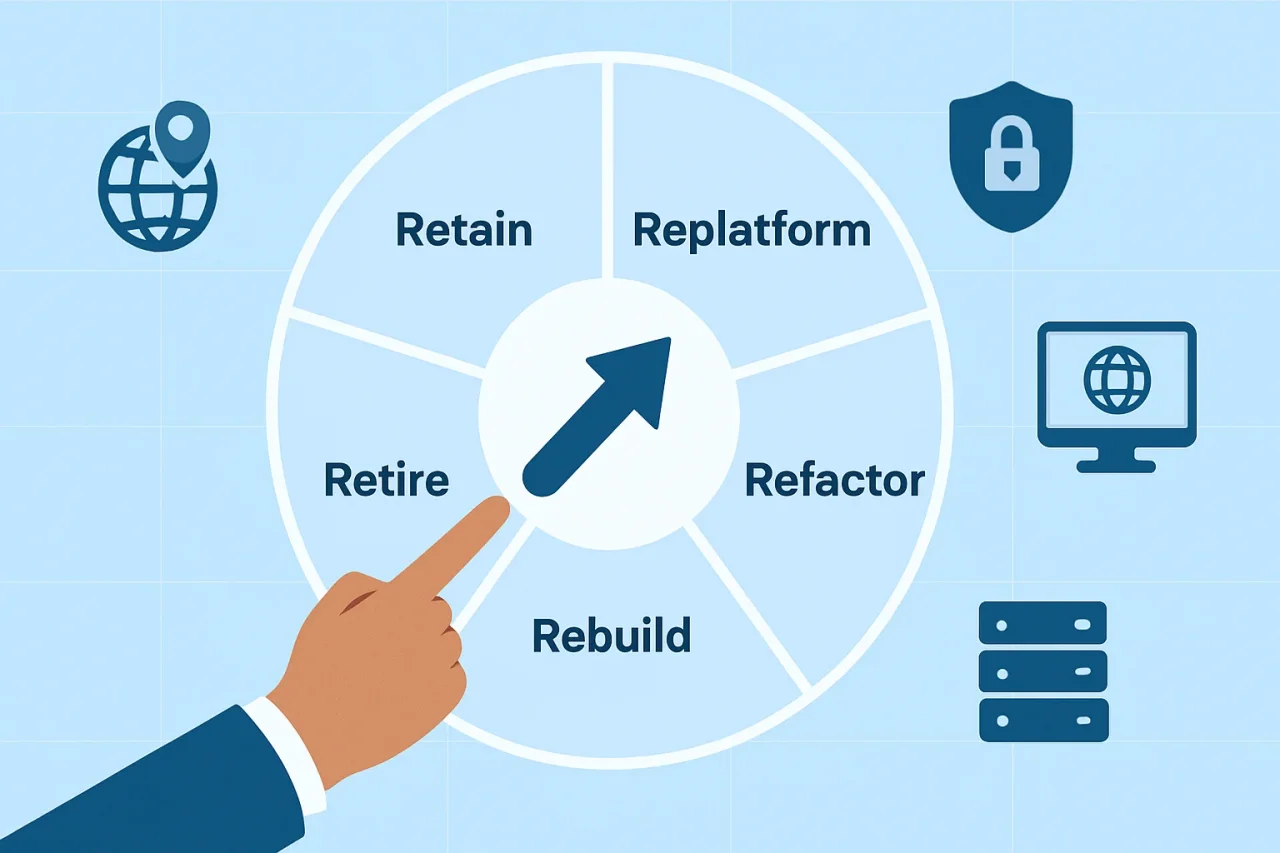
The Five-Path Framework: Retain, Replatform, Refactor, Rebuild, Retire
A useful decision framework narrows every legacy system down to one of five paths, and forces a documented reason for whichever one gets picked:
- Retain and stabilize: The system still earns its keep, and the risk is manageable; invest in monitoring and documentation, not new spend.
- Replatform: The logic is sound, but the infrastructure isn’t; move it to modern infrastructure without rewriting the core.
- Refactor: The system is valuable but the codebase is unmanageable; restructure incrementally while it keeps running.
- Rebuild: The business has outgrown what the system was designed to do, making it necessary to replace the existing system with one that can better support current requirements and future growth.
- Retire: The system’s function has been absorbed elsewhere, or the business need is gone; decommission it and redirect the budget.
The value isn’t in the five categories themselves; it’s that every application gets scored against the same criteria instead of whoever argues loudest in the roadmap meeting winning the call.
Picture a claims-processing system built fifteen years ago. It still runs the core business, but every regulatory update takes three sprints instead of one, and the two engineers who understand its batch jobs are both eligible to retire next year. Scored honestly, that’s a high-value, high-risk system — not a candidate for another patch, and not an obvious rebuild either until the assessment actually runs.
Running the Assessment: A Practical Enterprise Software Development Process
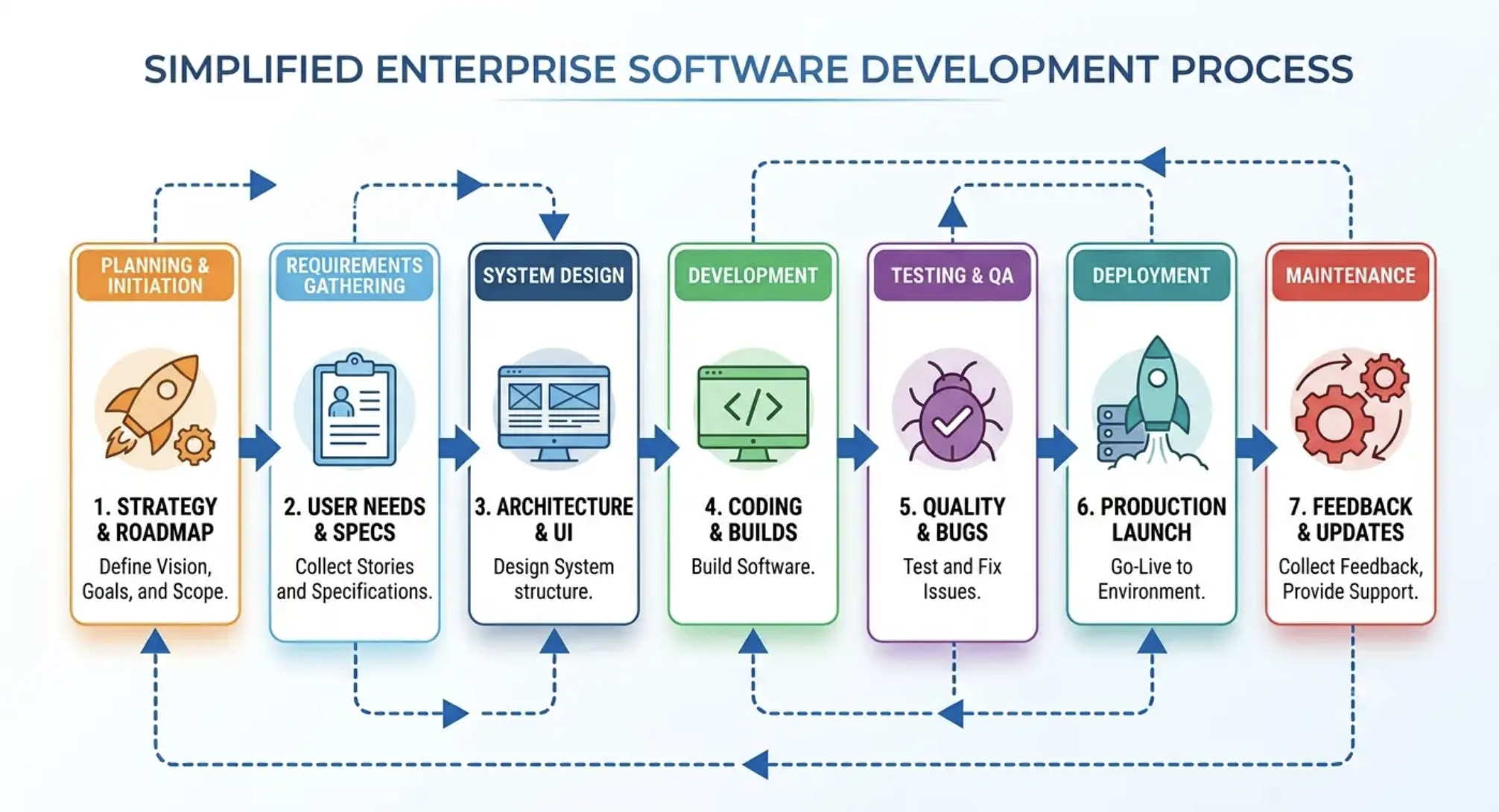
Score Each Application Against Business and Technical Risk
Every system in the portfolio gets scored on two axes: how much business value it delivers today, and how much technical and operational risk it carries. A high-value, low-risk system is an easy retain. A low-value, high-risk system is an easy retirement. The genuinely hard calls sit in the middle - high value, high risk - and that’s exactly where most enterprise software development process failures happen, because teams skip the scoring step and jump straight to a preferred solution.
Match the Score to a Path, Not a Preference
The scoring step matters because it separates the technical case from the political one. An architect who’s wanted to rebuild a system for two years will find reasons to justify a rebuild regardless of what the data says, and the same bias runs the other way for teams protective of a system they built. Scoring first, then mapping the score to one of the five paths, keeps the decision defensible when it gets challenged six months later — and it will get challenged.
When Rebuilding Makes Sense: Custom Enterprise Software Development
Rebuilding is the most expensive path on the list, so it should only get picked when refactoring genuinely can’t get the system where the business needs it to go. A few signals tend to point toward a full rebuild instead of an incremental fix:
- The current system’s data model can’t represent how the business actually operates anymore, not just how it operated when the system was built.
- Every new feature requires a workaround because the core architecture wasn’t designed for it.
- The system is core to the business, often an ERP, a claims engine, or a pricing system, and off-the-shelf configuration has hit its ceiling.
That third signal is worth sitting with. When the legacy core is an ERP platform, a rebuild can preserve the parts of the system that still earn their place while restructuring the rest around the business’s actual data model, instead of continuing to bend an existing schema to fit a use case it was never built for.
Planning a rebuild of this size is its own project. Teams need to account for enterprise integrations, migration requirements, parallel-run periods, data reconciliation between old and new systems, and rollback plans if the cutover doesn’t go cleanly. These considerations can help reduce disruption while the new system is introduced.
Depending on the scope of the rebuild, software development may involve areas such as system architecture, integration, data migration, testing, and deployment. Regardless of how the work is structured, the rebuild should be based on clearly defined technical and operational requirements.
Building a Legacy Software Modernization Strategy That Sticks
A framework only works if it runs on a schedule instead of a crisis. A legacy software modernization strategy that holds up treats this as a standing portfolio review, not a one-time cleanup project — the same five-path scoring exercise run on a fixed cadence, with a small budget reserved for the retain-and-stabilize systems so they don’t quietly slide into the high-risk category between reviews.
That cadence is what turns “we'll deal with it next quarter” into an actual decision instead of a deferral. Score the portfolio, map each system to a path, fund the ones that need it, and revisit on schedule, not when the system finally breaks, and the decision gets made for you.
The technology choice - retain, replatform, refactor, rebuild, or retire — is rarely the hard part once the scoring is honest. The hard part is building the discipline to run the exercise before the crisis, not during it.
Conclusion
A consistent framework can make legacy system decisions easier to evaluate and defend. By scoring applications according to business value and technical risk, teams can determine whether retaining, replatforming, refactoring, rebuilding, or retiring a system is the most appropriate path.
The technology choice is rarely the hard part once the scoring is honest. The bigger challenge is building the discipline to review systems before problems become urgent. A regular assessment process helps turn modernization from a reactive response into a planned part of managing the technology portfolio.
Comments
Comments are moderated to keep the discussion useful and respectful. Spam, automated submissions, and low-value promotional comments are removed. Comments with outbound links may be approved when the link is relevant to the article and genuinely helpful to readers.
No comments have been published yet.