

Agentic AI in Cybersecurity: Autonomous Threat Detection and Response

Introduction
The cybersecurity challenge for businesses has grown dramatically as digital systems, cloud platforms, connected devices, and remote work expand the attack surface. Agentic AI—autonomous, learning systems that can act on their own assessments—is emerging as a new layer of defense that augments traditional security tools.
What is Agentic AI in Cybersecurity?
Agentic AI refers to intelligent systems capable of monitoring an environment, assessing information, recognizing threats, and taking action without human instruction. In cybersecurity, these systems continuously ingest large volumes of security data, surface anomalous behavior, analyze suspicious activity, and respond to threats faster than a purely human-driven process.
Why Traditional Security Is Struggling
Conventional security solutions rely on signatures, static rules, and manual analyst workflows. As attackers adopt automation and AI-powered techniques—phishing, sophisticated ransomware, credential theft, supply-chain attacks and zero-day exploits—signature-based defenses and overloaded security teams increasingly miss novel or subtle threats. Alert fatigue further delays detection, allowing some attacks to remain undetected for long periods.
Key Capabilities of Agentic AI
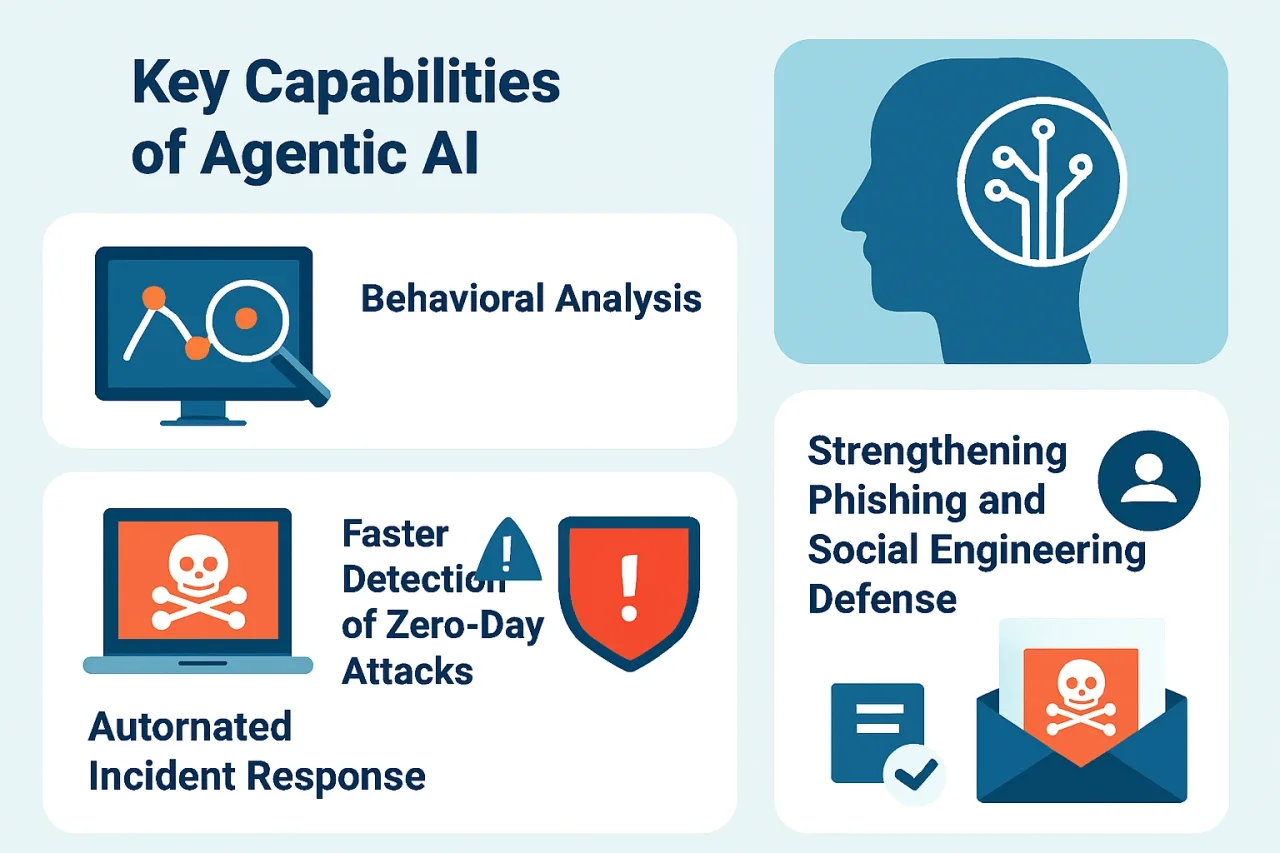
Behavioral Analysis
Agentic AI builds a baseline of an organization's normal digital behavior—user activity patterns, application communications, and typical access windows—and continuously compares current activity to that baseline. Unusual patterns are flagged for investigation.
Example: If a compromised employee account begins accessing sensitive files from an unfamiliar location or downloads large volumes of data outside normal hours, the system flags the behavior as suspicious and escalates or responds.
Faster Detection of Zero-Day Attacks
Zero-day vulnerabilities are unknown to vendors and defenders, so signature-based tools often miss them. Agentic AI detects anomalous application or system behavior rather than known attack signatures, enabling earlier detection and faster containment of previously unseen exploits.
Automated Incident Response
Detection alone is insufficient; rapid action is critical. Agentic AI can execute automated response playbooks seconds after detection to limit attacker movement and damage. Typical automated actions include:
- Isolating compromised devices
- Blocking suspicious IP addresses
- Disabling or quarantining accounts
- Restricting unauthorized access
- Initiating deeper forensic or investigative steps
Strengthening Phishing and Social Engineering Defense
Agentic AI analyzes email content, sender behavior over time, communication patterns, and attachments or links in real time. It identifies subtle indicators of malicious intent and continuously learns from new phishing attempts to improve detection accuracy.
Enhanced Threat Hunting
Threat hunting is proactive investigation to find hidden threats. Agentic AI augments analysts by continuously scanning and correlating vast datasets, surfacing relationships across systems and prioritizing likely attack vectors so humans can focus on the highest-risk investigations.
Protecting Cloud and Hybrid Environments
Cloud and hybrid infrastructures are dynamic and complex. Agentic AI provides cross-environment visibility, detects misconfigurations or unusual activities that expose data, and recommends or applies corrective policies as infrastructure changes in real time.
Reducing Security Team Workloads
By automating routine monitoring, triage, and remediation tasks, agentic AI helps reduce alert volume and lets security teams concentrate on strategic, high-risk incidents—improving efficiency and lowering operational costs.
Challenges and Considerations
Agentic AI is not a complete replacement for human expertise. Responsible deployment requires:
- Proper training, continuous validation, and monitoring of AI models
- Human oversight for complex decisions and ethical considerations
- Explainability and transparency so organizations understand how automated decisions are made
- Governance frameworks to maintain accountability and regulatory compliance
- Defenses against adversarial attacks that attempt to manipulate AI systems
The Future of Cyber Defense
As attacks become faster, automated, and more sophisticated, defense technologies must evolve. Agentic AI offers autonomous detection, pattern analysis, continuous learning, and rapid automated response—capabilities that improve visibility, reduce response time, lower overhead, and increase resilience.
Conclusion
Agentic AI complements human security expertise by providing machine-speed analysis and actions across complex, changing environments. When governed and monitored responsibly, agentic AI is poised to play an increasingly important role in protecting businesses, critical infrastructure, and sensitive information from the next generation of cyber threats.
Disclaimer
This article is provided for general informational purposes about agentic AI in cybersecurity. It summarizes concepts, capabilities, and considerations but is not exhaustive and may not reflect the latest threats, product features, or regulatory changes.
Before making security decisions, deploying tools, or changing defenses, verify details with up‑to‑date sources and consult qualified cybersecurity professionals, vendors, or your internal security team; test and validate any automation in controlled settings with appropriate oversight.
Comments
Comments are moderated to keep the discussion useful and respectful. Spam, automated submissions, and low-value promotional comments are removed. Comments with outbound links may be approved when the link is relevant to the article and genuinely helpful to readers.
No comments have been published yet.