

Edge Computing vs Cloud Computing: Which Architecture Fits Modern Applications?
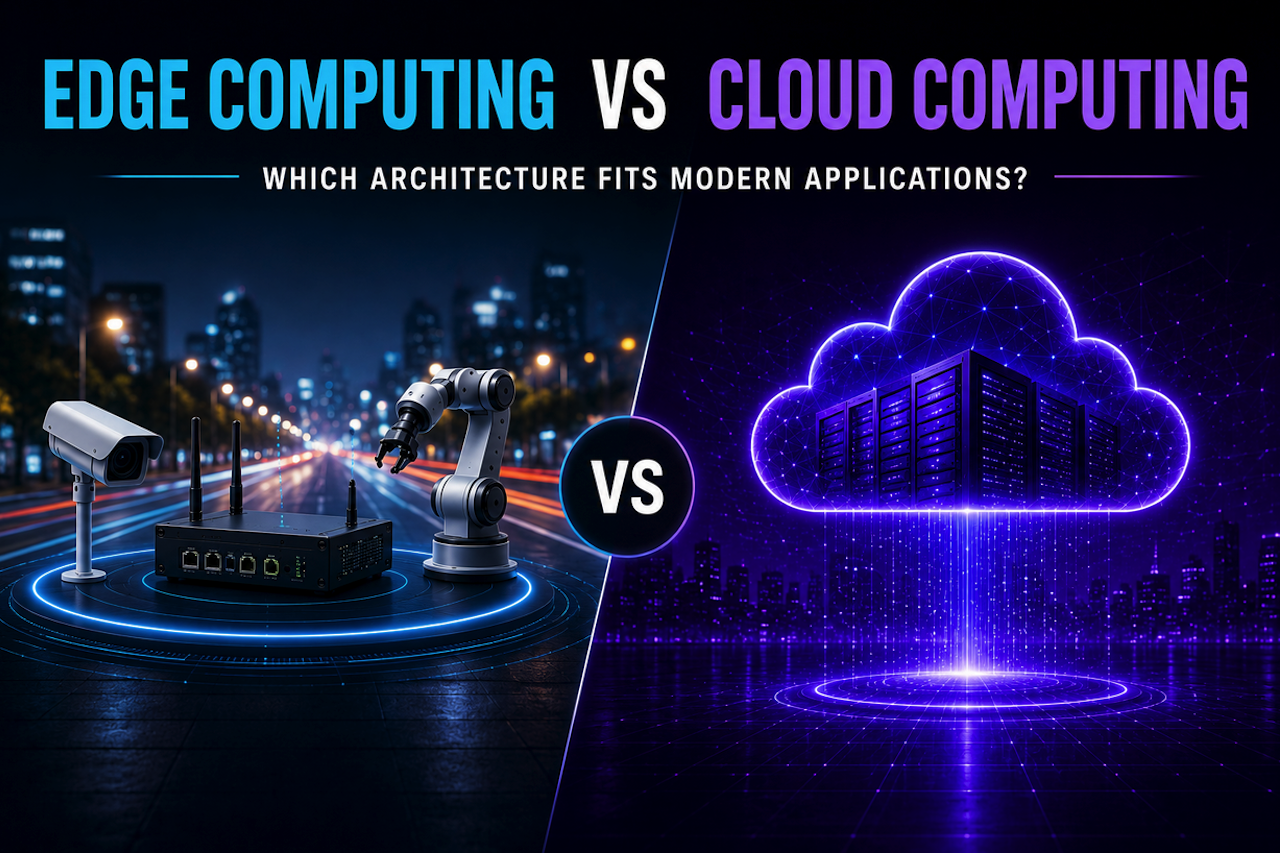
Your autonomous vehicle needs to brake in 50 milliseconds. Your factory floor sensor just detected an anomaly. Your hospital's patient monitoring system just flagged something important. None of these can afford a round trip to a data center thousands of miles away.
That's the moment when the edge computing vs cloud computing debate stops being theoretical and starts being very, very real.
Both architectures are genuinely powerful. Both have a place in modern infrastructure. However, they solve different problems, and picking the wrong one can quietly kill your application's performance, budget, and security posture. Let's break it down.
Understanding Edge Computing and Cloud Computing
What Is Edge Computing?
Edge computing moves data processing closer to where the data is actually generated at the device, the factory, the vehicle, or the sensor. Instead of sending raw data to a central server, computation happens locally or at a nearby node.
The result? Lower bandwidth usage, faster decisions, and reduced dependence on a constant internet connection. This is why edge computing architecture has become the backbone of IoT deployments, autonomous systems, and anything that requires real-time data processing without tolerating even a slight delay.
What Is Cloud Computing?
Cloud computing, by contrast, centralizes everything. Processing power, storage, databases, and applications all reside on remote servers managed by providers such as AWS, Google Cloud, or Microsoft Azure. You access all of it over the internet.
Cloud servers have changed how businesses build and scale software. You don't need to own physical hardware. You pay for what you use. You scale up during peak demand and scale down when traffic drops. For most general-purpose applications, the cloud is still the default choice and for good reason.
Key Differences Between Edge and Cloud Architectures
The core differences between edge and cloud computing depend on where computations are performed and how long it takes for results to be returned. In terms of edge computing, calculations occur at the very source. In cloud computing, data is centralized.
Edge Computing vs Cloud Computing: A Detailed Comparison
| Factor | Edge Computing | Cloud Computing |
|---|---|---|
| Latency | Lowest (often measured in milliseconds) | Depends on network latency and distance to data centers |
| Scalability | Limited by local hardware resources | Highly scalable with virtually unlimited resources |
| Data Privacy | Data remains close to the source or device | Data is transmitted to centralized remote servers |
| Cost Model | Higher upfront investment in hardware and infrastructure | Pay-as-you-go pricing with lower initial costs |
| Best For | Real-time applications, IoT, autonomous systems, local processing | Large-scale applications, data analytics, storage, and centralized workloads |
Performance and Latency
This is where edge wins without much argument. Real-time data processing at the source means there's no waiting for data to travel to a cloud server and back. For edge computing for IoT applications - think smart grids, industrial sensors, or connected medical devices - that speed difference isn't just a nice-to-have. That's the whole point.
Cloud computing performance has improved significantly, but it still relies on network connectivity. The farther your data travels, the more latency you introduce. For applications where a 200ms delay is noticeable and a 500ms delay is unacceptable, edge computing architecture is simply the better fit.
Scalability and Resource Management
Here's the thing: edge computing has a ceiling. Each node has finite processing power and storage. Scaling edge deployments means deploying more physical devices, which takes time, planning, and money.
On the other hand, cloud servers can scale almost instantly. Need 10 times the computing power for the next six hours? Done. This flexibility is why cloud computing remains the go-to for applications with unpredictable or growing demand, workloads, and large datasets that don't require sub-millisecond response times.
Security, Privacy, and Compliance
Since data remains within the same network in edge computing, this would be a good thing for data privacy. In fact, since your data would remain on your device or network, there wouldn't even be any opportunity for data theft in transit.
That said, edge devices themselves can be physically tampered with, left unmonitored, or poorly patched. Cloud providers usually invest heavily in security infrastructure, compliance tooling, and certifications that most individual organizations couldn't match on their own.
According to industry analysts, the edge computing market is expected to continue growing as organizations increasingly deploy low-latency applications, connected devices, and distributed computing infrastructure, signaling sustained investment despite ongoing security and operational challenges.
Cost Considerations
Cloud computing's pay-as-you-go model looks attractive early on, but costs can climb quickly at scale. Sending massive volumes of data to cloud servers continuously, especially from thousands of IoT endpoints, generates real bandwidth and storage costs.
Edge computing requires upfront hardware investment, but it significantly reduces ongoing data transfer costs. For high-volume, continuous data environments, edge can be cheaper in the long run.
Which Architecture Fits Modern Applications?
When to Choose Edge Computing
- Real-time processing with low latency is necessary
- Your application operates on IoT devices or in remotely located areas
- Local processing is a necessity due to data privacy/security concerns
- Data uploading is consuming too much of your company's bandwidth.
When to Choose Cloud Computing
- You need to scale quickly without managing physical infrastructure
- Your workloads are unpredictable or bursty
- You need centralized analytics, machine learning, or large-scale data storage.
- Your team doesn't have the resources to manage distributed hardware
Hybrid Approaches for Modern Applications
Most serious deployments don't pick one or the other - they use both. The future of edge computing and cloud computing is increasingly hybrid. Edge handles the time-sensitive, local tasks. Cloud handles the heavy computation, long-term storage, and analytics.
A smart manufacturing plant, for example, might process quality control data at the edge in real time but send aggregated reports to the cloud for trend analysis and historical storage. Neither architecture alone would do the job as well.
Conclusion
There's no one-size-fits-all answer to whether edge or cloud computing should be used. But there is one correct approach: evaluate your needs as dictated by your application in terms of speed, scalability, privacy, or efficiency.
Use edge processing for apps where milliseconds matter. Use cloud computing for flexibility and scalability. And for many modern applications, both will be necessary.
Related Articles
June 25, 2026
The Role of Cloud Computing in Digital Transformation
Cloud computing has become the most important foundation for digital transformation in 2026.
Read More
November 21, 2025
Top 8 Cloud Computing Courses to Accelerate Your Career in 2025
Cloud computing is transforming the global tech landscape, creating new opportunities for professionals across IT, business, and engineering. As companies adopt cloud-based systems...
Read More
March 10, 2025
Cloud Mining vs. Traditional Mining: Which One Is More Profitable?
With the growing interest in cryptocurrency mining, many investors face a common dilemma: Cloud Mining vs. Traditional Mining. Which method offers better profitability, and which i...
Read More
Comments
Comments are moderated to keep the discussion useful and respectful. Spam, automated submissions, and low-value promotional comments are removed. Comments with outbound links may be approved when the link is relevant to the article and genuinely helpful to readers.
No comments have been published yet.