

Geofence Time Tracking: The Basics of Location‑Based Timekeeping
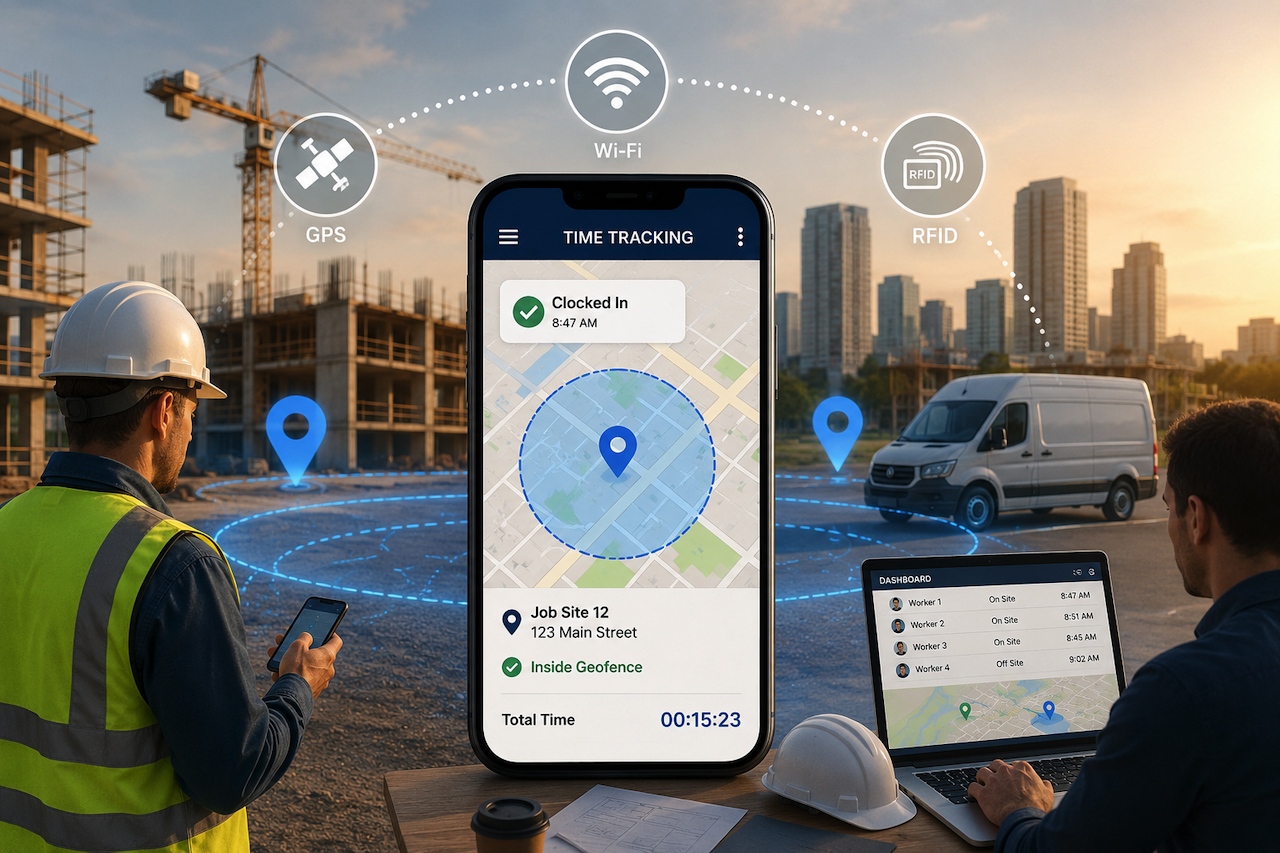
The clock has a terrible memory. It counts seconds but never pays attention to where. The result is a peculiar vulnerability in modern business: we trust our time sheets, but they often lie.
For an increasing number of companies, the solution isn't a better time clock; it's a better map. They are drawing invisible lines around job sites, shops, and client locations, turning physical space into an automated accounting system. This is geofence time tracking, a technology that binds payroll to presence as tightly as a lock binds a door.
What is Geofence Time Tracking?
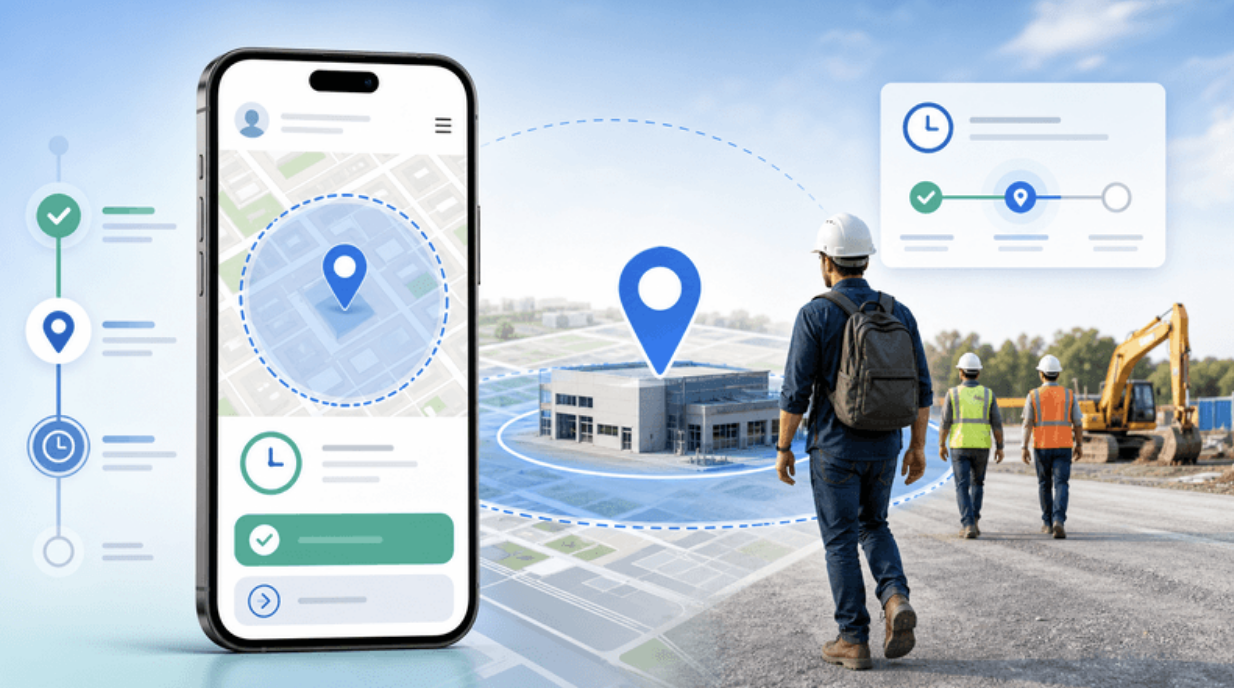
At its simplest, geofence time tracking uses location technology to draw a virtual perimeter around a real-world place. Think of it as creating an invisible tripwire in a digital field. These boundaries, called geofences, can be a simple 100-meter-radius circle or a custom polygon tracing a property line. The function, however, is universally elegant: when a worker’s device enters this digital zone, the system takes notice.
This recognition relies on a technology stack: GPS for outdoor precision (accurate to within 3 to 15 meters), Wi-Fi for pinpoint indoor tracking (down to 1 to 3 meters), and RFID for identifying specific assets and workers. The result transforms a construction trailer, a delivery warehouse, or a sprawling campus into a self-surveilling territory, one that can automatically log a clock-in when a worker crosses its threshold and a clock-out the moment they depart.
How Does Geofencing Work?
The process of geofence time tracking unfolds in a straightforward, three-step sequence.
- Define the Boundary: An administrator accesses a time-tracking software interface and, with a few clicks, draws a geofence on a digital map around the chosen location.
- Location Detection: Workers, equipped with a smartphone or company-owned tracking device, arrive at the site. The mobile device’s GPS network, Wi-Fi signals, and cellular triangulation begin relaying its position back to the central server.
- Trigger the Action: The system compares the employee's live location against the pre-set geofence. When the software recognizes that the device has entered the zone, it triggers a pre-programmed response: an automatic clock-in.
The Cracks in the Manual System
Why does this mapping of minutes matter? Because manual time tracking is riddled with exploitable cracks. The American Payroll Association estimates that various forms of "time theft" cost U.S. businesses up to $400 billion annually. This is not always a grand heist; more often, it is a slow, steady drift of 15-minute increments.
Nearly half of all hourly employees admit to some form of timesheet falsification. Buddy punching, where one employee clocks in for another, is a persistent drain, affecting 75% of U.S. businesses. For an individual company, these small, undetected discrepancies can add up to as much as 8% of total gross payroll costs.
Why Businesses Are Turning to Geofencing
By automating attendance, geofences plug these leaks. The financial incentives are substantial. Fleet operations have reported seeing a 250–400% return on investment (ROI) within 18 months of implementing geofencing. This immediate ROI originates from several interconnected sources:
Eliminating Payroll Padding and Buddy Punching
When a time sheet is tied to a physical location, the guesswork disappears. A worker can no longer claim an 8:00 AM arrival if their device's GPS logs show they entered the geofenced job site at 8:47 AM. The system allows attendance to be marked only when the employee is physically present within the approved zone, rendering the time-honored practice of buddy punching an impossibility.
For instance, one time-tracking platform handles this by triggering a time entry as soon as GPS confirms site arrival, an approach shared by many competing tools.
Direct Labor Cost Reduction
The financial impact of a single daily discrepancy can be jarring. If a technician earning $30 per hour adds just 47 minutes to their timesheet each day, it costs a company $23.50 in unworked wages in a single morning. Multiply that across even a small team, and the company could be losing over $18,000 per year to a problem it cannot see.
Real-Time Visibility and Bulletproof Client Billing
Geofencing provides immediate, real-time visibility into labor allocation across all projects. It turns ambiguous "time on site" claims into objective data, instantly resolving client disputes on invoices. A manager no longer needs to call a technician to ask if they've arrived; they can check the dashboard to see exactly when the vehicle crossed the geofence boundary.
Legal and Privacy Considerations
A digital perimeter is, however, a boundary in more ways than one. The same precision that empowers an employer can encroach upon an employee's right to disconnect. Any business deploying geofence time tracking must navigate a thicket of legal and ethical considerations.
As a foundational rule, companies must provide informed consent: employees must be made fully aware of the monitoring system, its purposes, and its scope before it is deployed. The tracking must strictly adhere to the principle of proportionality: data collection should be the minimum necessary for the intended purpose, and location monitoring outside of working hours is widely considered excessive and an invasion of privacy. The FTC, as well as state laws such as the California Consumer Privacy Act (CCPA), have made clear that geolocation data is considered "sensitive location data," requiring companies to handle it with the utmost care.
Even in regions with strong worker protections, the law is clear: continuous, passive surveillance is almost always illegal. A 2025 decision by the Italian Data Protection Authority (the Garante) fined a public entity €50,000 for using an attendance-tracking app that recorded employees' GPS location at clock-in and clock-out. The Garante’s ruling reinforced the requirement that GPS employee monitoring must be carefully planned, proportionate, and lawful, respecting the core GDPR principles of lawfulness, transparency, and data minimization.
Best Practices for Implementation
Fortunately, the technology offers a clear path to compliance and employee acceptance. Geofencing is best deployed as a tool to validate, not a cage to confine. The following best practices ensure fairness and legal integrity:
- Limit Scope: Activate location services only at clock-in and clock-out. This prevents a system from building a shadow map of an employee's private life.
- Maintain Transparency: Provide a written policy to every employee. Explain what data is captured, why it is needed, and how long it will be retained.
- Enable the Override: Technology is fallible. GPS drift or a dense urban canyon can create a false clock-out. Best-in-class systems pair geofences with GPS breadcrumbs and allow a supervisor to verify and override exceptions, preventing legitimate work from going unpaid.
- Secure the Data: Companies have a legal obligation to protect the personal data collected. Geolocation logs should be stored securely with appropriate technical and organizational measures to prevent unauthorized access.
Trends
The adoption of geofencing technology is accelerating. The global geofencing market, valued at roughly $3.22 billion in 2025, is projected to grow to $11.85 billion by 2034, a compound annual growth rate (CAGR) of nearly 15%. Within the HRMS (Human Resource Management System) sector specifically, geofencing has become a headline feature for 2026, lauded for its ability to remove buddy punching for remote, hybrid, and field-based employees.
Conclusion
The final note to any employer considering this system is one of intention. Geofence time tracking is at its best when it is a means of verification, not a mechanism of suspicion. The data it collects solves real business problems: underbilling clients, overpaying for inaccurate timesheets, and battling the silent drain on productivity. It offers a fairer, more accurate payroll system for everyone by ensuring that every minute of overtime billed is a minute truly spent on the job. The goal, in the end, is not to trap workers within an invisible boundary, but to ensure that their time is valued without question, and that is a perimeter anyone would want to enter.
Featured Image generated by ChatGPT.
Related Articles
February 13, 2026
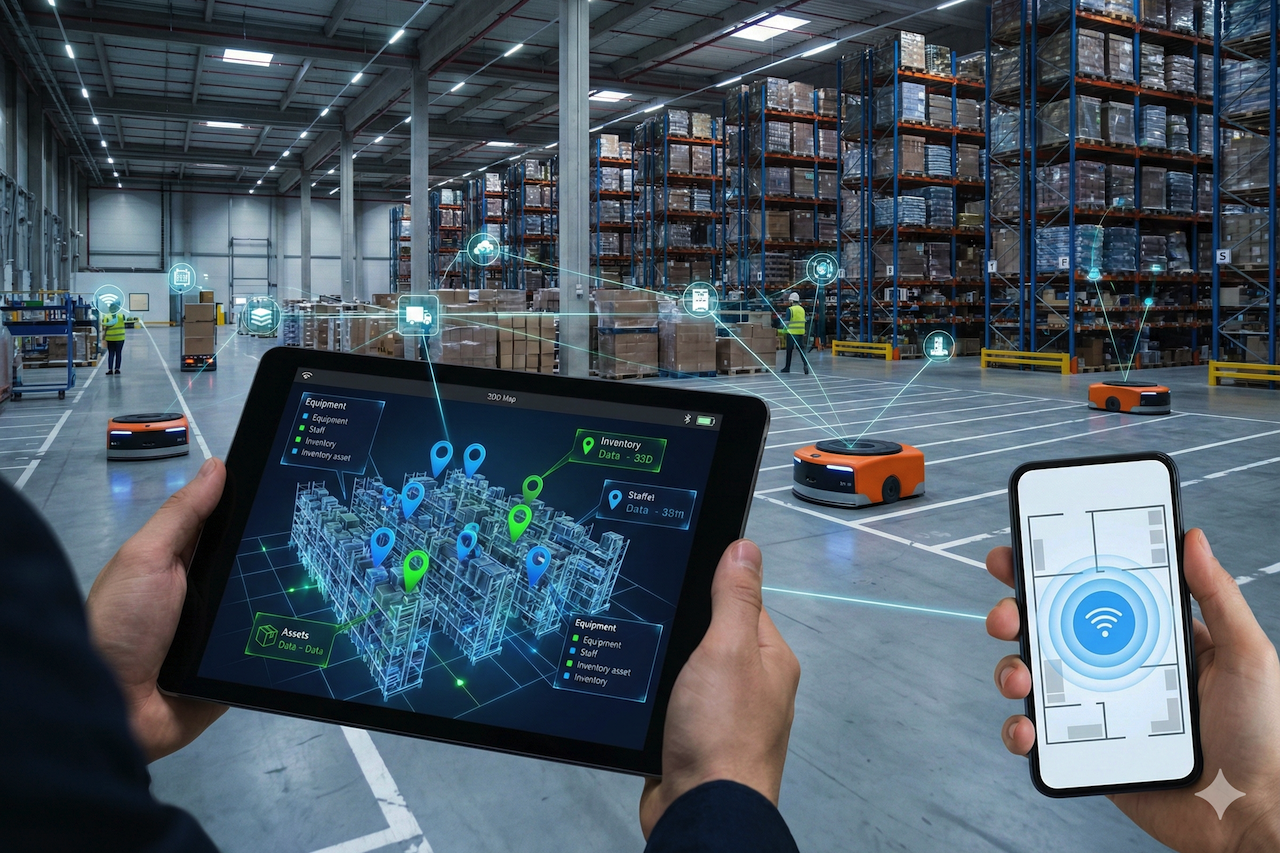
Indoor Location Tracking with Wi-Fi RTT Vs. RTLS Technology
Remember when finding a staff member or worker in a massive facility meant calling their phone and playing the "warmer, colder" game? Those days are fading fast, thanks to Wi-F...
Read More
June 2, 2025
GPS for Beginners: Understanding the Technology Behind Location Tracking
Whether you’re driving, following a food delivery, or mapping a workout with a fitness app, you’re most likely relying on GPS technology. What exactly is GPS, and how does it work?...
Read More
August 19, 2024
Why Employee Location Tracking is a Must for Field Service Industries
For industries with employees working in the field in multiple locations, it’s important to keep track of where workers are throughout their shifts. Doing so ensures employees work...
Read More
Comments
Comments are moderated to keep the discussion useful and respectful. Spam, automated submissions, and low-value promotional comments are removed. Comments with outbound links may be approved when the link is relevant to the article and genuinely helpful to readers.
No comments have been published yet.