

How Distributed Teams Verify Employee Work Locations in 2026: A Compliance Playbook

Country boundaries or fixed office locations no longer define remote work. In 2026, distributed teams routinely hire talent across cities, states, and continents, often without opening local entities. While this flexibility gives organizations access to global talent, it also introduces a serious operational challenge: verifying where employees actually work.
For HR, finance, legal, and compliance teams, employee location verification has become more than an administrative task. It now affects payroll taxes, labor law obligations, data privacy compliance, permanent establishment (PE) exposure, benefits eligibility, and immigration risk. A mismatch between an employee’s reported location and their actual working location can trigger unexpected liabilities, especially for companies operating across multiple jurisdictions.
This compliance playbook explains how distributed organizations verify employee work locations in 2026, the technologies and processes involved, and the operational safeguards companies are implementing to reduce risk.
Why Employee Work Location Verification Matters
In traditional office environments, employee location was straightforward. Teams worked from designated offices under a single legal entity. Remote and hybrid work models changed that structure entirely.
Today, employees may:
- Work from a home office in another state
- Relocate temporarily to another country
- Travel frequently while remaining on payroll
- Use coworking spaces or flexible work hubs
- Split time across multiple jurisdictions
For distributed companies, this creates a moving compliance target.
Employee location directly impacts payroll taxes, employment law compliance, immigration requirements, data protection, and entity-related risk. This is especially important for companies managing cross-border teams, where local employment rules need to align with the employee’s actual work location. Many organizations now rely on global employer of record services and workforce compliance platforms to help manage these obligations across distributed teams.
Payroll Tax Obligations
Many countries and states calculate payroll tax obligations based on where work is physically performed rather than where the employer is headquartered.
Employment Law Compliance
Local regulations around working hours, leave entitlements, overtime, termination rules, and social security contributions often depend on the employee’s actual work location.
Immigration and Visa Requirements
Remote employees working internationally without proper authorization can expose employers to immigration violations.
Permanent Establishment (PE) Risk
A remote employee conducting revenue-generating or strategic activities from another jurisdiction may create a taxable business presence for the company.
Data Protection and Security
Cross-border work arrangements may trigger additional obligations under regulations such as GDPR and local data residency laws.
As distributed work matures, regulators are paying closer attention to where employees physically work, not just what employment contracts say.
The Shift From “Declared Location” to “Verified Location”
In earlier remote work models, organizations largely relied on employee self-reporting. Employees updated their addresses in HR systems, and companies treated that information as accurate.
That approach is no longer sufficient for global operations.
In 2026, organizations will increasingly use continuous or event-based verification systems to validate employee work locations. The goal is not employee surveillance but operational accuracy.
Most modern verification programs focus on:
- Confirming tax jurisdiction
- Tracking long-term cross-border work
- Identifying unauthorized relocations
- Managing compliance thresholds
- Supporting payroll accuracy
Companies are also under pressure from auditors, regulators, insurers, and tax authorities to demonstrate that location data is reasonably verified rather than assumed.
Common Methods Distributed Teams Use to Verify Work Locations
Organizations now combine multiple methods rather than relying on a single source of truth.
HRIS and Employee Self-Reporting Systems
The foundation of most verification workflows remains employee-provided information through HR platforms.
Employees typically declare:
- Residential address
- Primary work location
- Temporary travel arrangements
- International remote work requests
- Tax residency details
Modern HR systems increasingly require periodic re-confirmation rather than one-time onboarding declarations.
However, self-reporting alone has limitations. Employees may forget to update records or misunderstand compliance implications.
For that reason, organizations now layer additional verification processes on top of HR declarations.
IP Address and Network Location Monitoring
Many distributed organizations use network-level signals to identify discrepancies between reported and actual work locations.
This often includes:
- VPN login locations
- Corporate device IP activity
- Geographic login patterns
- Access timestamps across regions
For example, if an employee is officially based in Singapore but consistently logs in from Germany for several months, compliance teams may review the arrangement.
Importantly, mature organizations use this information cautiously and transparently. Most companies establish clear internal policies explaining what data is collected, why it is collected, and how it is used.
Privacy considerations remain critical, particularly in regions with strict employee monitoring laws.
Device and Endpoint Management Tools
Endpoint security systems increasingly support compliance workflows.
Corporate-managed laptops and mobile devices may provide:
- Registered geographic usage
- Time-zone inconsistencies
- Device location permissions
- Regional access anomalies
These tools are primarily used for cybersecurity purposes, but they also help organizations detect unauthorized cross-border work activity.
Companies typically avoid continuous real-time tracking. Instead, they focus on exception management, identifying cases that require review.
Travel and Remote Work Approval Programs
Many organizations now formalize remote mobility through approval workflows.
Employees seeking to work temporarily from another country or state often must:
- Submit a remote work request
- Specify intended duration
- Confirm immigration eligibility
- Receive legal or tax approval
- Update HR and payroll records
This approach allows organizations to evaluate compliance exposure before work begins.
Large multinational employers increasingly maintain internal “remote work matrices” that classify countries and states by compliance risk level.
Some jurisdictions allow short-term remote work with limited obligations, while others require immediate payroll or tax registration.
Payroll and Tax Reconciliation Processes
Payroll systems have become a critical verification checkpoint.
Organizations now compare:
- Payroll tax jurisdiction
- Employee-declared location
- Benefits enrollment data
- Time-zone patterns
- Expense claims
- Travel reimbursements
Discrepancies often trigger compliance reviews.
For example:
- State tax withholding may not match employee login activity
- Benefits eligibility may conflict with residency rules
- Expense claims may indicate a long-term presence elsewhere
Cross-functional reconciliation between HR, payroll, finance, and legal teams has become standard practice for distributed companies.
Managerial and Operational Oversight
Technology alone cannot solve location verification challenges.
Operational leaders often provide important context around:
- Employee travel patterns
- Temporary project assignments
- Hybrid work schedules
- Regional client engagement
- Cross-border relocations
Managers increasingly receive compliance training to recognize location-related risks early.
This operational awareness matters because location risk is often behavioral rather than technical. Employees may casually extend international stays without realizing compliance implications.
Key Compliance Risks Companies Are Trying to Avoid
Tangible legal and financial risks drive the growing focus on work location verification.
Misaligned Payroll Tax Reporting
Incorrect tax withholding remains one of the most common issues for distributed employers.
An employee working from a different jurisdiction may require:
- New payroll registrations
- Updated tax withholding
- Social contribution adjustments
- Local employer obligations
Delayed corrections can create penalties and back payments.
Unauthorized International Employment
Employees working abroad without employer review may trigger:
- Immigration complications
- Local labor law exposure
- Corporate tax obligations
- Employment misclassification risks
Short-term arrangements can become long-term compliance issues if not monitored carefully.
Permanent Establishment (PE) Exposure
PE risk continues to concern global finance and legal teams.
A remote employee performing strategic functions from another country may unintentionally establish a taxable business presence for the employer.
Verification programs help organizations identify activities and jurisdictions requiring deeper legal review.
Data Privacy and Security Violations
Cross-border access to regulated data may conflict with local privacy requirements.
Companies handling healthcare, financial, or customer-sensitive data often apply stricter location restrictions for remote work.
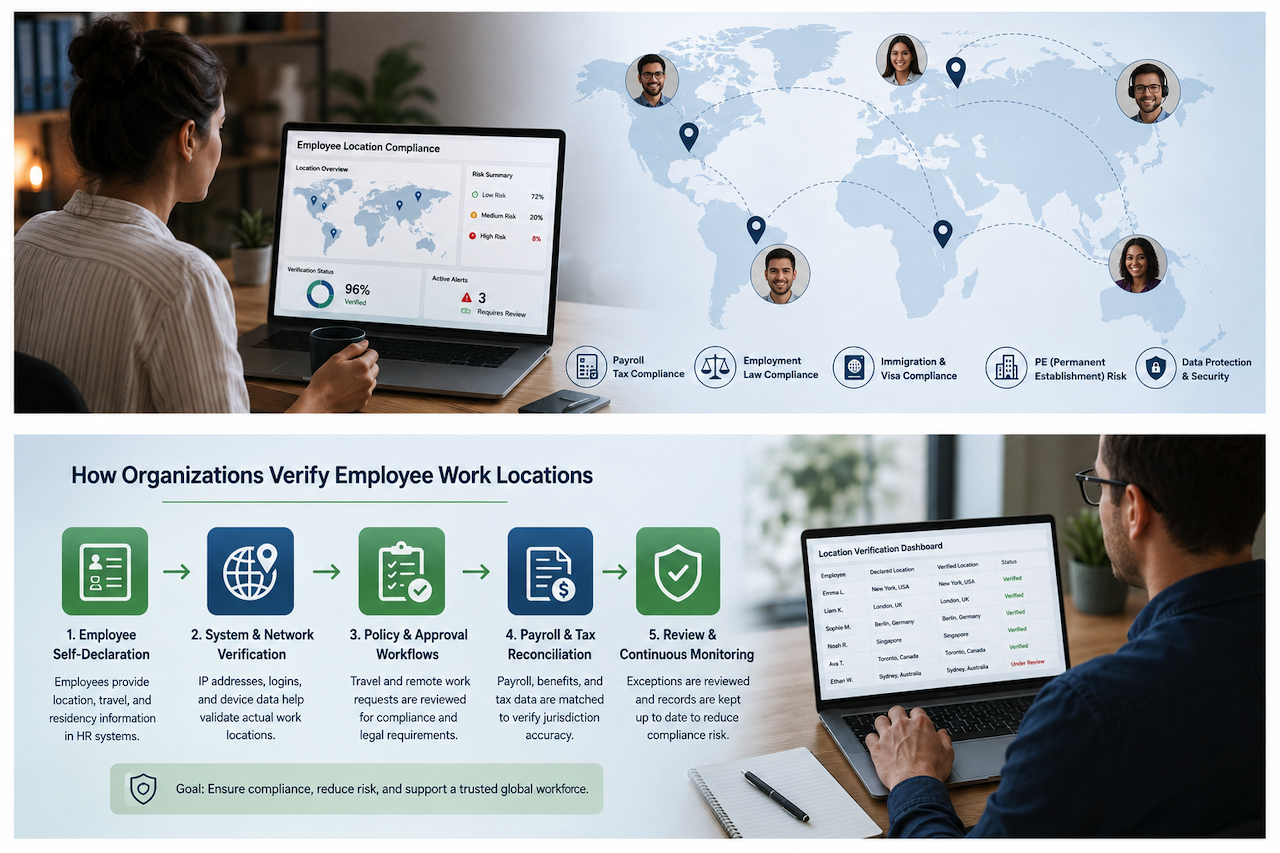
Image generated by ChatGPT.
Best Practices for Distributed Teams in 2026
Organizations with mature compliance programs typically follow several operational principles.
Create Clear Remote Work Policies
Policies should explain:
- Approved work jurisdictions
- Travel notification requirements
- Temporary international work rules
- Compliance review procedures
- Employee responsibilities
Clarity reduces accidental violations.
Use Multiple Verification Signals
No single verification method is fully reliable.
Leading organizations combine:
- HR declarations
- Payroll data
- IT security signals
- Travel records
- Manager input
This layered approach improves accuracy while reducing overreliance on surveillance.
Focus on Transparency
Employees should understand:
- What information is collected
- Why verification matters
- How data is protected
- When reviews occur
Transparent policies improve trust and reduce resistance.
Establish Cross-Functional Governance
Location compliance now spans multiple departments:
- HR
- Payroll
- Finance
- Legal
- IT
- Security
Companies with centralized governance frameworks respond faster to emerging risks.
Conduct Periodic Audits
Routine reviews help identify outdated employee records and emerging compliance exposure before regulators do.
Many organizations now run quarterly or biannual location audits for distributed teams.
The Role of Global Employment Infrastructure
As distributed work becomes permanent, organizations increasingly rely on structured global employment frameworks to manage location complexity more effectively.
Many companies use specialized global hiring and compliance resources to better understand country-specific obligations, remote work risks, payroll requirements, and employment regulations before expanding internationally. For example, platforms such as Asanify provide educational resources related to cross-border workforce management and distributed team compliance.
The broader trend is clear: location verification is becoming an operational discipline rather than an occasional HR process.
Conclusion
In 2026, employee work location verification will no longer be optional for distributed organizations. As regulators tighten oversight around payroll taxes, labor laws, immigration, and permanent establishment risk, companies need structured systems to understand where employees actually work.
The most effective organizations are not relying on invasive monitoring. Instead, they combine transparent policies, operational workflows, payroll reconciliation, security signals, and employee communication to build sustainable compliance programs.
Distributed work continues to create enormous opportunities for global hiring and workforce flexibility. But successful remote-first companies increasingly recognize that flexibility must be supported by accurate location governance.
For operators managing international teams, verifying employee work locations is now a core part of modern workforce compliance.
Disclaimer
This article is intended for informational and educational purposes only and should not be considered legal, tax, payroll, immigration, or compliance advice. Employment regulations, payroll obligations, data privacy laws, and remote work requirements may vary significantly by jurisdiction and can change over time. Organizations managing distributed teams should consult qualified legal, tax, HR, payroll, and compliance professionals before making operational or regulatory decisions.
References to third-party companies, platforms, or services are provided for informational purposes only and do not constitute endorsements or recommendations. While efforts have been made to ensure accuracy at the time of publication, iplocation.net makes no guarantees regarding the completeness, reliability, or current validity of the information contained in this article and shall not be held liable for any losses, liabilities, or decisions arising from the use of this content.
Featured Image generated by ChatGPT.
Related Articles

March 26, 2026
What Rights Do You Actually Have Under the Human Rights Act?
Something feels off… but you can’t quite prove it. Your manager crosses a line, your landlord pushes boundaries, or a public authority brushes you aside. You’re left wondering, is...
Read More
September 4, 2025
The Global Remote Workforce: Navigating the Legal Minefield of Monitoring Employees Across Borders
Remote work, which began as a necessity during the pandemic, has evolved into a long-term work strategy for businesses. At present, it's not confined to one or ten companies; it ha...
Read More
August 3, 2025
A Practical Guide to Integrating AI into Legal Team Workflows
Legal teams often juggle endless documents, tight deadlines, and repetitive tasks. It’s easy to feel swamped by the sheer volume of work. If your team struggles with inefficiencies...
Read More
Comments
Comments are moderated to keep the discussion useful and respectful. Spam, automated submissions, and low-value promotional comments are removed. Comments with outbound links may be approved when the link is relevant to the article and genuinely helpful to readers.
No comments have been published yet.