

Network, Cybersecurity, Internet of Things
How Edge AI protects critical IT infrastructure from data breaches
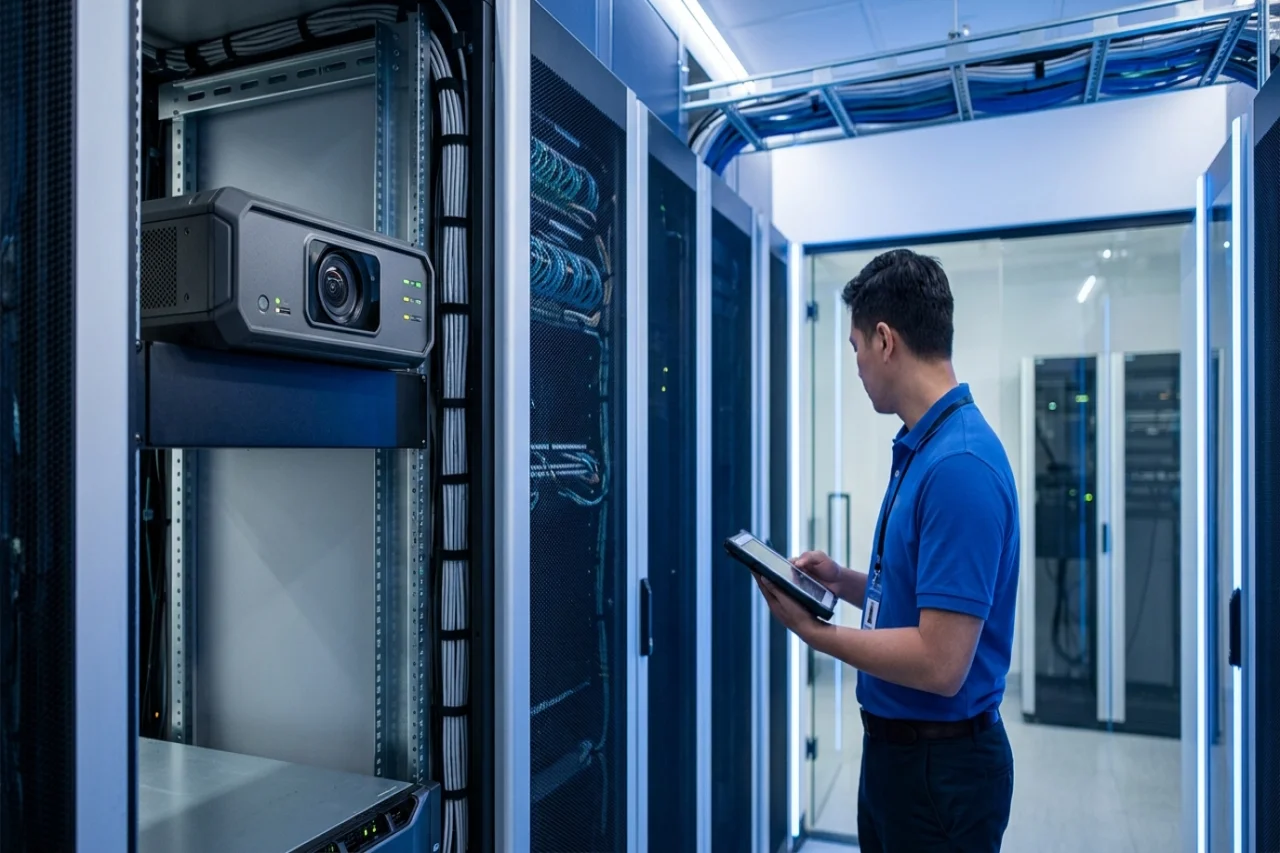
When designing data protection systems and ensuring network security, the vast majority of engineers and cybersecurity professionals focus exclusively on the digital perimeter. They implement multi-layered firewalls, intrusion prevention systems (IPS), cryptographic traffic protection, and strict zero-trust policies at the software level.
However, this paradigm often leaves a critical vulnerability unaddressed: the physical point of contact between humans and hardware. If an attacker gains direct access to a server rack or switch, all digital defenses can be bypassed in seconds through a direct connection to a network port, hardware-based traffic sniffing, or the physical removal of storage devices.
Traditional access control methods, such as RFID cards or basic fingerprint scanners, no longer meet modern security requirements. A card can be copied, its code intercepted using the simplest of readers, or “borrowed,” while first-generation biometric terminals are vulnerable to advanced spoofing techniques. Furthermore, centrally transmitting gigabytes of video streams from hundreds of security cameras to the cloud or a remote monitoring center creates unacceptable delays in network channels, clogs bandwidth, and increases the risk of data interception.
The synergy between Computer Vision and Edge AI architecture is becoming a game-changing solution in the field of data protection. Deploying neural network models directly on local computing modules (smart cameras or edge servers) within the protected perimeter enables instant biometric verification and behavioral analysis without delays or the transmission of raw data outside the local node. Today, the service IT company Data Science UA will share its vision with us.
Why Traditional Access Control Systems Compromise Data Security
Most access control systems still rely on discrete validation: a user holds a card up to a sensor—the lock opens. From that moment on, the system assumes that an authorized person is inside, completely ignoring what happens next. This approach creates several fundamental data security threats:
- This is the most common breach of physical security. An authorized engineer swipes their card to open the airlock, and a second person—an attacker without the appropriate access level—follows them unimpeded into the restricted area. A traditional access control system counts this as a single visit, and the security logs remain clean while the data is already being copied to an external storage device.
- Biometric Spoofing Attacks (Presentation Attacks). Simple facial recognition systems based on standard 2D cameras can be fooled by a high-quality photograph or video of an employee displayed on a smartphone screen. Advanced attackers use 3D masks or printed, highly detailed images, which allow them to bypass basic terminals and gain access to equipment control consoles.
- Lack of continuous verification. Access control systems only record the fact of entry. If, once inside the premises, an authorized employee leaves a terminal unlocked or hands over their tools and access to an open server rack to a third party, a traditional security system will not detect this. Control is lost at the most critical moment, the moment of direct contact with the hardware storing the data.
To ensure reliable information security, continuous, dynamic monitoring is required, not merely to verify access rights upon entry, but to conduct end-to-end biometric and behavioral audits throughout the entire time a person remains in a critical area.
Edge AI Architecture: Moving Computation to the Perimeter to Minimize Latency
The main barrier to implementing deep neural networks in security systems is the demands on network bandwidth and latency. If a high-resolution video stream from dozens of cameras is sent to a centralized cloud, the time required to transmit, process, and return a control command can range from 2 to 5 seconds. If an attacker attempts to physically disable a switch, deploy a malicious hardware module (such as a keylogger or Rubber Ducky), or remove an SSD, those few seconds can mean the difference between a thwarted threat and the compromise of the entire network.
The Edge AI concept solves this problem by offloading the inference (execution) of ML models directly to hardware modules located “on-board” cameras or local edge controllers (for example, based on a specialized NPU).
The process of continuous edge security auditing consists of three parallel technological stages:
1. 3D Biometric Analysis and Liveness Detection
Peripheral cameras use a combination of optical sensors and infrared illumination (or Time-of-Flight depth sensors) to construct a detailed 3D map of the face. Custom convolutional neural networks (CNNs) instantly run liveness detection algorithms. The model analyzes micro-expressions, skin texture, natural pupil movements, and light reflections to distinguish a real person from a photograph, a screen, or a mask. Identity recognition and verification on an edge device take less than 100 milliseconds. Global forecasts on the integration of behavioral analysis and AI to minimize the risks of successful targeted attacks are available on the Gartner Cybersecurity Insights portal.
2. Dynamic Tailgating Detection Based on Multi-Camera Tracking
As soon as the door to the server room opens, the edge computer vision model switches to object counting and space segmentation mode. The neural network constructs silhouettes of all people in the passageway. If the algorithm detects that two individuals have passed through the door, but only one ID has been validated by the access control system, the system instantly classifies this as a critical incident of physical intrusion and locks down the terminals.
3. Behavioral Analysis and Control of Responsibility Zones
Inside the server room, CV models use pose estimation algorithms to construct a real-time skeletal model of a person. The system compares the engineer’s arm and body coordinates with a 3D map of the server racks. If an employee opens a cabinet for which they do not have an individual work order, or if their movement pattern indicates an attempt to forcibly dismantle equipment, the Edge controller detects the anomaly and automatically isolates the compromised network segment at the switch level.
Technical Advantages of Edge AI for Data Protection
Moving video stream analysis to the edge offers fundamental advantages in terms of network architecture and the protection of the surveillance data itself.
First, bandwidth optimization. Traditional continuous video surveillance systems require the constant streaming and recording of terabytes of “raw” video data. This places an enormous load on network backbones. Cameras with Edge AI support process the video stream locally. Only lightweight metadata (text logs in JSON format, object coordinates, event types) and short video clips are transmitted to the central storage or SIEM system immediately upon detection of an anomaly. The network is not clogged with redundant data.
Second, attack surface reduction. When video data does not leave the edge device without a valid reason, it becomes impossible to intercept it while it is being transmitted over the network. Raw video streams showing employees’ faces and service monitor screens are not stored on third-party servers or transmitted over public communication channels, which prevents the leakage of confidential biometric information.
Third, Automated Incident Response. Since data processing occurs on-site, the edge controller can be directly connected to actuators and network switches. When unauthorized access to a workstation is detected, the system responds via hardware in a fraction of a second: it disables the ports, cuts off power to the target unit, activates the electromagnetic locks on adjacent panels, and sends an alarm signal to the SOC. The human factor is completely eliminated from the decision-making process during the first, most critical stage of the attack. — Fortinet
Seamless integration at the API layer
The main advantage of integrating modern computer vision systems at the edge is that there is no need to completely replace the network infrastructure or remove old cameras. The custom ML core is designed as an isolated API layer.
If high-resolution IP cameras that support RTSP streaming are already installed on-site, they can be used as sensors. Model inference is offloaded to compact edge computing devices (coprocessors) that are mounted directly in server racks. They intercept the stream, perform mathematical computations on neural accelerators, and send the resulting security triggers to existing monitoring systems (SIEM, Zabbix, Grafana) via standard APIs.
Conclusion
The physical perimeter of an IT infrastructure can no longer be secured using passive methods. Simply having cameras and access-card-based locks creates only an illusion of security, leaving data vulnerable to a skilled intruder.
Edge AI-based computer vision transforms video surveillance from a tool for passively recording incidents after the fact into a proactive, autonomous defense system. The ability of algorithms to make decisions in fractions of a second directly at the source of the threat makes it possible to block unauthorized actions before an attacker can compromise data integrity or gain access to network traffic. In an environment where the value of information and network uptime determine the resilience of the entire infrastructure, the transition to intelligent edge security is a fundamental technical requirement for protecting data at the physical level.
Comments
Comments are moderated to keep the discussion useful and respectful. Spam, automated submissions, and low-value promotional comments are removed. Comments with outbound links may be approved when the link is relevant to the article and genuinely helpful to readers.
No comments have been published yet.