

Artificial Intelligence, Technology, Healthcare
How Generative AI Is Transforming Telemedicine and Healthcare Applications
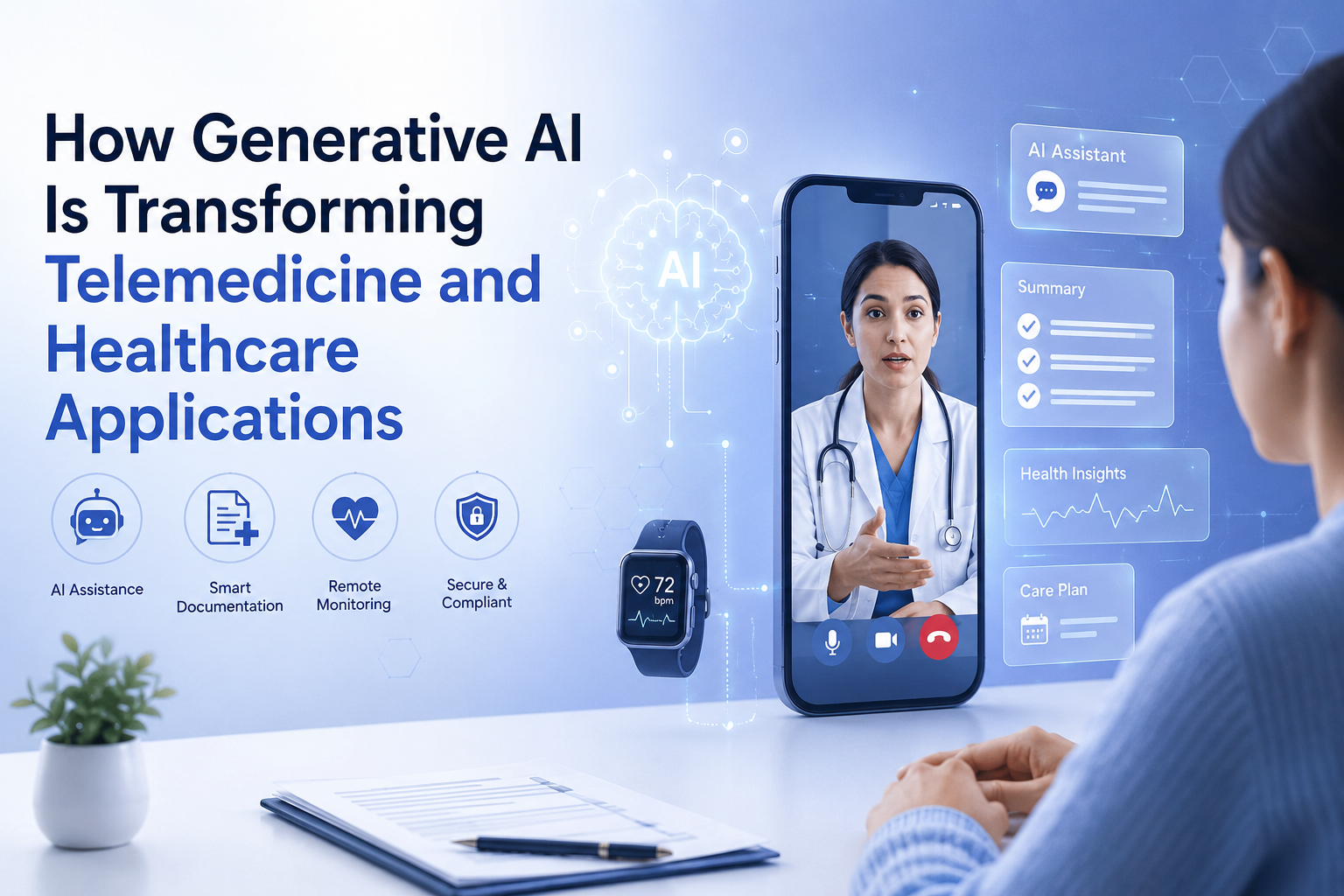
Telemedicine has changed how people access healthcare.
Instead of traveling to a clinic for every consultation, patients can now connect with doctors through video calls, receive digital prescriptions, and monitor their health remotely. What was once considered a convenient alternative has become a regular part of healthcare delivery.
As virtual care continues to expand, healthcare providers are investing in technologies that improve patient experiences and simplify clinical workflows. Alongside artificial intelligence, many organizations are also exploring healthcare app development to build secure, scalable platforms that support virtual consultations, remote monitoring, and digital patient engagement.
Artificial intelligence is taking these platforms one step further.
Rather than simply storing patient information, generative AI can summarize conversations, assist with documentation, organize medical records, and support communication between patients and healthcare professionals.
The objective isn't to replace doctors.
It's to reduce repetitive work so healthcare professionals can spend more time caring for patients and less time completing administrative tasks.
This article explores how generative AI is transforming telemedicine, where it's creating the greatest impact, and what healthcare organizations should consider before adopting these technologies.
Why Telemedicine Needs Smarter Technology
Virtual consultations have made healthcare more accessible.
Patients living in remote areas can speak with specialists without having to travel long distances. Follow-up appointments are easier to schedule, and healthcare providers can reach more people through digital platforms.
Despite these improvements, telemedicine still comes with operational challenges.
Every consultation creates documentation that must be completed accurately. Healthcare professionals also manage appointment scheduling, patient records, referrals, prescriptions, and follow-up communication.
These responsibilities often continue long after a video consultation has ended.
As patient demand grows, managing these repetitive tasks manually becomes increasingly difficult.
Generative AI helps reduce that workload by supporting everyday administrative processes while allowing healthcare professionals to remain responsible for medical decisions.
Where Generative AI Is Making the Biggest Difference
Generative AI isn't changing healthcare by replacing clinicians.
Its value comes from improving the smaller tasks that happen throughout the patient journey.
When combined, these improvements create a more efficient healthcare experience for both providers and patients.
Smarter Clinical Documentation
Documentation is one of the most time-consuming parts of any consultation.
Doctors must record symptoms, diagnoses, medications, treatment plans, and follow-up recommendations after every patient interaction.
Generative AI can prepare structured clinical notes based on the consultation.
Instead of writing every document from the beginning, clinicians can review, edit, and approve AI-generated drafts before adding them to the patient's record.
This saves time without removing professional oversight.
Faster Patient Communication
Patients often have questions after leaving a consultation.
Some want clarification about medications, while others need guidance before their next appointment.
Responding to every routine question manually can increase the workload for healthcare teams.
AI-powered assistants can provide answers to common non-emergency questions using approved healthcare information.
If a patient's concern requires medical judgment, the conversation can be transferred to a healthcare professional.
This creates a better experience without compromising patient safety.
Personalized Follow-Up Care
Recovery doesn't stop when a consultation ends.
Patients often receive instructions about medications, lifestyle changes, follow-up appointments, or rehabilitation exercises.
Generic reminders don't always meet individual needs.
Generative AI can prepare personalized follow-up messages using information from the consultation.
Patients receive recommendations that are more relevant to their condition while healthcare providers spend less time preparing routine communications.
Simplifying Medical Information
Medical terminology can be difficult for patients to understand.
A diagnosis explained during a consultation may not be easy to remember later.
Generative AI can translate complex medical language into clear, patient-friendly explanations.
Helping patients better understand their condition often improves treatment adherence and reduces unnecessary follow-up questions.
Supporting Remote Patient Monitoring
Wearable devices and connected health sensors continue to generate large amounts of patient data.
Heart rate, blood pressure, glucose readings, sleep quality, and activity levels all contribute valuable insights.
The challenge isn't collecting this information.
It's understanding what the information actually means.
Generative AI can summarize long-term trends, highlight unusual changes, and prepare concise reports for healthcare professionals.
Instead of reviewing pages of raw data, clinicians receive meaningful summaries that support informed decision-making.
Reducing Administrative Work
Administrative work consumes a significant portion of a healthcare professional's day.
Appointment scheduling, referral letters, patient messages, documentation, and record management all require attention.
Many of these activities follow predictable workflows.
Generative AI can assist with these routine processes, allowing healthcare teams to complete administrative work more efficiently.
Even saving a few minutes during every consultation can create hours of additional clinical time each week.
Improving Accessibility
Digital healthcare should be accessible to everyone.
Generative AI can improve accessibility by translating patient instructions, supporting multiple languages, and adapting communication for different reading levels.
This helps healthcare organizations serve more diverse patient populations while improving understanding and engagement.
Technology becomes more valuable when it's easier for everyone to use.
Privacy and Security Must Come First
Healthcare data is among the most sensitive information stored online.
Medical histories, prescriptions, diagnostic reports, and consultation records contain personal details that require strong protection. As AI becomes part of telemedicine platforms, safeguarding this information becomes even more important.
Healthcare organizations should ensure that AI systems operate within secure environments. Encryption, role-based access controls, secure cloud infrastructure, and regular security assessments all play an important role in protecting patient information.
Transparency also matters.
Patients should understand when AI is being used to assist with documentation or communication. Clear policies help build trust and encourage responsible adoption.
Technology can improve healthcare, but only when privacy remains a priority.
AI Still Needs Human Oversight
Generative AI can process large amounts of information quickly.
However, it doesn't understand medical situations the same way experienced healthcare professionals do.
AI may occasionally misinterpret symptoms, overlook context, or generate inaccurate responses. For that reason, its output should always be reviewed before becoming part of a patient's medical record or treatment plan.
Healthcare professionals remain responsible for diagnosis, treatment decisions, and patient safety.
Generative AI works best as a supporting tool rather than an independent decision-maker.
Combining clinical expertise with AI assistance creates a safer and more reliable healthcare experience.
Challenges Healthcare Organizations Should Prepare For
Adding AI to telemedicine isn't simply a software upgrade.
Healthcare organizations also need clear policies, quality data, and trained professionals who understand how these systems should be used.
Some of the most common challenges include:
- Protecting patient privacy and confidential health records.
- Reducing bias in AI-generated recommendations.
- Maintaining accurate and up-to-date medical information.
- Integrating AI with existing healthcare systems.
- Meeting healthcare regulations and compliance requirements.
- Training staff to use AI responsibly.
Addressing these challenges early helps organizations reduce risk while improving long-term adoption.
Best Practices for Responsible AI Adoption
Successful AI implementation requires more than choosing the right technology.
Healthcare providers should establish clear processes that support both efficiency and patient safety.
Some practical recommendations include:
- Review AI-generated content before sharing it with patients.
- Use secure infrastructure to protect healthcare data.
- Regularly update AI systems with trusted medical information.
- Monitor system performance and correct inaccurate outputs.
- Keep patients informed about how AI supports their care.
Responsible adoption creates confidence among both healthcare professionals and patients.
The Future of AI in Telemedicine
Generative AI is still evolving.
As technology improves, healthcare applications will become more capable of supporting clinicians throughout the patient journey.
Continued advances in AI in healthcare will make it easier to integrate generative AI, remote patient monitoring, secure messaging, and virtual consultations into unified digital healthcare platforms.
Future platforms may offer more natural conversations, smarter clinical documentation, better remote monitoring, and highly personalized health recommendations.
Voice-enabled virtual assistants, multilingual support, predictive health insights, and AI-powered patient education are also expected to become more common.
Even as these technologies advance, one thing is unlikely to change.
Healthcare will continue to rely on human expertise, empathy, and informed medical judgment.
AI will strengthen those capabilities rather than replace them.
Conclusion
Generative AI is helping telemedicine become more efficient, responsive, and patient-focused.
From automating documentation to improving communication and supporting remote monitoring, AI reduces routine administrative work while allowing healthcare professionals to concentrate on patient care.
Its greatest value isn't replacing clinicians.
It's helping them work more efficiently while improving the overall healthcare experience.
Organizations that adopt AI thoughtfully, invest in secure digital infrastructure, and maintain strong human oversight will be better prepared for the future of virtual healthcare.
As telemedicine continues to evolve, generative AI will play an increasingly important role in creating healthcare systems that are smarter, more connected, and easier for both patients and providers to use.
Comments
Comments are moderated to keep the discussion useful and respectful. Spam, automated submissions, and low-value promotional comments are removed. Comments with outbound links may be approved when the link is relevant to the article and genuinely helpful to readers.
No comments have been published yet.