

Network, Cloud Services, Business
How VoIP and Cloud Communications Help Businesses Manage Peak Call Demand
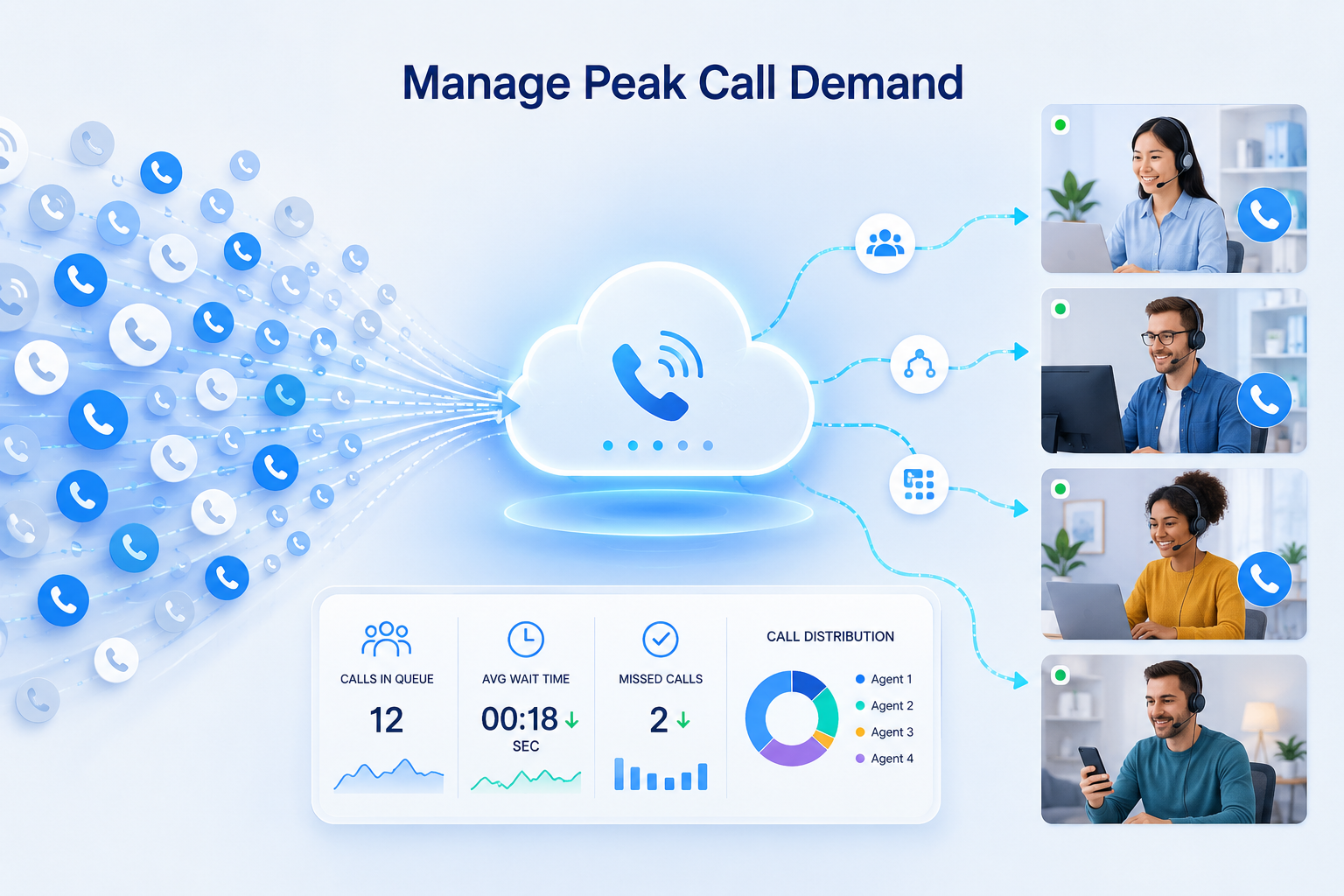
Peak call hours can overwhelm even the strongest businesses. When call volume surges, customers face longer wait times, agents become overloaded, and important inquiries risk being missed. This often happens during seasonal sales, service outages, appointment rushes, product launches, or urgent customer support periods.
A modern cloud-based business phone system eases this pressure by offering greater flexibility and control. With VoIP technology, teams can answer calls seamlessly from desktops, mobile phones, or web apps. While cloud features help route callers to the right person or department. As a result, businesses can handle sudden spikes in calls efficiently while maintaining professional, timely communication.
What is VoIP?
VoIP, or Voice over Internet Protocol, is a technology that allows people to make and receive phone calls using the internet instead of traditional telephone lines. Rather than sending your voice through a physical phone network, VoIP converts your voice into digital data and transmits it over an internet connection. Businesses use VoIP to handle calls from computers, mobile phones, and web applications without relying on separate phone infrastructure.
During a VoIP call, the system converts voice into digital packets, sends them through the internet, and converts them back into sound for the person on the other end. While the process sounds technical, it happens in seconds and is invisible to the users. As a result, conversations feel like a regular phone call, while it offers more flexibility than traditional phone systems.
Why Do Traditional Phone Systems Struggle During Call Spikes?
Traditional phone systems often work fine during normal call volume, but they struggle when many customers call at the same time. They are built around fixed infrastructure, offer less flexibility, and have weaker call control than modern cloud-based business phone systems.
- Limited Phone Lines: Traditional phone systems can handle only a fixed number of calls at a time. When all lines are busy, new callers may hear a busy signal or fail to connect.
- Harder to Scale Quickly: Adding more capacity often requires extra hardware, wiring, provider support, or new phone lines. This process is not ideal when call demand increases unexpectedly.
- Less Flexible Call Routing: Older systems may not route calls easily to available agents, backup teams, or another office. As a result, one team may become overloaded while other staff remain available.
- Limited Remote Access: Traditional systems are often tied to office desk phones. This makes it harder to involve remote employees or branch teams during busy hours.
- Poor Real-Time Visibility: Many older systems do not clearly display live call volume, queue length, missed calls, or agent availability. Without this information, managers may not notice problems until customers have already experienced long wait times.
Why is VoIP Ideal for Managing Peak Call Demand?
VoIP helps businesses manage peak call demand by organizing and distributing incoming calls more efficiently. Features such as call queues, IVR menus, intelligent routing, and call forwarding direct callers to available agents or departments based on predefined rules.
When call volume increases, VoIP systems can place callers in queues and route calls to available agents. It can forward calls to another number or send calls to different departments. This helps reduce missed calls and keeps customer communication more organized.
VoIP systems also give managers better visibility into call activity. They can see live call volume, waiting calls, missed calls, and agent availability. This helps them adjust staffing or routing before delays become a bigger problem.
Since calls move over the internet, teams are not limited to an office, a phone line setup, or a single physical location. This allows you to distribute call traffic across a wider team during periods of high demand.
Key Cloud Communication Features to Handle High Call Volume
Cloud communication systems help businesses manage high call volume by keeping calls organized and easier to control. The right features route callers, reduce wait times, support agents, and prevent missed calls during busy periods.
Intelligent Call Routing and ACD
Intelligent call routing and ACD (Automatic Call Distribution) help send each call to the right agent, team, or department. Calls can be routed based on agent availability, caller need, location, or priority.
During peak demand, this keeps calls from going to one overloaded person or team. The system spreads calls more evenly, helps agents handle the right type of request, and reduces the chance of callers waiting in the wrong place.
Call Queues and Overflow Management
Call queues and overflow management are essential features for handling high call volumes. Call queues keep callers in an organized waiting line when all agents are busy. Instead of hearing a busy signal or getting disconnected, callers stay in the system until someone becomes available.
Overflow management helps when the main queue becomes full. The system moves extra calls to backup agents, another department, branch, or an external support team. This helps businesses handle sudden spikes in calls without missing important calls.
IVR and Auto Attendants
IVR (Interactive Voice Response), auto attendants, and virtual receptionists answer calls automatically and guide callers to the right option.
Auto attendants work like virtual receptionists, while IVR greets callers and routes them to the correct department or agent using a voice menu (e.g., "Press 1 for Sales, Press 2 for Support"). This reduces call load, shortens wait times, prevents missed calls, and helps agents focus on the calls that need human support.
AI-Powered Virtual Agents and Self-Service
AI-powered virtual agents can handle simple, repetitive questions before the call reaches your team. They can answer basic queries, confirm information, book appointments, check status, or guide callers to the right next step.
When AI handles simple requests, your teams get more time for urgent or high-value calls.
Real-Time Analytics and Dashboards
Real-time dashboards show what is happening while calls are coming in. Managers can see call volume, queue length, wait time, missed calls, abandoned calls, and agent availability.
This visibility helps your teams respond quickly during a call spike. You can move agents to busy queues, change routing rules, call in backup staff, or fix bottlenecks before wait times become too long.
Business Application Integrations
Cloud communication systems can connect with CRM software, help desk, and other business tools. When a customer calls, agents can see useful details such as the customer's call history, support tickets, notes, and account information.
This helps agents solve calls faster because they do not need to search across different systems.
How Cloud Communication Supports Remote and Distributed Teams
Cloud communication allows employees to stay connected even when they work from different locations. Instead of relying on office phone systems tied to a specific building, team members can access business calls, messages, voicemail, and collaboration tools through an internet connection.
For example, a customer call can be answered by an employee working from home, transferred to a specialist in another city, and reviewed later by a manager in a different country. Everyone works within the same communication system, regardless of physical location.
For growing businesses, this also reduces the need for separate phone infrastructure in every location. Teams can stay connected through one cloud-based system while serving customers across different regions.
Conclusion
VoIP and cloud communication help businesses manage peak call demand by making calls easier to distribute, monitor, and handle across teams. Unlike traditional phone systems, cloud-based platforms can adapt more easily when call volume suddenly increases.
Features such as intelligent call routing, call queues, and IVR help keep callers organized and direct them to the right destination. This reduces pressure on agents, shortens wait times, and helps businesses maintain a better customer experience during busy periods.
Comments
Comments are moderated to keep the discussion useful and respectful. Spam, automated submissions, and low-value promotional comments are removed. Comments with outbound links may be approved when the link is relevant to the article and genuinely helpful to readers.
No comments have been published yet.