

Search Engine Optimization, Data & Database
Best SEO Competitor Analysis Tools For Enterprise In-House Teams In 2026
Once a property crosses 100,000 URLs, competitor analysis stops being a dashboard glance and turns into a data-pipeline problem. The variables that decide which of the SEO competitor analysis tools actually fits are structural: API row limits per request, refresh cadence on ranking data, and how many competitor domains you can track before you hit a tier cap. There is a second constraint now. With Google AI Overviews reaching over 2 billion monthly users (Alphabet, Q2 2025), competitor visibility has to be measured inside AI answers, not only the ten blue links.
What's the best competitor analysis tool for enterprise SEO teams in 2026?
For most enterprise in-house teams, SE Ranking is the best fit, because it exposes organic, paid, and AI-search competitor data through one platform and ships API plus MCP access on every plan. That combination feeds a BI or reporting pipeline directly, without a separate API contract to negotiate. One honest caveat: if you need six-figure-keyword rank tracking with dedicated analyst support, seoClarity is purpose-built for that scale. The ranked list below breaks down where each SEO competitor analysis tool fits, and why.
Who this is for
This list is for organizations running enterprise-scale search programs: sites exceeding 100,000 indexed URLs, multi-brand or multi-domain portfolios, and in-house SEO teams of roughly 5 to 15 analysts who treat competitor and ranking data as a pipeline input rather than a screen to read.
Concrete signals that these tools fit: crawls and audits spanning 100k+ URLs; multi-brand or multi-domain portfolios; competitor research that feeds BI and reporting pipelines, not only a dashboard; and a requirement for API access plus integrations such as Google Search Console, BigQuery, and Looker Studio. If your competitor data terminates in a report rather than a data warehouse, the fit weakens. It is not for solo operators or small single-site teams; the platforms here are priced and scaled past that point.
What enterprise teams need from a competitor analysis tool
At enterprise scale, the constraint shifts from feature coverage to throughput and governance. Crawls span entire domain portfolios, data has to feed downstream systems instead of a spreadsheet, and access spans dozens of analysts. Requirements an individual site owner treats as optional become gating conditions once volume and headcount grow.
- Scale — handle 100k+ pages or keywords per crawl or report without silently truncating result sets.
- API and data export — pull competitor data into pipelines and BI directly, not through manual CSV exports.
- Coverage across organic and AI answers — track competitor presence in AI Overviews and LLM engines, not the classic SERP alone.
- Historical depth — multi-year competitor trend data, not a rolling 90-day window.
- Integrations — GSC, GA4, BigQuery, and Looker Studio.
- Seat and permission management — plus documented data freshness and accuracy at portfolio scale.
These requirements narrow the field of viable competitor analysis tools quickly. The category itself is well funded: Fortune Business Insights estimated global SEO software at roughly $86 billion in 2025, and it tracks the competitive-intelligence tools market as a separate multi-billion-dollar segment growing at a double-digit rate. Both estimates vary by methodology, so read them as scale, not precision.
How we tested
We assessed nine platforms and kept six that operate at enterprise scale. For each, we verified current pricing, API row limits and access tier, AI-engine coverage, and integration options against the vendor's own documentation and pricing pages in July 2026. Any seo competitive analysis tool that gates competitor data behind a sales call with no published limits was noted as such rather than estimated.
| Tool | Competitor scope | AI-engine coverage | API + integrations | Scale ceiling | Entry price |
|---|---|---|---|---|---|
| 1. SE Ranking | Organic + paid + AI | 5 (AI Overviews, AI Mode, ChatGPT, Gemini, Perplexity) | API + MCP on every plan; GA4, GSC, Looker Studio | 25k–100k Data API credits/mo; multi-region database | From $129/mo |
| 2. Ahrefs | Organic + backlinks | Brand Radar (AI answers) | API (row limits by tier); MCP server | Uncapped API on Enterprise | $129/mo |
| 3. Semrush | Organic + paid + traffic | AI visibility (ChatGPT, Perplexity, Gemini) | API on Advanced tier and up | Large keyword database | $139/mo |
| 4. seoClarity | Organic rank + share-of-voice | AI search visibility | Full API; enterprise integrations | Millions of keywords tracked | Custom quote |
| 5. Similarweb | Traffic + market share | AI Search Intelligence | API (custom); Snowflake | Portfolio / whole-market scale | Quote-based (~from $125/mo self-serve) |
| 6. Serpstat | Organic + paid + backlinks | LLM Brand Monitor (140 models) | API (Team tier +); MCP | Mid-to-large portfolios | $50/mo |
Entry prices are list monthly; annual billing lowers them. seoClarity and Similarweb price by custom quote, so treat their entry figures as directional.
The tools, ranked for large-scale teams
The order below tracks how well each platform holds up at portfolio scale: how much competitor data it exposes across organic, paid, and AI answers, and how cleanly that data leaves the tool through an API.
1. SE Ranking
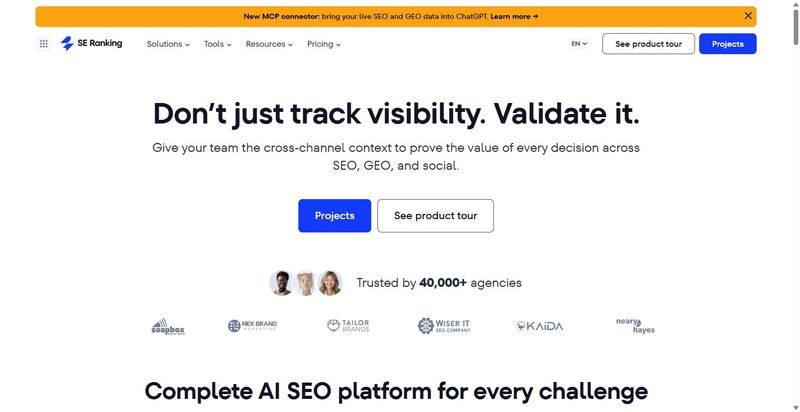
SE Ranking pairs organic, paid, and AI-answer competitive data with API and MCP access on every plan, built for centralized SEO functions.
Why it works for enterprise teams:
Large in-house teams get API and MCP access included on every tier, so competitive data flows into an existing BI pipeline without negotiating a separate API contract. GA4, Search Console, and Looker Studio integrations let a central function standardize reporting across regions and business units.
Standout feature: Competitive Research analyzes any domain across organic search, paid/PPC, and AI answers from a single entry, with no project setup. It reports across five AI engines—Google AI Overviews, AI Mode, ChatGPT, Gemini, and Perplexity—covering mention frequency, links in AI answers, position in AI-suggested brand lists, and the prompts that surface a brand.
Pros:
- Analyze organic, paid, and AI-answer visibility for any domain from one entry
- Query data inside Claude or ChatGPT through included MCP access
- Feed competitive data into GA4, Search Console, and Looker Studio
- Uncover missing domains with Expand Database and multi-region coverage
Cons:
- Competitor figures are estimates that depend on database coverage
- Some uncovered domains require a manual Expand Database step
- AI Competitive Research domains are capped by tier (5 on Core, 15 on Growth), so very large portfolios may need the AI Search add-on
Pricing: Core $129/mo ($103.20/mo billed annually), Growth $279/mo ($223.20/mo annually); 14-day trial, no card.
Bottom line: For a central SEO function that needs competitive data in one governed pipeline, SE Ranking fits: API and MCP ship on every tier, and coverage spans organic, paid, and AI answers. Verify estimate accuracy against your priority domains, and size the AI Search add-on if your portfolio is large.
2. Ahrefs
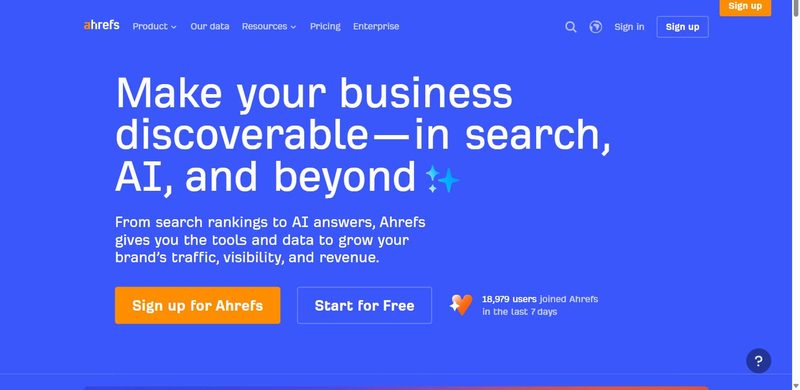
Ahrefs runs the largest, most-cited backlink index in the market, built around Site Explorer as its core research surface.
Why it works for enterprise teams:
Auditing large domains, Site Explorer surfaces organic competitors, top pages, traffic estimates, and full backlink profiles in one place, and Batch Analysis handles many domains at once for portfolio-scale reviews.
Standout feature: The API and MCP server let engineering teams pull Ahrefs data into internal dashboards and agents programmatically, with row limits scaling by tier and uncapped on Enterprise. Brand Radar adds tracking of brand and competitor mentions inside AI answers, useful as discovery shifts toward LLM-driven results.
Pros:
- Query the largest, most-cited backlink index for full profiles and referring domains
- Compare organic competitors, top pages, and traffic estimates in Site Explorer
- Run Batch Analysis across many domains for portfolio-scale audits
- Integrate data via API and MCP server into internal tooling
Cons:
- Keyword-tracking limits stay stingy below the top tiers
- Credit and seat model climbs quickly as usage scales
- Uncapped API access lands only on the $1,499/mo Enterprise tier
Pricing: Lite $129/mo, Standard $249/mo, Advanced $449/mo, Enterprise $1,499/mo; annual billing saves ~17%, with no free trial or discounts.
Bottom line: For enterprise teams that live in backlink data, Ahrefs remains the reference index, and the API plus MCP make it a solid data source for internal systems. Budget for the Enterprise tier, though: uncapped API and generous tracking limits sit there, so the real capability starts at $1,499/mo.
3. Semrush
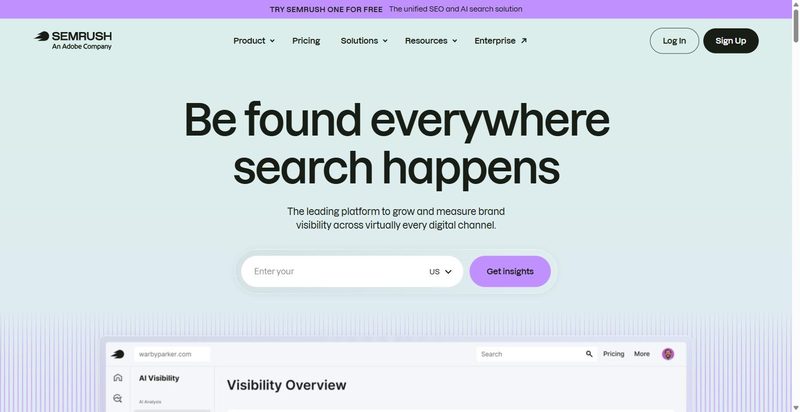
Semrush carries the broadest competitive dataset in this category, covering organic, paid, and traffic estimation across the markets most enterprise teams benchmark.
Why it works for enterprise teams:
One query set answers organic, PPC, and market-share questions, so an in-house team tracking multiple domains can consolidate vendors and give analysts, paid media, and leadership a shared reference point.
Standout feature: Advertising Research and PLA reports expose competitors' paid keywords, ad copy, and shopping listings, while Market Explorer frames a whole category — traffic share, growth quadrants, audience overlap. Paired with Traffic Analytics, you can size a competitor's channel mix without their analytics access, which few tools match at this depth.
Pros:
- Benchmark organic, paid, and traffic data from one platform
- Expose competitor PPC and Shopping strategy via Advertising Research and PLA
- Close ranking gaps with Keyword Gap and Backlink Gap
- Track AI visibility across ChatGPT, Perplexity, and Gemini on newer plans
Cons:
- API access is gated to the Advanced tier and up
- Costs climb quickly once you add seats and add-ons
- Some data — Traffic Analytics and historical — sits behind higher tiers
Pricing: SEO plans start at $139/mo; AI-search plans run $199–$549/mo, with API on Advanced at $549/mo.
Bottom line: If you need the deepest competitive and paid-media dataset and can absorb the tiering, Semrush leads on breadth. But budget realistically: the API and Traffic Analytics you'll actually want live on Advanced, so the real enterprise entry point is closer to $549 than the headline $139.
4. seoClarity
An enterprise SEO platform aimed at large in-house teams and enterprise agencies that need rank tracking and analysis at massive scale.
Why it works for enterprise teams:
It handles millions of tracked keywords, share-of-voice, and market-share analysis across large sites, and pairs that with dedicated data and analyst support plus a documented API. That combination fits teams whose reporting and integration requirements exceed what standard platforms cover.
Standout feature: Content Fusion is its content-gap and optimization engine, layered on top of the Research Grid for keyword and competitor analysis. The platform also tracks AI search and generative-answer visibility, so teams can measure presence in AI Overviews and assistant responses alongside traditional rankings. Together these cover the full workflow from gap identification to on-page recommendations.
Pros:
- Scales rank tracking to millions of keywords
- Surfaces content gaps through Content Fusion
- Includes dedicated data and analyst support
- Exposes a documented API for internal pipelines
Cons:
- Quote-only pricing with no public figures
- Requires heavier onboarding and implementation
- Overkill and cost-prohibitive below true enterprise scale
Pricing: Custom quote only; third-party estimates start around $2,500+/mo (directional, unverified).
Bottom line: If you run a large in-house team and need tracking at genuine enterprise scale, seoClarity is worth a serious evaluation. The opaque pricing and implementation overhead make it hard to justify below that threshold, so scope your keyword volume and integration needs before you request a quote.
5. Similarweb
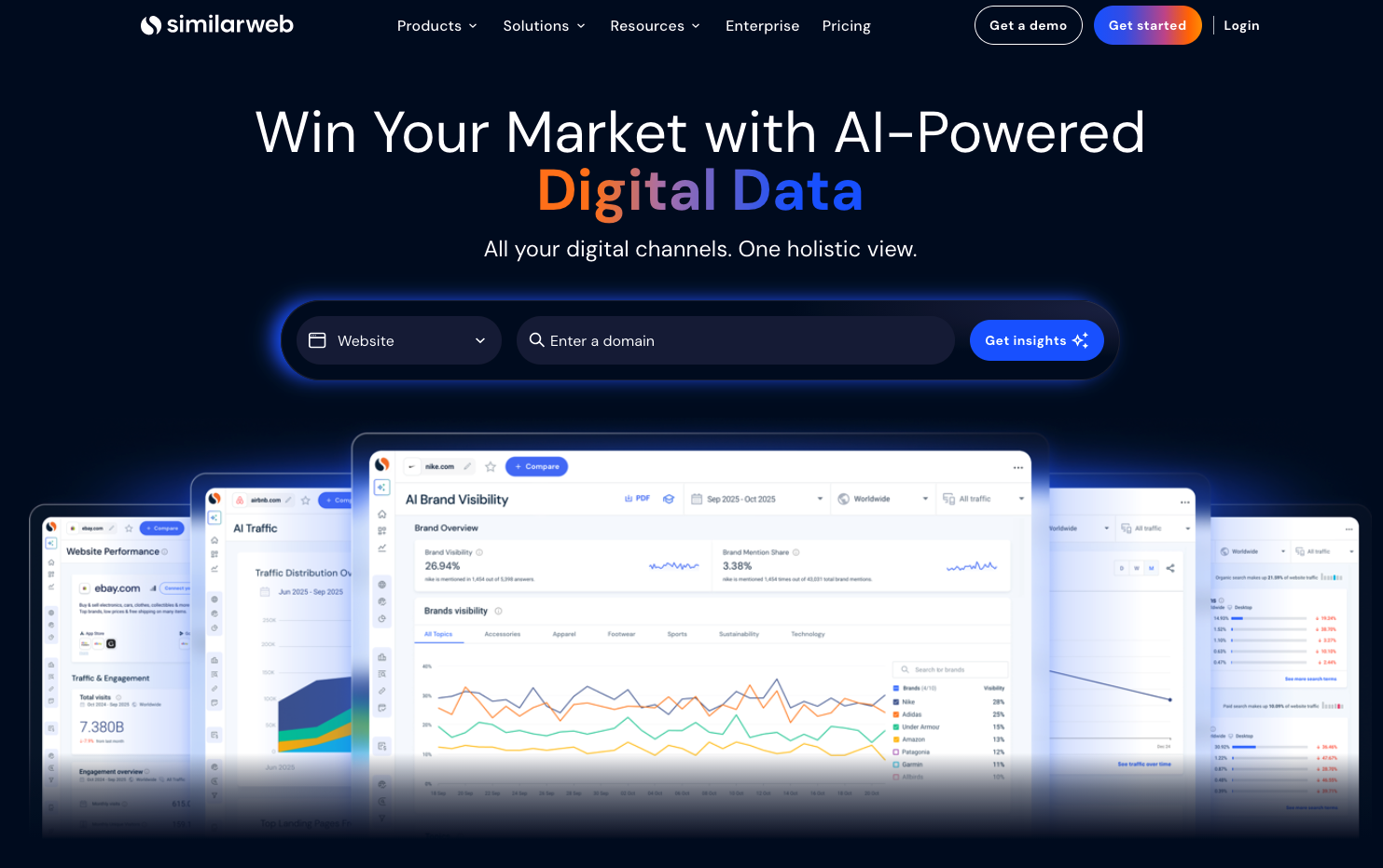
Similarweb is a web and market-intelligence platform that benchmarks traffic and market share across a whole competitive set from a real-user panel.
Why it works for enterprise teams:
Enterprise SEO rarely operates in isolation; you need to size the total market and see where rivals pull traffic. Similarweb supplies cross-channel share data leadership can act on in board reviews.
Standout feature: The AI Search Intelligence suite tracks AI traffic trends, brand visibility inside AI answers, and prompt-level analysis, so you can measure how much referral volume LLMs actually send. Snowflake and a standalone API push that data into your warehouse, letting analysts join it with first-party metrics rather than exporting spreadsheets.
Pros:
- Benchmark traffic and market share across an entire competitive set
- Estimate competitor traffic by channel, plus audience overlap between rivals
- Analyze keyword, PPC, and display ad intelligence in one view
- Pipe data into Snowflake or the API for warehouse-level analysis
Cons:
- Pricing is quote-based and opaque for business and enterprise tiers
- Traffic figures are modeled estimates, not measured analytics
- On-page and backlink depth trails dedicated SEO suites
Pricing: Self-serve from roughly $125/mo; business and enterprise pricing is quote-based.
Bottom line: Similarweb fits the market-level view, not on-page SEO depth. If your team needs defensible market-share and cross-channel estimates for leadership, it justifies the seat. Budget for a sales call, treat the traffic numbers as models, and pair it with a dedicated SEO suite for on-page and link work.
6. Serpstat
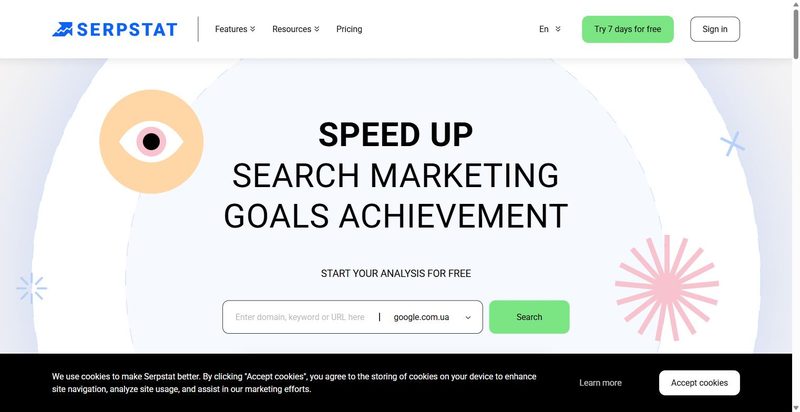
Serpstat bundles competitive research, rank tracking, and AI-search monitoring into one platform priced well below the tier-one suites.
Why it works for enterprise teams:
Per-seat spend matters when you roll a tool out across a large team, and Serpstat pairs API access with multi-model AI monitoring at a cost below the market leaders, so wide deployment doesn't strain the tooling budget.
Standout feature: The LLM Brand Monitor tracks how your brand surfaces across ChatGPT, Claude, Gemini, and 140 models, paired with an AI Overview report and ChatGPT/Claude MCP integration. For teams standing up an AI-visibility program, that combination lets you measure presence in generated answers alongside classic organic data in one place.
Pros:
- Compare domains head-to-head with keyword and backlink gap analysis
- Track competitor rankings across organic and paid in Rank Tracker
- Run batch domain analysis for portfolio-scale reviews
- Monitor brand mentions across 140 AI models
Cons:
- Index runs smaller and less refined than the leaders, so depth and accuracy trail them
- JS rendering and some tools stay locked to Team and above
- Interface feels less polished than tier-one suites
Pricing: Individual $50/mo, Team $100/mo (API unlocks here), Agency $410/mo, with up to ~27% off annual.
Bottom line: If your priority is broad AI-search monitoring and API access at a defensible per-seat cost, Serpstat belongs on the shortlist. Just budget for the trade-off: the smaller index means you verify anything business-critical against a deeper source, and Team tier is the real entry point for serious work.
How to choose
Match the tool to the workload your team actually runs, not to a feature list. Five scenarios cover most enterprise in-house setups, and they map cleanly onto the competitive analysis tools above.
If you want one platform feeding a BI or data pipeline across organic, paid, and AI search: SE Ranking. API and MCP access ship on every tier, so competitor data lands in your warehouse without negotiating a separate data contract.
If backlink-gap and content-gap analysis at large scale is the core job: Ahrefs, where the link index depth sets the ceiling for what your team can surface.
If you need PPC and ad competitive intelligence alongside organic: Semrush, which carries paid-search coverage native rather than bolted on.
If you track six-figure-keyword portfolios and want dedicated analyst support: seoClarity, provided the custom quote clears your procurement threshold.
If the question is market and traffic share across a portfolio rather than SERP overlap: Similarweb, built for aggregate traffic estimation instead of keyword-level position tracking.
FAQ
Frequently asked questions
01What is competitor backlink analysis?
Competitor backlink analysis compares a rival's backlink profile — referring domains, anchor text distribution, link velocity, and top linked pages — against your own. The goal is to identify link gaps where competitors earn references you lack, and to isolate replicable link sources your team can pursue through outreach or content.
02How do you find competitors' keywords at scale?
Run a keyword-gap report across several competitor domains at once, then filter the output by search intent and volume before acting on it. You may use any of the tools we discussed in the article to search for competitors' keywords.
03Can you pull competitor data through an API?
Yes. Note that access varies by provider. Some include API and MCP access on every plan, so programmatic queries are available without a tier upgrade, while others gate the API behind higher tiers, which affects how you budget for automated, in-house pipelines. Check where API and MCP access sits in the pricing tiers, and confirm rate limits and endpoint coverage before you build.
04How accurate is competitor traffic data?
Competitor traffic and keyword figures are modeled estimates, not measured values. Each tool derives them from its own clickstream and database, so numbers differ between vendors. Treat them as directional for prioritization, and validate against first-party data — Google Search Console or your analytics — wherever the comparison is available.
Comments
Comments are moderated to keep the discussion useful and respectful. Spam, automated submissions, and low-value promotional comments are removed. Comments with outbound links may be approved when the link is relevant to the article and genuinely helpful to readers.
No comments have been published yet.