

Privacy, Artificial Intelligence, Data & Database
The Personal Data Management Challenge Behind the Rise of Personal AI
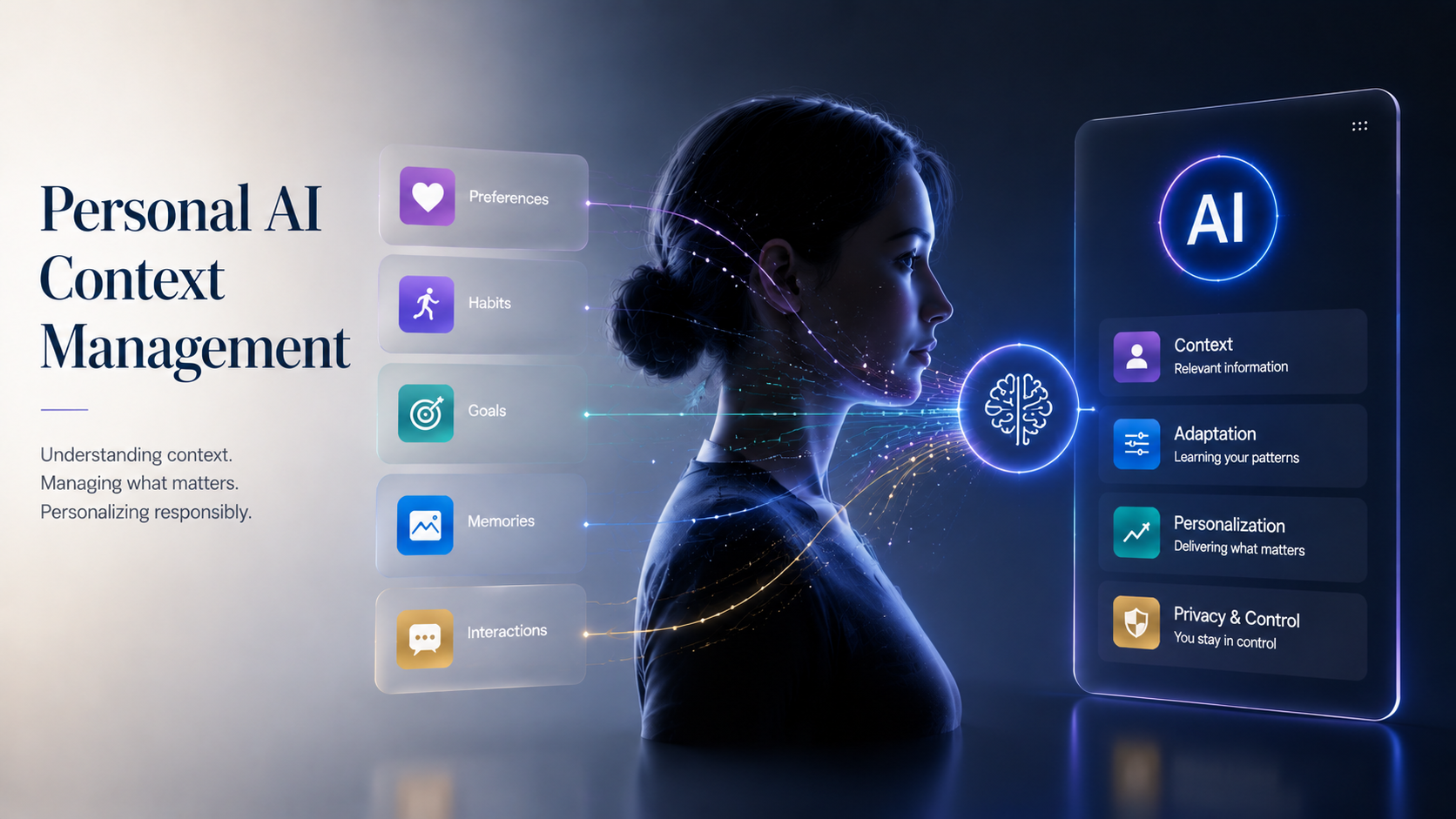
AI assistants have traditionally been built around individual interactions. A user asks a question, receives an answer, and moves on to the next task. Personal AI changes this model by creating systems that can maintain context and become more relevant through repeated use.
However, building a useful personal AI system is not simply about collecting more information. More data does not automatically create better personalization. The real challenge is understanding which parts of a user’s context are useful for future interactions and how different types of information should be handled over time.
Personal AI Needs to Identify Useful Patterns from User Context
A more personalized AI experience depends on more than a larger model or a longer conversation history. More context does not automatically create better personalization. AI systems need to identify which patterns from previous interactions are useful for future responses.
For example, an AI learning assistant may become more effective when it recognizes that a user prefers shorter explanations, struggles with certain concepts, or responds better to a specific learning approach. These patterns can help the system provide more relevant assistance without treating every previous interaction as equally important.
This creates a different challenge from traditional AI development. The goal is not to create a complete record of a person, but to help AI systems recognize meaningful patterns and apply them appropriately.
One challenge in developing personal AI products is enabling shared AI models to adapt to individual users without requiring a separate model for each person. Researchers have explored several approaches to this problem, including parameter-efficient fine-tuning (PEFT), which allows a shared foundation model to provide general capabilities while smaller adaptive components capture user-specific patterns. For example, Mind Lab, the research initiative behind the personal AI agent Macaron, explores this approach as part of its work on personalized AI systems.

These adaptive components can represent preferences, skills, tool habits, or memory-like updates. Instead of rebuilding an entire model for each person, this approach allows AI systems to develop more specialized capabilities while maintaining a shared foundation.
Personal AI Needs to Distinguish and Manage Different Types of Information
Once an AI system can identify useful user patterns, another challenge appears: different types of information should not be managed in the same way.
Not all information serves the same purpose. A calendar event, a personal document, a temporary request, and a long-term preference may all appear during AI interactions, but they should not necessarily be stored, updated, or accessed through the same approach.
For example, a dietary preference may influence future recommendations, while a restaurant search for a specific evening may only matter during one interaction. A personal document may contain useful facts, but retrieving information from that document when needed may be more appropriate than making it part of a permanent user profile.
This distinction is important because personalization does not mean allowing AI systems to absorb unlimited information. Effective personal AI requires clear boundaries between temporary context, reusable preferences, and external information sources.
These boundaries also improve user control. When people understand which information influences AI behavior, they can make better decisions about what to retain, change, or remove.
A useful personal AI system is not one that remembers everything. It is one that can identify what matters, appropriately manage different types of information, and adapt while remaining understandable.
Personal AI Systems Need Infrastructure for Continuous Management
Identifying useful patterns and managing information boundaries are only part of the challenge. Once personal AI systems operate at larger scales, development teams also need ways to manage how adaptive capabilities are created, evaluated, updated, and deployed.
The difficulty becomes more obvious when thousands or millions of personalized AI instances exist at the same time. A system needs to track which version is active, how an adaptation has changed, whether an update improves performance, and whether the latest version should be deployed.
This is different from simply storing user data. It involves managing the lifecycle of adaptive AI capabilities.
For example, an AI learning assistant may develop an adaptation based on a user’s learning patterns. Over time, the system needs to evaluate whether those changes improve recommendations, track how the adaptation has evolved, and ensure that updates do not reduce reliability.
Supporting adaptive AI systems often requires infrastructure capable of managing reinforcement learning, model evaluation, and continuous optimization throughout the development lifecycle. Several research initiatives are exploring this area. For example, MinT AI infrastructure, developed within the Mind Lab research environment, is designed to support training, evaluation, and optimization workflows for adaptive AI systems rather than treating AI development as a one-time release.
As personal AI becomes more complex, infrastructure needs to support more than computation. It needs to make model changes traceable, evaluation processes consistent, and deployment decisions manageable.
Although users do not interact with these workflows directly, this infrastructure affects whether Personal AI systems can improve over time while maintaining reliable behavior.
Building Trust in Adaptive AI Systems
The rise of personal AI does not mean users will automatically accept systems that know more about them. As AI becomes more integrated into daily life, trust will depend on whether people understand how personalization works and what information influences their experience.
A system that remembers useful preferences can create a better experience, but unclear personalization can make AI behavior difficult to predict. Users need to understand what shapes an AI’s responses and how those factors can be adjusted when their needs change.
The next stage of personal AI will not only depend on stronger models, but on whether these systems can adapt to individuals while remaining understandable and controllable.
Conclusion
Personal AI represents a shift from systems that respond to individual prompts toward systems that can adapt to users over time. Achieving this requires more than expanding model size or storing additional information. It depends on identifying meaningful patterns, appropriately managing different types of user context, and supporting continuous evaluation as AI systems evolve.
As research into personalized AI continues, areas such as adaptive learning, parameter-efficient fine-tuning, memory management, and model lifecycle infrastructure are expected to play an increasingly important role. The long-term success of personal AI will depend not only on how effectively these systems personalize experiences, but also on whether they remain transparent, reliable, and under the user's control.
Comments
Comments are moderated to keep the discussion useful and respectful. Spam, automated submissions, and low-value promotional comments are removed. Comments with outbound links may be approved when the link is relevant to the article and genuinely helpful to readers.
No comments have been published yet.