

IP Address, Geolocation, Travel
The Real Cost of Travel Data: How eSIM Price-per-GB Varies by Country
For most travelers, mobile data abroad is bought on impulse — a roaming pass at the airport, or the first eSIM that shows up in a search. Yet the price of a single gigabyte of travel data varies enormously depending on where you are going and which provider you pick. Understanding that variation is the difference between overpaying and traveling smart.
Why price-per-gigabyte is the metric that matters
Sticker prices are misleading. A "$4.99 plan" tells you nothing until you know how many gigabytes it includes and for how long. The only honest way to compare travel connectivity is price per gigabyte — the normalized cost of the data itself. Once you look at it that way, clear patterns appear: competitive, high-density mobile markets tend to have very low price-per-GB, while remote destinations and small island territories sit far higher, because the underlying wholesale cost of data there is simply greater.
Just how wide is the gap?
According to the Simsima eSIM Price Index, which tracks the median price per gigabyte across 17 leading travel-eSIM providers in 213 countries and updates daily, the global median is roughly $3.50 per GB in mid-2026.
But the spread is dramatic. A gigabyte costs around $1.20 in Thailand and under $1.50 across much of Central and Eastern Europe (Bulgaria, Poland, Austria), while in remote island territories it can climb into the hundreds of dollars. No single brand wins everywhere, either: the cheapest provider changes from one country to the next.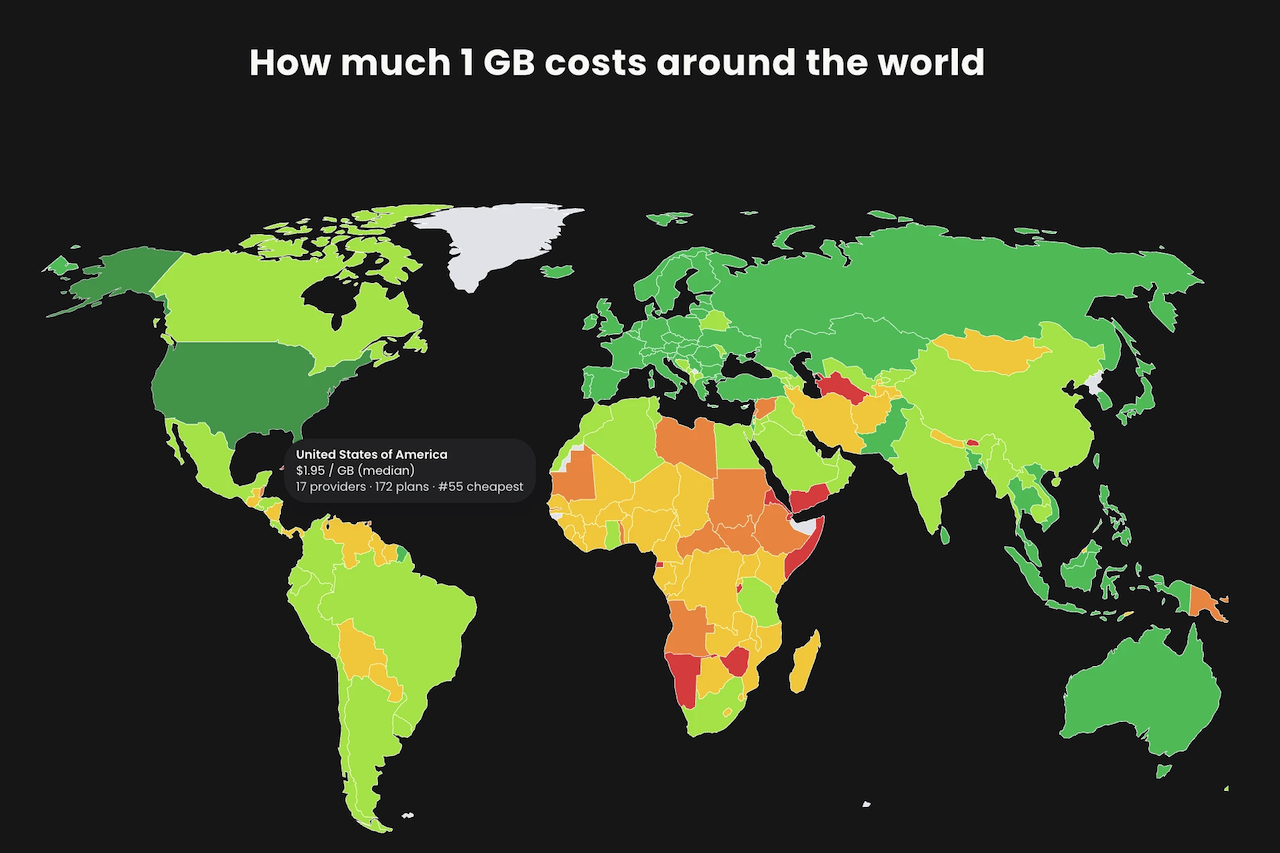
What drives the differences
Several factors shape the price of a travel eSIM in a given country: local wholesale data costs and the number of mobile operators competing; whether a plan is local (single-country), regional, or global; and how aggressively each brand prices in particular regions. That is why comparing the same brand across destinations, or the same destination across brands, produces such different numbers.
Reading the market with open data
What makes an index useful is its neutrality. It uses the median rather than the average, so a few very expensive outliers do not distort the picture, and it is published as open data under a permissive license. For anyone researching connectivity or writing about it, it is a reference point for what data actually costs, country by country, instead of relying on a single vendor's marketing.
The IP and geolocation angle
There is a second reason this matters. When you activate a local or regional eSIM, your device connects through a local carrier, and your public IP address and apparent geolocation shift to the country you are visiting. Apps, streaming catalogs, and fraud checks all respond to that change. Travelers who care about how their connection is seen online should weigh eSIM choice as carefully as VPN choice.
Practical takeaways
- Compare on price-per-GB, not sticker price.
- For multi-country trips, a regional or multi-country plan usually beats stacking several local eSIMs.
- Right-size your data: maps, messaging, and light browsing need far less than streaming video.
- Check a neutral reference before buying, so you know whether a plan is fair for that destination.
Travel data will never be free, but with the right metric and a neutral benchmark, it no longer has to be a guessing game.
Comments
Comments are moderated to keep the discussion useful and respectful. Spam, automated submissions, and low-value promotional comments are removed. Comments with outbound links may be approved when the link is relevant to the article and genuinely helpful to readers.
No comments have been published yet.