

The Technology Behind AI Agent Monitoring and Observability
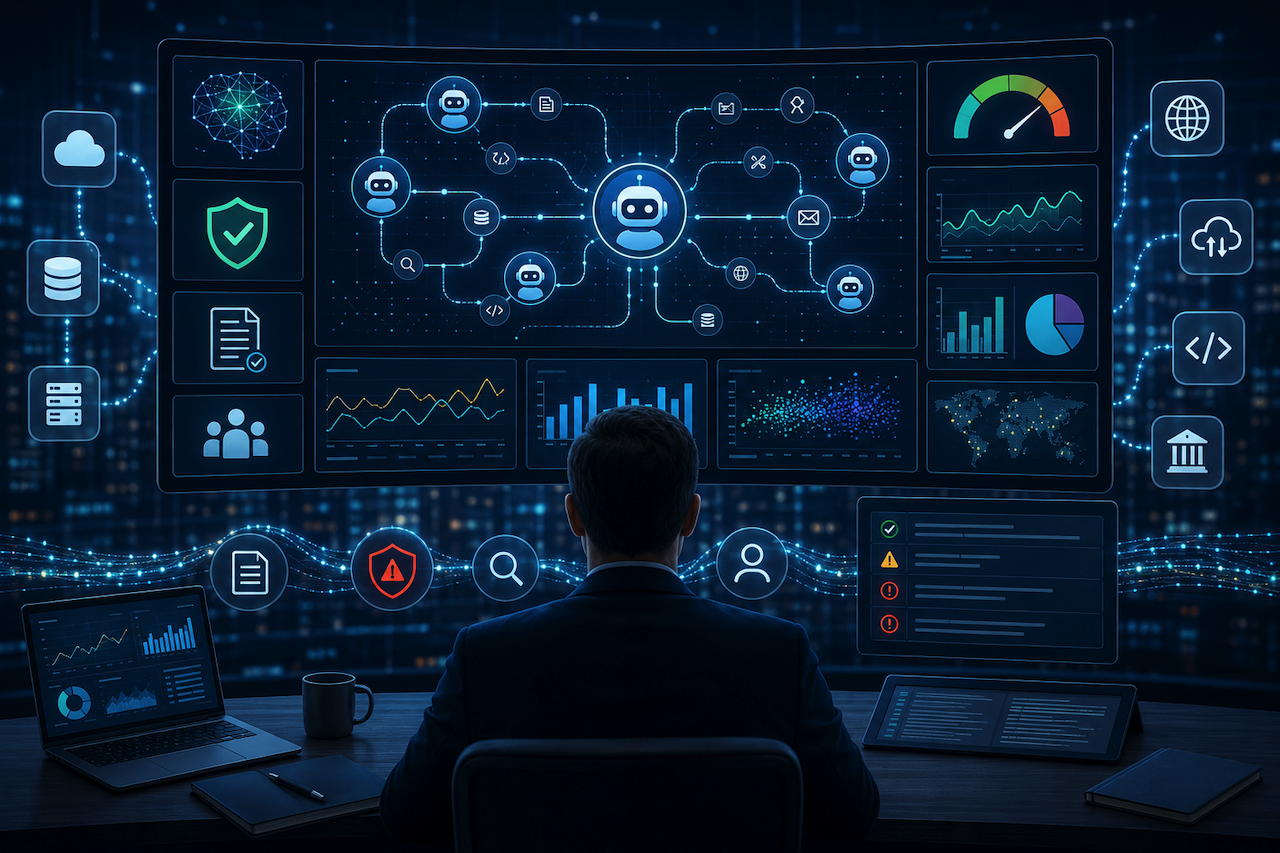
AI agents are being used by businesses around the world to streamline processes, make faster decisions, and cut down on expenses. However, one thing that few leaders ask before go-live is: "How do you know your AI agents are doing what they're supposed to be doing?"
AI agents are truly "black boxes" without robust monitoring and observability. They perform a task, make a decision, and engage with customers, without providing your teams the visibility they need to catch errors, detect drift, or ensure compliance.
The new frontier in enterprise AI governance is AI agent monitoring and observability. In this article, we'll explore the technology behind it, why it matters, and what organizations should expect when deploying AI agents in production environments.
What Is AI Agent Monitoring?
AI agent monitoring is the ability to track an AI agent's actions, decisions, inputs, and outputs in real time. AI agent monitoring is more in-depth than the standard software monitoring that covers uptime and response times; it looks at:
- The information the agent is ingesting.
- What decisions it is making and why.
- Whether its outputs are accurate, safe, and aligned with business intent.
- How its performance changes over time.
If AI agents are integrated into essential business workflows, such as loan underwriting, customer support, and supply chain management, any incorrect decision by the agent can have a ripple effect throughout the organization. Monitoring helps prevent this from happening.
What Is AI Observability?
Observability is a broader concept than monitoring. While monitoring tells you when something goes wrong, observability gives you the context to understand why it went wrong.
In the context of AI agents, observability encompasses three core data streams:
1. Traces
A trace captures the full sequence of steps an AI agent takes to complete a task, from input received to tool calls made to the final output generated. Traces let teams reconstruct exactly what happened inside an agent's decision loop.
2. Logs
Logs record specific events, errors, and state changes during agent operation. In agentic systems, logs might capture when an agent retrieved external data, called an API, or handed off a task to another agent.
3. Metrics
Metrics are quantitative performance indicators such as response latency, task completion rate, hallucination frequency, token consumption, confidence scores, and more. Metrics allow teams to spot performance degradation before it impacts business outcomes.
Together, traces, logs, and metrics provide enterprise leaders and technical teams with a complete picture of how AI agents behave in production.
Why AI Agent Observability Is Harder Than Traditional Software Monitoring
It's easy to monitor a classic software application: requests, responses, errors, and uptime. There are several reasons why AI agents are more complex:
- Non-determinism: AI agents are not deterministic like rule-based software, and may return different results for the same input. This is more complex than usual anomaly detection.
- Multi-step reasoning: Modern AI agents aren't just answering; they are reasoning through tasks in multiple steps, invoking external tools, and even spawning sub-agents. Every step is a possibility of failure.
- Data drift: A decline in AI performance caused by changes in the data being analyzed, the prompts being used, or the external tools and services connected to the system.
- Hallucination risk: Large language model (LLM)-based agents can produce plausible but incorrect outputs. Specialized assessment tools are needed to detect and measure hallucinations.
This complexity creates challenges for C-suite leaders because generic IT monitoring tools have limitations. Purpose-built infrastructure is needed for AI agent observability.
Key Technologies in AI Agent Monitoring
Large Language Model (LLM) Evaluation Frameworks
Tools like LangSmith, Weights & Biases, and Arize AI are purpose-built to track the performance of LLM-based agents. They capture prompt-response pairs, flag anomalies, and enable A/B testing of agent configurations, giving teams data-driven insights into agent quality over time.
Distributed Tracing with OpenTelemetry
OpenTelemetry is rapidly becoming the open standard for AI observability. It allows teams to instrument AI agents with tracing capabilities that flow across multi-agent pipelines, tracking how a task moves from one agent to another, which tools are called, and where latency or errors originate.
Guardrails and Output Validation
Frameworks like Guardrails AI and NeMo Guardrails add a validation layer on top of AI agent outputs. They check responses against predefined rules, blocking harmful, off-topic, or non-compliant outputs before they reach end users or downstream systems.
Human-in-the-Loop (HITL) Checkpoints
For high-stakes decisions such as credit approvals, medical recommendations, or legal document review, enterprise teams embed HITL checkpoints into agent workflows. These pause the agent and route the decision to a human reviewer before proceeding, ensuring accountability without sacrificing automation efficiency.
Drift Detection
AI agents trained on historical data can degrade as real-world conditions change, a phenomenon known as model drift. Drift detection tools continuously compare live agent outputs against baseline benchmarks, alerting teams when performance falls outside acceptable thresholds.
What Business Leaders Should Demand from AI Agent Observability
For executives and operations leaders, the technology details matter less than the business outcomes they enable. Here's what effective AI agent observability should deliver for your organization:
- Compliance confidence: In regulated industries such as finance, healthcare, and insurance, you need an auditable record of every AI decision. Observability provides that trail.
- Risk reduction: Real-time monitoring catches agent misbehavior before it reaches customers or regulators, protecting your brand and your bottom line.
- Continuous improvement: Observability data feeds directly into model retraining and prompt optimization cycles, ensuring your AI agents get smarter over time.
- Cost control: Tracking token consumption, API call volume, and task completion rates allows finance teams to optimize AI operating costs at scale.
- Stakeholder trust: When boards, regulators, or customers ask, "How does your AI make decisions?" observability provides the transparency needed to answer that question.
Building an Observability-First AI Culture
Technology alone isn't enough. The best organizations use AI agent observability from the outset of the project and make it part of their culture and governance structures.

This means:
- The first step to "good agent behavior" is to define it in advance of deployment, rather than as it occurs after deployment.
- Creating dedicated roles for AI monitoring (AI Ops, ML Engineering, or a Center of Excellence).
- Setting up escalation procedures when agent behavior falls outside expected parameters.
- Checking observability dashboards during reported executive cycles.
The Road Ahead: Autonomous Agents Need Oversight in Their Own Right
With the advent of autonomous AI agents that can initiate tasks lasting days, coordinate workflows across enterprise systems, and make critical decisions, keeping a close eye on and understanding AI systems has become even more imperative.
Gartner analysts forecast that by 2027, half of all companies that roll out agentic AI will experience at least one major incident due to poor AI oversight. The organizations that invest in observability infrastructure now will be best positioned to scale AI safely and sustainably.
The question every business leader should ask is: "How do we monitor our AI agents?" The real question is whether organizations can afford not to.
Conclusion
AI agent monitoring and observability are no longer optional; they are essential components of a successful agentic AI strategy. Your teams gain visibility into the decisions, actions, and performance of AI agents. The organizations that embrace this technology will do so with confidence, trust, and a drive for continuous performance improvement.
Featured Image generated by ChatGPT.
Related Articles
October 3, 2025
Artificial Intelligence: The Driving Force Behind the Future of Technology
Artificial intelligence is now a reality, not an idea of tomorrow. It is transforming industries today, redefining how we work, communicate, and innovate. From healthcare and f...
Read More
October 1, 2025
AI-Powered Virtual Agent Assist: Smarter Support for Businesses
The way people expect to deal with businesses has undergone a total transformation. Customers now demand instant gratification, personalized service, and the same level of consiste...
Read More
May 15, 2025
Using AI Media Monitoring to Forecast Market Trends
With a faster-paced world in which information spreads like wildfire, businesses need an edge to ensure that they keep at the forefront of any incident. AI media monitoring in dete...
Read More
Comments
Comments are moderated to keep the discussion useful and respectful. Spam, automated submissions, and low-value promotional comments are removed. Comments with outbound links may be approved when the link is relevant to the article and genuinely helpful to readers.
No comments have been published yet.