

Tracking Is Not Managing: Top 5 Defect Workflows for Modern Automation Teams

When engineering teams scale continuous integration and continuous delivery (CI/CD) pipelines, traditional issue trackers often stop functioning effectively as coordination tools and become passive data repositories. Finding a bug is simple — managing its lifecycle across automated tests, distributed environments, and multiple teams is where most operational friction appears.
In modern QA automation, the core challenge is shifting from basic defect tracking to defect-workflow orchestration: how issues move from programmatic detection through resolution and validation to automated regression verification. The main distinction between modern and legacy tools lies not only in feature sets but also in how well they integrate with CI/CD pipelines and automated test execution systems to maintain a predictable bug life cycle.
This analysis is based on observed patterns in CI/CD-driven QA environments and modern automation stacks used in distributed engineering teams. Below is an analytical breakdown of five widely used environments for managing software bug workflows in automated testing ecosystems.
1. Testomat.io — Automation-Centric Test Management Layer
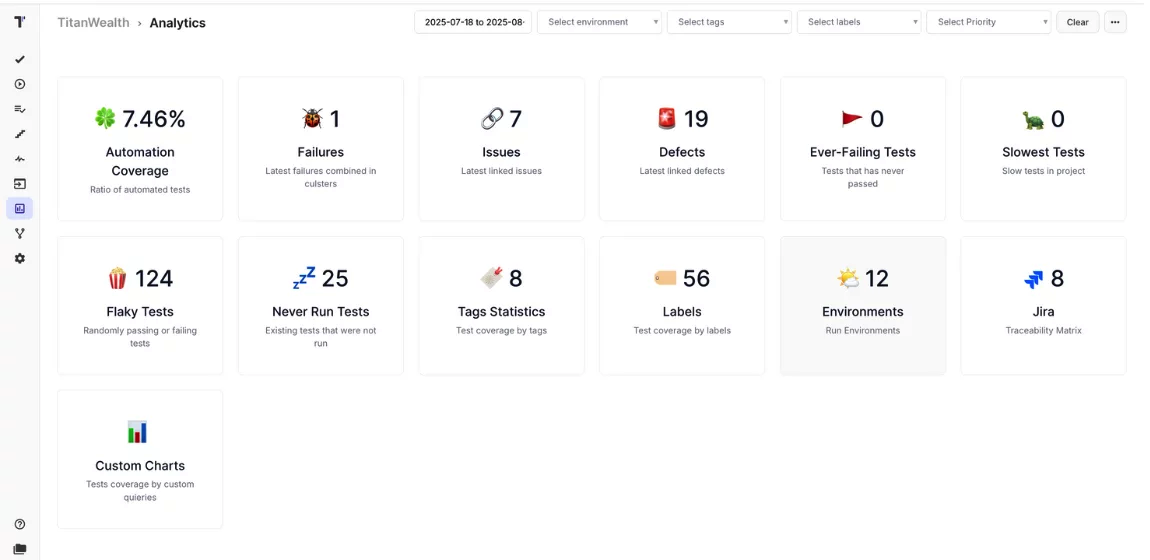
Most traditional platforms separate issue tracking from real-time test execution. Modern QA architectures introduce a unified approach: a test management layer directly integrated with automation frameworks such as Playwright, Cypress, and Selenium.
Instead of requiring manual intervention to move a defect life cycle forward, the system centralizes test execution results and failure context at the point of failure:
- Automated Failure Enrichment: Logs, console output, stack traces, and network payloads are automatically attached to the related issue.
- Programmatic Deduplication: Recurring failures are grouped based on stack trace signatures, reducing duplicate tickets in the backlog.
- Closed-Loop Automation: Regression suites are triggered after fixes, and ticket status can be updated based on test results.
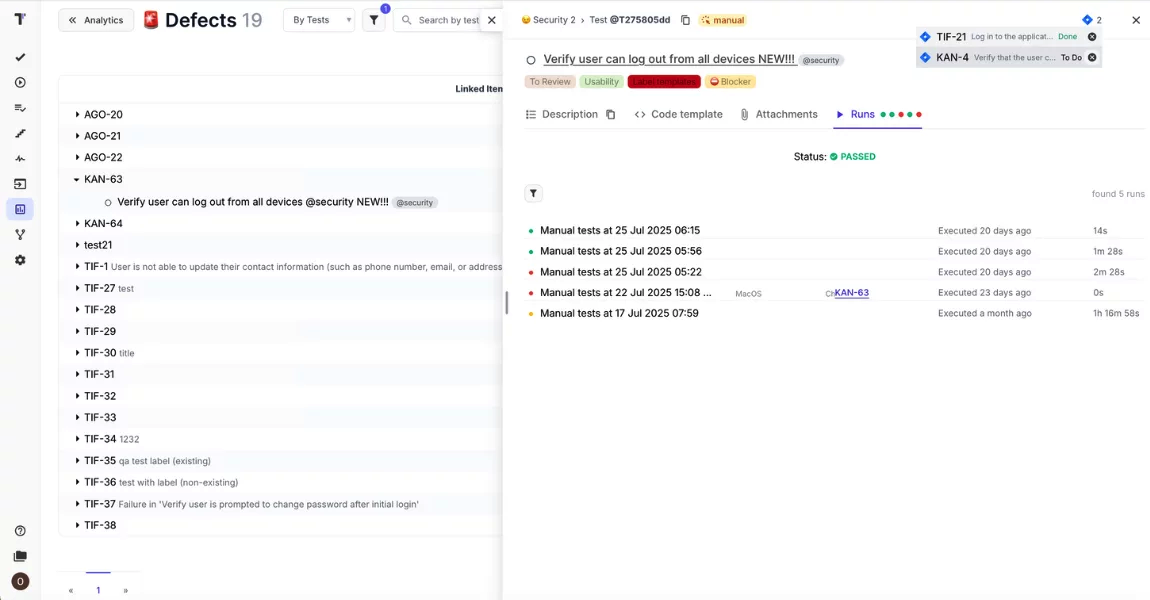
Analytical Verdict: This model reduces manual QA overhead and strengthens traceability between source code changes and test outcomes, especially in continuous deployment environments. This is why teams scaling their pipelines utilize automation-first workspaces to orchestrate their quality gates without administrative friction.
2. Jira (Atlassian) — Flexible but General-Purpose Workflow Engine
Jira is widely used as a general-purpose issue-tracking and project-management system due to its workflow flexibility and enterprise readiness.
Key strengths include:
- Highly configurable workflows and state transitions.
- Strong Agile support (Scrum and Kanban boards).
- Large ecosystem of integrations and plugins.
However, Jira was not originally designed for automated test execution workflows. Managing automated test telemetry in Jira often requires additional plugins or custom API integrations, increasing configuration and maintenance overhead.
Analytical Verdict: This makes Jira highly effective for planning and coordination, but less efficient in automation-heavy QA environments without additional tooling.
3. Linear — Streamlined Issue Tracking for Product Teams
Linear focuses on speed, simplicity, and developer experience.
It is well-suited for:
- Fast-moving product engineering teams.
- GitHub/GitLab-based workflows.
- Lightweight issue tracking and sprint management.
However, Linear does not natively support QA-specific structures such as automated defect clustering, test execution reporting, or cross-suite coverage mapping.
Analytical Verdict: As a result, teams running complex automation pipelines typically require a separate QA or test management layer to complement Linear's developer-centric tracking.
4. Azure DevOps — Enterprise CI/CD Integration Suite
Azure DevOps provides an integrated ecosystem covering repositories, pipelines, releases, and basic test management.
Its key advantages include:
- Tight integration with Microsoft cloud infrastructure.
- Built-in CI/CD pipelines and release orchestration.
- Strong enterprise security and compliance controls.
The main limitation is complexity. When integrating modern open-source automation frameworks, test reporting and analytics often require significant configuration effort.
Analytical Verdict: As a result, Azure DevOps works best in standardized enterprise environments but can feel rigid in rapidly evolving QA stacks.
5. GitHub Issues — Lightweight Tracking Inside Code Ecosystems
GitHub Issues is tightly integrated with source control and widely used in developer-centric workflows.
Key advantages:
- Direct connection to code repositories.
- Minimal context switching between code and issues.
- Native automation via GitHub Actions.
However, it lacks deeper QA capabilities, such as test-execution analytics, defect-density tracking, or structured test-coverage mapping.
Analytical Verdict: This makes it suitable for smaller teams or open-source projects, but limited for large-scale QA orchestration and advanced testing workflows.
Comparative View: Defect Workflow Capabilities
| Capability / Metric | Testomat.io | Jira | Linear | Azure DevOps | GitHub Issues |
|---|---|---|---|---|---|
| CI/CD Failure Enrichment | Native | Plugin-based | No | Partial | No |
| Test Framework Integration | Native | No | No | Partial | No |
| Stack Trace Deduplication | Yes | No | No | No | No |
| Workflow Flexibility | Medium | High | Medium | High | Low |
| Automation Setup Time | Low (< 5 min) | High | N/A | High | N/A |
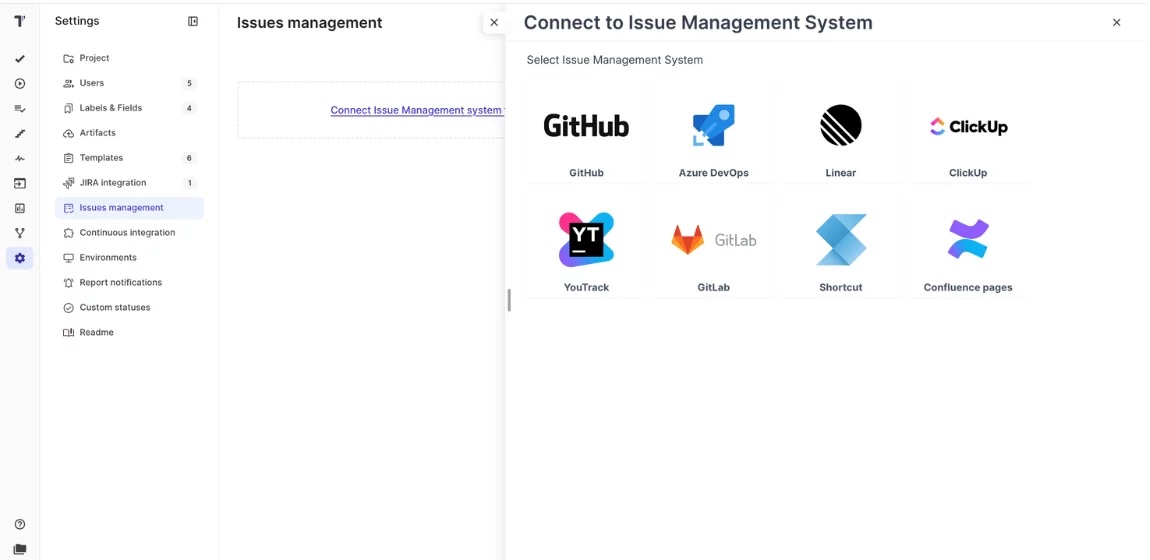
Consolidating Testing and Tracking Workflows
The architectural shift in modern engineering teams is not about replacing existing issue trackers, but about removing the separation between testing systems and tracking platforms.
When test execution, defect reporting, and regression validation operate in isolation, teams typically face predictable inefficiencies:
- Manual ticket creation and status updates.
- Duplicate bug reports from identical pipeline failures.
- Delayed CI/CD feedback loops slow down deployment cycles.
Modern QA teams increasingly move toward unified, automation-driven workflows in which test execution data is directly connected to the comprehensive bug life cycle within software test tools. This approach improves feedback speed, reduces operational noise, and increases confidence in release stability without forcing teams to change their core development tools.
Conclusion
Modern defect management is evolving from static tracking systems into integrated workflow orchestration layers. Tools that connect CI/CD telemetry with issue tracking systems provide faster feedback cycles and better visibility across the software delivery pipeline.
The future of QA infrastructure is not about improving tracking tools individually, but about eliminating the boundary between testing frameworks and project management systems.
Featured Image generated by ChatGPT.
Related Articles

December 2, 2025
Top 9 Software Testing Trends Seen in Headless eCommerce Platforms
Headless eCommerce continues to grow as one of the most flexible and innovative architectures for modern online stores. Unlike traditional monolithic systems, headless platform...
Read More
November 8, 2024
How to Optimize Testing Processes: Approaches and Tools
As software development accelerates, fine-tuning testing workflows has taken on a pivotal role, becoming key to achieving high-quality standards, operational efficiency, and the ti...
Read More
September 28, 2024
The Differences Between Low-Code and No-Code Test Automation Tools
Test automation has become an indispensable tool in fast-paced software development. It boosts efficiency, reduces errors, and speeds up the delivery of new software products. Amon...
Read More
Comments
Comments are moderated to keep the discussion useful and respectful. Spam, automated submissions, and low-value promotional comments are removed. Comments with outbound links may be approved when the link is relevant to the article and genuinely helpful to readers.
No comments have been published yet.