

Cybersecurity, Artificial Intelligence
What Could Go Wrong? The Risk of AI Misuse for Company Security and Data
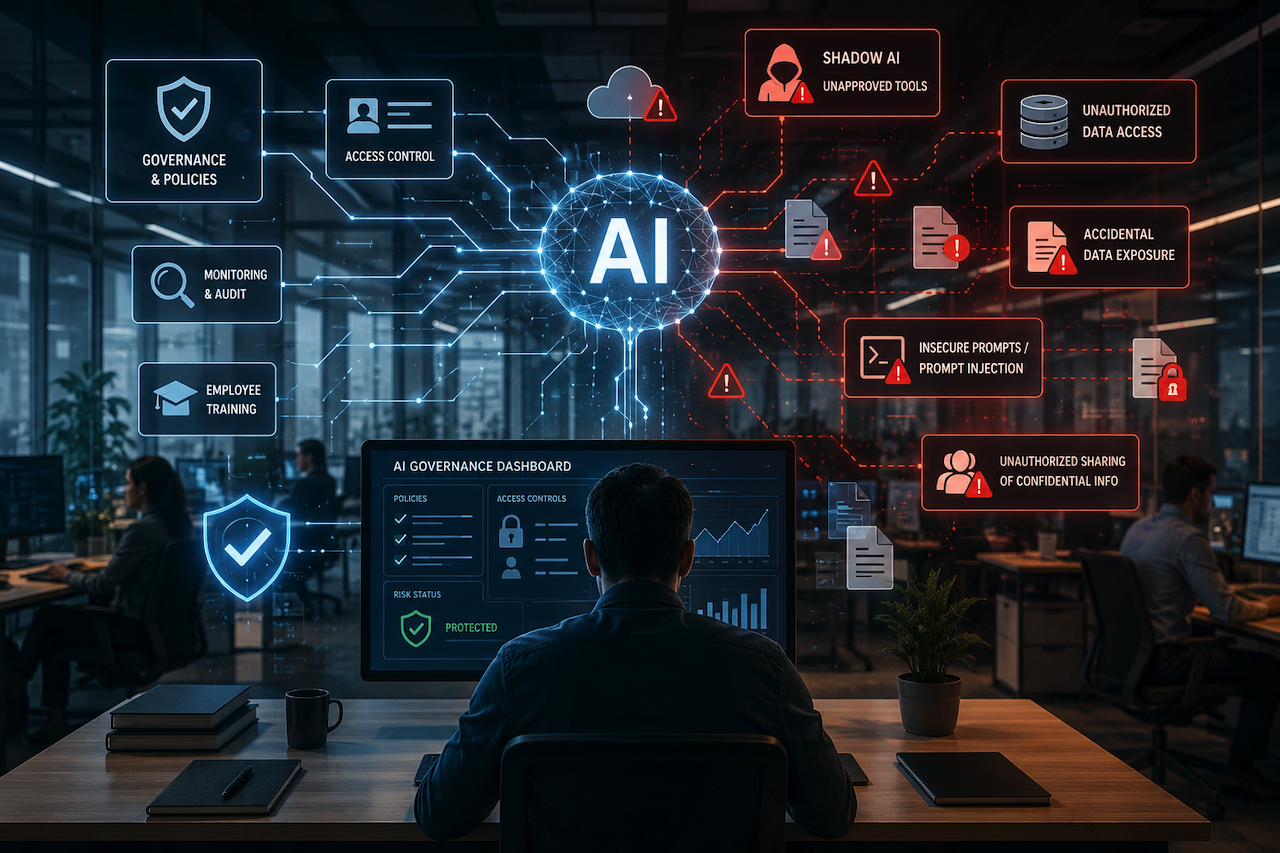
The development of and focus on adopting artificial intelligence in the workplace has had an empowering effect on employees. However, the gains are counterbalanced by misuse, especially in work environments where AI systems are introduced haphazardly.
Learn more about the risks of AI misuse to protect sensitive data and client trust while helping ensure future resilience.
The Importance of Governance in AI Adoption
The pressure to adapt and adopt drives companies to rapidly deploy new and untested AI systems. Further, doing so at scale results in environments where hastily adopted AI operates without clear policies for use and monitoring. Operational, legal, and cybersecurity concerns become inevitable byproducts.
Operational Concerns
In the operational sense, ungoverned AI is unreliable because it can’t distinguish between fact and confident-sounding hallucinations. Fragmented or poor-quality training data exacerbates this, leading to unreliable or biased outputs, disrupted workflows, and inconsistent processes.
Lack of oversight leads to taking AI outputs at face value or implementing automation with little to no human involvement. Since the ownership structure isn't clear and accountability is nonexistent, it takes longer to respond to inevitable malfunctions or damaging outputs.
Legal Concerns
Lack of governance introduces a variety of legal and compliance liabilities. If there’s nothing to ensure AI systems comply with standards like the GDPR, sensitive customer and IP data might be unintentionally exposed.
The lack of transparency in some AI’s decision-making processes is concerning from a legal standpoint, as are potential biases, false claims, and discrimination that are all too possible in unregulated AI outputs.
Cybersecurity Concerns
AI-related cybersecurity risks further complicate an already elaborate threat landscape. When governance is lacking, both employees and higher-ups are more likely to use unsanctioned AI tools. This unvetted shadow AI may leak the sensitive information it is fed, bypassing and weakening safeguards that may otherwise be in place on an enterprise level.
Many organizations still operate with legacy access control systems designed to monitor and restrict human activity. Since AI agents autonomously interface with multiple systems, it becomes difficult to ascertain what data they’re accessing or transmitting, and whether they’re doing so in accordance with legal guidelines and related internal policies.
What Specific Risks Does AI Misuse Introduce?
Governance is essential for establishing everything from AI usage and access policies to prompt guidelines and training standards. Without it, AI gets rolled out before it can be properly secured or monitored. The following risks compound and only become more pronounced as reliance on AI deepens.
Accidental Data Exposure
Accidentally feeding sensitive data to publicly available AI models was among the first widely publicized risks, and continues to be a pervasive one. Employees who don’t understand how these models store data and whether it will be used in future training risk leaking highly confidential information with no means of reversal or recovery.
A now classic example happened at Samsung. Employees were feeding ChatGPT proprietary data while trying to troubleshoot an issue. They didn’t realize that ChatGPT processes information externally, so the sensitive data included in their prompts was no longer exclusively under Samsung’s control. The company ended up banning the use of ChatGPT internally.
Unauthorized Sharing of Confidential Information
Accidental data exposure happens without harmful intent and often stems from a lack of awareness and training. On the other hand, sharing confidential information without authorization amounts to bypassing approval and disregarding policies.
For example, a paralegal might feed contracts to an external LLM and ask it to summarize them because it’s faster and more familiar, even though the company prohibits the use of third-party AI tools. Alternatively, AI agents without proper guardrails may integrate with CRMs, internal databases, and other systems and overshare information with employees or third-party partners who otherwise lack access to it.
Insecure Prompts
Even when using sanctioned tools, employees may include information in prompts that the AI isn't supposed to access. This can range from login details and API keys to confidential customer information.
Prompt injection is the malicious alternative. An attacker might ask an AI to process a document that contains harmful instructions. These may order the AI to bypass original instructions or send confidential data to unauthorized destinations.
Overreliance on Unapproved AI Tools
The aforementioned shadow AI is a serious concern because it’s difficult to identify and restrict. Employees resort to shadow AI because it’s readily available, more convenient, and less restrictive than internal alternatives.
As a result, organizations lack insight into the exact unsanctioned tools specific employees use. Additionally, they don’t know what data is being shared, or where and how it’s stored. Since outputs are also opaque and untraceable, it’s unclear whether and how they’re used in making business decisions.
That's why organizations need to place greater emphasis on vetting the AI tools employees use to complete tasks efficiently. Ruling out AI systems jeopardizes productivity, especially since demand and supply for AI are increasingly prevalent. A great practice for businesses is to employ the best AI agent builders and safeguard both the input and the output of these tools.
Conclusion
While malicious intent can play a role, it’s rarely the primary driver of AI misuse. A lack of understanding, coupled with reckless adoption and limited oversight, does far more damage. Addressing these shortcomings requires establishing clear governance and ensuring security best practices remain in lockstep with emerging AI-related threats.
Featured Image generated by ChatGPT.
Related Articles

October 21, 2025
Enhancing IT Security Operations with AI Digital Twins
Cyberattacks are becoming more intelligent and quicker each day. IT teams struggle to keep pace, often feeling like they’re patching holes in a sinking ship. If you’ve ever bee...
Read More
June 17, 2025
The Role of IP Geolocation in Protecting Against Cyber Threats: Tools and Techniques
Cybersecurity threats are changing quickly in today's hyperconnected digital world. Data breaches, financial fraud, and violations of personal security are more likely than ever be...
Read More
November 10, 2023
AI-Driven Intrusion Detection Systems for Connected Cars: Staying One Step Ahead of Hackers
As technology advances, so does the threat of cyber attacks on vehicles. But with the power of AI, you can detect and prevent hacks in real-time. These systems use machine learning...
Read More
Comments
Comments are moderated to keep the discussion useful and respectful. Spam, automated submissions, and low-value promotional comments are removed. Comments with outbound links may be approved when the link is relevant to the article and genuinely helpful to readers.
No comments have been published yet.