

How SEO Helps Businesses Grow Across Multiple Cities
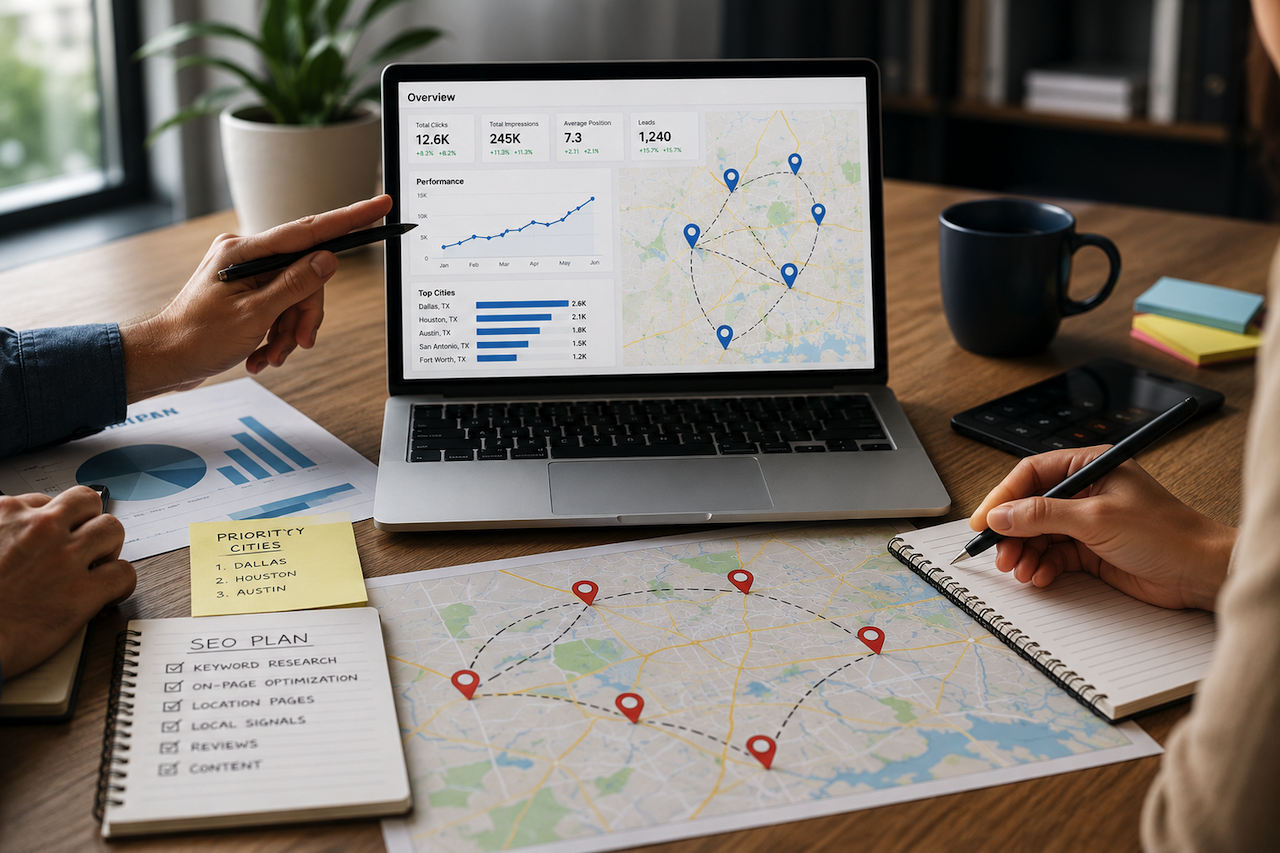
Expanding into multiple cities can be a strong growth opportunity for local and service-based businesses. A company may already perform well in one area and want to reach nearby cities, suburbs, or service regions. For movers, pest control companies, contractors, med spas, tutors, cleaning companies, and many other businesses, this can create a clear path to more leads.
But multi-city SEO needs to be planned carefully.
Many businesses try to grow across several locations by creating basic city pages, repeating the same content, changing only the city name, and expecting Google to rank each page. This approach rarely works well anymore. Thin location pages, duplicate content, weak local signals, and poor internal linking can limit results and waste budget.
A cost-effective SEO approach is different. It focuses on the cities, services, and pages most likely to generate real business value. Instead of trying to target every possible location at once, it builds a stronger foundation and expands in a structured way.
For businesses that want to grow locally without wasting budget, multi-city SEO should be strategic, useful, and realistic.
Why Multi-City Growth Needs a Smarter SEO Strategy
Ranking in one city is already competitive. Ranking in several cities adds another layer of complexity.
Each target city may have different competitors, search demand, customer expectations, local SERP layouts, review competition, and proximity challenges. A business may have strong visibility near its main office but weak visibility in nearby cities because Google does not yet see enough local relevance.
This is especially important for service-area businesses. A company may serve several cities, but Google still needs clear signals that the business is relevant for each location.
A smarter multi-city SEO strategy should answer several questions:
- Which cities are most important for revenue?
- Which services should be prioritized in each city?
- Which locations have realistic ranking potential?
- What competitors are already ranking there?
- Are separate city pages needed?
- Does the business have proof of serving those areas?
- Are local reviews, citations, and internal links supporting the strategy?
- Can the website support multiple city targets without thin content?
The goal is not to create as many location pages as possible. The goal is to create the right pages, optimize them properly, and support them with strong local signals.
The Problem With Generic Location Pages
Many businesses make the mistake of building city pages too quickly.
A generic location page may include a short paragraph, a city name, a list of services, and a contact form. Then the same template is copied for many cities. This may seem efficient, but it usually creates weak SEO value.
Google does not need dozens of nearly identical pages.
A strong location page should explain why the business is relevant in that city. It should include useful local context, services offered, customer needs, nearby areas served, FAQs, internal links, and a clear reason for the page's existence.
For example, a moving company targeting multiple cities may need to explain local moving, apartment moving, office relocation, packing help, long-distance moving, and city-specific logistics. A pest control company may need to discuss local pest issues, seasonal problems, termite concerns, rodent control, and commercial pest needs in that area.
A generic city page does not build much trust. A useful city page helps both users and search engines understand the business’s connection to the target location.
What Cost-Effective Local SEO Looks Like
Cost-effective local SEO is not about doing the minimum. It is about doing the highest-impact work first.
Instead of spreading the budget across too many weak pages, a business should prioritize the cities and services with the strongest opportunity. That may mean starting with three to five important cities instead of twenty. It may mean improving one main service page before building supporting pages. It may mean strengthening Google Business Profile visibility before expanding into new city targets.
A cost-effective approach may include:
- Choosing priority cities based on demand and competition
- Building useful location pages
- Improving service pages
- Adding internal links between related pages
- Optimizing Google Business Profile signals
- Improving citations and business information consistency
- Collecting reviews that mention services and locations naturally
- Publishing supporting local content
- Tracking rankings by city
- Building relevant backlinks where needed
This approach avoids random SEO activity. Every task should support visibility in a specific market or strengthen a page that can generate leads.
Whether working with an internal team or a cost effective SEO company, businesses should focus on strategies that support measurable growth rather than SEO activities performed simply for volume.
Building a Multi-City SEO Foundation
A strong multi-city SEO foundation usually includes several connected elements:
- Clear service pages: These pages explain the main services the business offers. If the core service pages are weak, city pages may also struggle due to a lack of strong topical support.
- Useful location pages: Location or city pages should only be created when justified. They should not be copies of each other and should provide enough value to stand on their own.
- Strategic internal linking: Internal links should connect services, cities, and supporting content. City pages should link to relevant service pages, while blog articles can support both service and location pages.
- Consistent business information: Name, address, phone number, service areas, and other business details should remain consistent across major platforms where applicable.
- Reviews and reputation signals: Reviews that mention services, customer experiences, and locations can help strengthen trust and local relevance.
- Location-specific tracking: Rankings and performance should be monitored by city. Without location-level tracking, it can be difficult to identify where the strategy is succeeding and where improvements are needed.
How to Prioritize Cities and Services
Multi-city SEO becomes more cost-effective when the business chooses priorities carefully.
Not every city is equally valuable. Some cities may have higher demand, better conversion potential, lower competition, or stronger existing relevance. Others may be too competitive or too far from the business’s strongest service area.
A good prioritization process may consider:
- Search volume
- Competition level
- Distance from the main location
- Service profitability
- Current rankings
- Existing customers in the area
- Review signals
- Local competitors
- Ability to create unique content
- Business capacity
For example, a contractor may want to target 10 nearby cities. Still, the best first step may be to optimize the 3 cities where the company already has customers, photos, reviews, and completed projects.
A med spa may prioritize services with stronger demand in specific neighborhoods. A tutoring business may prioritize cities with strong school-related search demand. A pest control company may focus first on cities where seasonal pest problems create higher lead potential.
The best SEO strategy is not always the broadest one. Often, it is better to win a smaller number of valuable markets before expanding further.
Why Internal Links and Content Clusters Matter
Internal links are one of the most important parts of a multi-city SEO strategy.
They help Google understand which pages are related and which are important. They also help users move from informational content to service pages and from general service pages to city-specific pages.
For example, a blog article about preparing for a local move may link to a city-specific moving page. A pest prevention article can support termite, rodent, and local pest control pages, while a med spa article about treatment options can strengthen related service and location pages.
This is where content clusters become useful.
A cluster may include a main service page, several city pages, supporting blog articles, FAQs, and internal links between them. Together, these pages build topical and local relevance.
For businesses targeting multiple locations, multi city SEO helps create a more organized website structure. This makes it easier for both users and search engines to understand how services, locations, and supporting content are connected.
Growing Across Cities Without Wasting Budget
The biggest mistake in multi-city SEO is trying to expand too quickly without enough strategy.
A business may create too many pages, target too many cities, publish thin content, build low-quality links, or ignore local signals. This creates activity, but not always progress.
A better approach is slower but stronger.
Start with the most valuable cities. Build genuinely useful pages. Strengthen the main service pages. Improve internal links. Keep business information consistent. Review competitors. Track rankings by city. Add supporting content where it helps. Build authority gradually.
This approach is more sustainable because it focuses on quality and relevance instead of volume.
For many businesses, multi-city SEO works best in phases:
- Audit the current site and local visibility
- Choose priority cities and services
- Improve core service pages
- Build or improve location pages
- Add internal links and supporting content
- Strengthen reviews, citations, and local signals
- Track city-level rankings and leads
- Expand into additional cities once the foundation is stronger
This makes the campaign easier to manage and easier to measure.
Cost-Effective SEO Is About Smart Expansion
Growing across multiple cities can yield strong results, but only when the SEO strategy is carefully built.
More city pages do not automatically mean more rankings. More content does not always mean more traffic. More links do not always mean better local visibility. The work needs to be connected to a clear plan.
A cost-effective approach focuses on the cities that matter, the services that drive revenue, the pages that can rank, and the signals that help Google understand local relevance.
For businesses expanding into multiple cities, SEO should not be a random collection of tasks. It should be a structured growth strategy.
When done properly, multi-city SEO can help a business reach more local customers, improve visibility in nearby markets, and grow without wasting budget on thin pages or unfocused campaigns.
Featured Image generated by ChatGPT.
Related Articles
June 4, 2026
White Label SEO: A Scalable Growth Strategy for Modern Businesses
The digital marketing industry continues to evolve at a rapid pace. Businesses of all sizes are investing heavily in online visibility, paid advertising, and search engine opti...
Read More
May 7, 2025
Local SEO for MSPs with Multiple Locations | Strategies & Structured Data
Managed Service Providers (MSPs) with multiple locations face unique challenges in optimizing their online presence. To attract clients across different regions, leveraging local S...
Read More
March 31, 2025
8 Reasons SEO Solutions Help Businesses Grow Organically Online
Businesses must build a strong online presence to succeed. With millions of websites competing for attention, search engine optimization (SEO) has become essential for sustainable...
Read More
Comments
Comments are moderated to keep the discussion useful and respectful. Spam, automated submissions, and low-value promotional comments are removed. Comments with outbound links may be approved when the link is relevant to the article and genuinely helpful to readers.
No comments have been published yet.