

IP Address, Network, Cybersecurity
IP Address Intelligence and Its Impact on Modern Risk Management
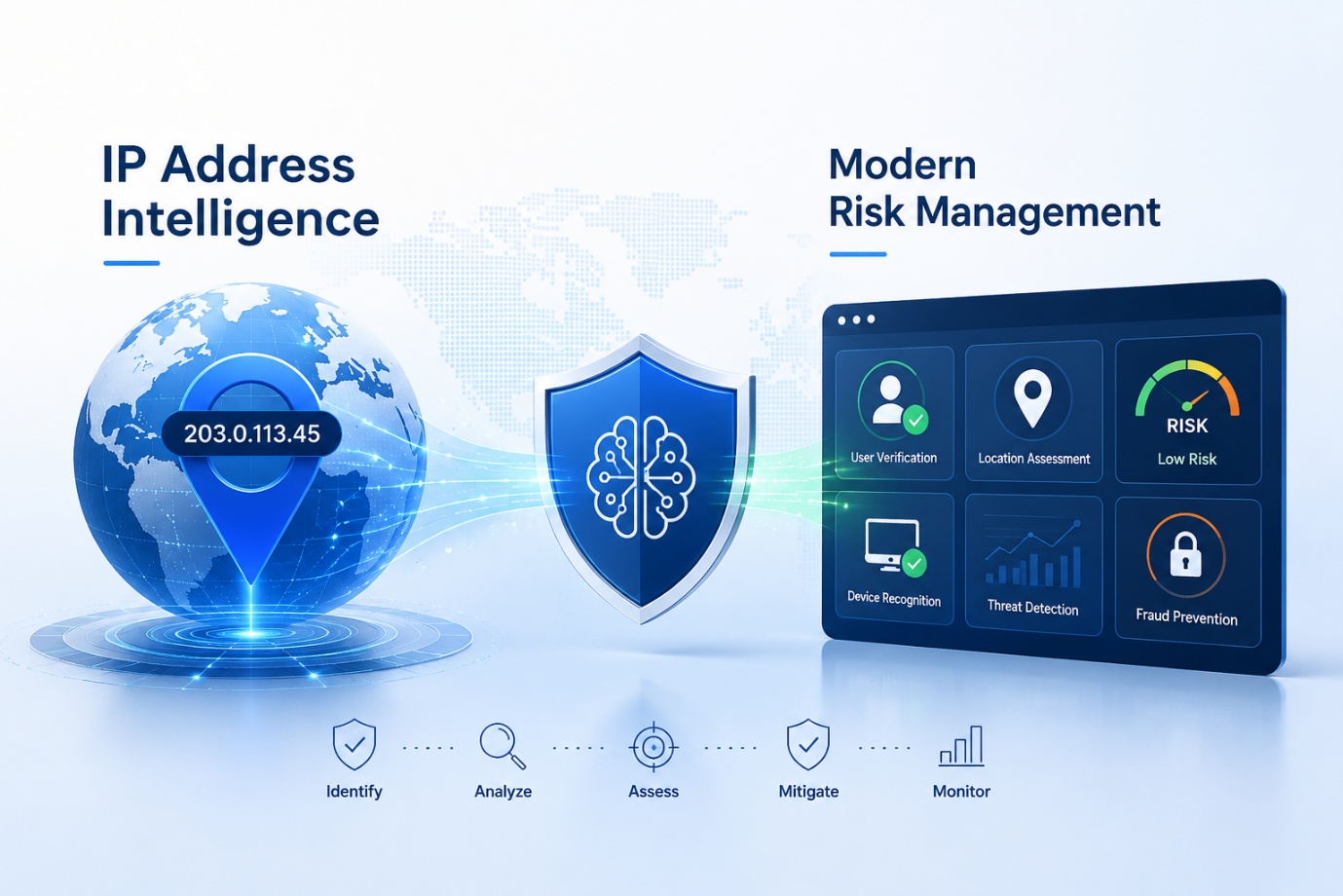
Companies today rely primarily upon an infrastructure of digital IT resources, therefore identifying and measuring risk associated to these resources is essential to running a successful business. Risks associated with cyberattacks, cloning of accounts, fraudulent payment transactions, and unauthorized access are on the rise in frequency and sophistication levels of existence.
Consequently, with this increase in risk to organizations, IP address intelligence has emerged as one of the most important sources of data to be used in evaluating an organization's level of risk as well as supporting better decision making for that organization.
IP address intelligence is the process of analysing IP-related data to gain insight into the source, behavior, and reputation of Internet traffic. The previously simple networking identifier is now an extremely powerful tool for organizations to identify threats, evaluate risk, and enhance security practices.
The Importance of IP Intelligence in a Growing World
The internet has generated billions of interactions daily; therefore, the use of the internet has surpassed 400 Exabytes of bandwidth monthly and has produced vast amounts of data on networks to be analyzed for security. Beyond that, every request made online has an IP address associated with it - one of the most common forms of data available for cybersecurity and risk management.
Today's IP intelligence platforms can provide information about a user's location (including geographic location), their ISP (Internet Service Provider), whether they are using a proxy, whether they are using a VPN (Virtual Private Network), who is their host provider, and what their historical reputation score is. By using several of these data points, an organization can gain a better understanding of the risk of each attempted connection or transaction.
In addition to supporting an organization's risk management strategy, the increasing value of this type of intelligence is also reflected in the volume of investments in broader risk management solutions. As per Data Intelo, the Risk Management market globally reached $25.1 billion in 2025 and is estimated to grow to $55.44 billion by 2034, which is a CAGR (compound annual growth rate) of 9.2% for this timeframe. This growth also demonstrates the need for Technology solutions that provide safer and more accurate risk assessments and security for detecting threats.
Key Risk Management Applications
IP address intelligence supports several important risk management functions across industries.
- Detecting suspicious login attempts originating from high-risk locations.
- Identifying bot traffic responsible for automated attacks.
- Preventing payment fraud through geolocation verification.
- Flagging traffic routed through anonymous proxies or VPN networks.
- Check for abnormal access patterns that might indicate that the account is compromised.
Cybersecurity firms' research has shown that automated bot traffic makes up more than 30% of all internet traffic. This means that investigating IP addresses is crucial to fraud prevention program as well as your access control program.
How Using IP Intelligence Can Help with Risk Analysis
Traditional risk assessment models often relied on user credentials and transaction history. While these remain important, they do not always provide a complete picture of potential threats. IP intelligence adds an additional layer of context.
The risk of a financial transaction originating from a trusted customer is generally considered to be low; however, if an IP address associated with that customer is tied to a known proxy server located outside of the usual geographic area for that customer, the overall risk associated with the transaction would likely increase substantially.
Using this type of contextual analysis allows organizations to better judge the level of risk associated with any given transaction. According to various studies, organizations using multiple risk indicators to evaluate transactions (such as those provided by internet protocol intelligence) can improve fraud detection accuracy by 20%-40% compared to using only a single risk indicator.
Common IP Intelligence Indicators
The following table highlights several commonly used IP intelligence indicators and their role in risk management.
| IP Intelligence Indicator | Risk Management Value |
|---|---|
| Geolocation Data | Verifies whether activity aligns with expected user locations |
| IP Reputation Score | Identifies addresses associated with malicious activity |
| VPN and Proxy Detection | Reveals attempts to conceal origin or identity |
| Hosting Provider Information | Detects traffic from cloud servers often used in automated attacks |
| Connection History | Supports behavioural analysis and anomaly detection |
| Autonomous System Number Data | The ASN data can help determine who owns the network(s) and where it gets its traffic from. |
Rarely do the indicators mentioned above get looked at by themselves; the majority of current risk analysis frameworks will use more than one of these signals to create a complete risk profile.
Limitations and Challenges
There are clearly some drawbacks to using IP Address Intelligence for the purposes of digital intelligence collection and analysis, as there are limitations created by the dynamic nature of IP address assignments (e.g., mobile and VPN usage), the fact that many users may share a single IP address in a geographical region, and the likelihood that the number of Internet users continues to increase in many parts of the world; therefore requiring further refinement and development of methodologies designed to collect and analyze IP address information accurately.
Privacy regulations impact how organizations collect and/or utilize IP Address Intelligence and the extent of their respective risk management programs must comply with existing laws while ensuring transparency, accountability, and compliance with other data protection mechanisms.
In addition to these limitations, cybercriminals are creating new challenges through the growing sophistication of their attacks; therefore, it is critical to combine IP Address Intelligence with other security controls such as behavioral analytics and device intelligence for maximum effectiveness.
Looking Ahead
The Influence of IP Address Intelligence on Risk Management continues to grow with the development of new technologies that enable digital ecosystems to connect with each other and share data. The exponential growth of cybercrime (with various industry projections indicating annual costs will exceed $10 trillion in the next few years) has created pressure for organizations to identify threats before they are able to cause major damage.
IP Intelligence provides valuable context to turn raw network data into actionable risk insights (IP intelligence does not provide complete solutions). Fraud detection, threat assessment, and monitoring/management of fraud are all vastly improved with the use of IP intelligence, making this tool an increasingly relevant part of today's risk management strategy. With the continued evolution of digital risk, data-driven approaches powered by IP intelligence will remain fundamental to the resilience efforts of organizations globally.
Related Articles
June 25, 2026
Using IP Allowlisting and Geo-Blocking to Shrink Your Attack Surface
Learn how IP allowlisting and geo-blocking reduce your attack surface by restricting access to trusted IPs and blocking high-risk regions.
Read More
April 7, 2026
Using IP Intelligence to Detect Credential Stuffing Attacks
Credential stuffing has become one of the most prevalent threats in modern cybersecurity. Unlike traditional brute-force attacks, credential stuffing doesn't rely on guessing passw...
Read More
November 16, 2012
My IP address is hacked. What can I do?
Many readers of our website are contacting us for help on *allegedly* hacked IP address, and remedies for getting it back. One of the user is telling us his IP address used to be 6...
Read More
Comments
Comments are moderated to keep the discussion useful and respectful. Spam, automated submissions, and low-value promotional comments are removed. Comments with outbound links may be approved when the link is relevant to the article and genuinely helpful to readers.
No comments have been published yet.